
Cats don’t experience the world the same way people do. They rely on sharp senses, past experiences, and natural instincts to make decisions every day. Understanding how cats think, process information, and express emotions can help you build a stronger bond with your pet. It also makes it easier to tell the difference between normal feline behavior and signs that may need attention from a veterinarian or animal behavior professional.
Understanding Cat Cognition
What Is Cat Cognition?
Cat cognition refers to the mental processes that allow cats to learn, remember, solve problems, make decisions, and respond to their surroundings. In simple terms, it’s how a cat’s brain processes information and helps it interact with the world.
It’s important to understand the difference between instinct and learned behavior.
- Instinct is a natural behavior that cats are born with, such as stalking prey, grooming themselves, or hiding when they feel threatened.
- Learned behavior develops through experience. For example, a cat may learn that the sound of a treat bag means food is coming or that scratching a certain post is rewarded with praise.
Both instinct and learning shape a cat’s daily actions. Knowing how your cat thinks can help you train positive behaviors, reduce stress, and better understand why your cat reacts in certain situations.
How the Feline Brain Processes Information
Cats learn mainly through experience and repetition. When something leads to a positive outcome, such as receiving food or affection, they’re more likely to repeat that behavior.
They are also excellent at recognizing patterns. Many cats quickly learn daily routines, like when meals are served, when family members return home, or which sounds signal playtime. This ability helps them predict what will happen next and feel more secure in familiar environments.
Cats also show problem-solving skills. They may figure out how to open a simple cabinet, reach a favorite toy hidden under furniture, or find the easiest path to a high perch. While their problem-solving style differs from that of humans or dogs, it is well suited to their independent nature and survival instincts.
Why Every Cat Thinks Differently
No two cats think or behave exactly alike. Several factors influence how a cat learns and responds to the world.
- Personality: Some cats are naturally curious and adventurous, while others are cautious or shy.
- Breed influences: Certain breeds are often known for traits like high activity levels, strong curiosity, or greater sociability, although every individual cat is unique.
- Age: Kittens learn rapidly through exploration, while senior cats may process new experiences more slowly due to normal aging.
- Environment: A safe, enriched home with toys, climbing spaces, and regular interaction encourages learning and confidence.
- Life experiences: Early socialization, past interactions with people or animals, and previous positive or negative experiences all shape how a cat thinks and reacts.
Recognizing these differences helps you better understand your own cat’s unique behavior instead of expecting every cat to respond in the same way.
How Intelligent Are Cats?
Cats are intelligent animals, but their intelligence is different from human intelligence or even that of dogs. Instead of focusing on pleasing people, cats use their mental abilities to solve problems, stay safe, find food, and adapt to their surroundings. Their behavior reflects skills that helped their wild ancestors survive, many of which are still seen in household cats today.
Signs of Feline Intelligence
Several everyday behaviors can show that a cat is intelligent.
- Memory: Cats remember important people, places, feeding schedules, and routines. They can also remember positive or negative experiences for a long time.
- Curiosity: Exploring new objects, watching moving things, and investigating unfamiliar sounds are signs of an active and curious mind.
- Adaptability: Many cats adjust to changes in their environment over time, such as a new home, a different feeding schedule, or the arrival of another pet.
- Hunting strategies: Even indoor cats often stalk toys carefully, wait patiently, and change their approach if the first attempt fails.
- Social learning: Some cats learn by watching humans or other pets. For example, they may discover how to open a door, use a cat flap, or follow another cat to a favorite resting place.
How Cats Learn New Behaviors
Cats learn in several ways throughout their lives.
- Observation: They often watch people or other animals before trying a new behavior themselves.
- Trial and error: Cats repeat actions that produce a rewarding result, such as finding a hidden treat.
- Positive reinforcement: Rewards like treats, praise, or play encourage cats to repeat desired behaviors, making training possible.
- Daily routines: Consistent schedules help cats learn when to expect meals, playtime, or bedtime, allowing them to predict what happens next.
Common Myths About Cat Intelligence
Several myths underestimate feline intelligence.
- “Cats can’t be trained.” Cats can learn commands, tricks, and household rules when training is consistent and reward-based.
- “Cats ignore people.” Cats often respond to familiar voices, routines, and body language, although they may choose when to interact.
- “Cats only act on instinct.” While instinct plays an important role, cats also learn from experience, remember past events, and adjust their behavior over time.
Cat Memory: What Do Cats Remember?
A cat’s memory helps it navigate daily life, recognize familiar people, and avoid danger. Memory also plays an important role in learning and forming habits.
Short-Term vs Long-Term Memory
Short-term memory allows cats to remember recent events for a limited time, such as where they last saw a toy. Long-term memory stores important information that helps them throughout life, including familiar routines, safe locations, and memorable experiences.
Do Cats Remember Their Owners?
Yes. Cats can recognize their owners through a combination of sight, voice, scent, and daily interactions. Strong, positive relationships make these memories even more lasting. Many cats also recognize family members they have not seen for extended periods.
Can Cats Remember Places, Other Pets, and Past Experiences?
Cats can remember homes, favorite hiding spots, feeding areas, other household pets, and people they regularly interact with. They may also remember stressful experiences, which can influence how they react to similar situations in the future.
How Memory Influences Daily Behavior
Memory shapes many everyday behaviors. It helps cats:
- Return to favorite sleeping spots.
- Anticipate meal times.
- Avoid places associated with unpleasant experiences.
- Recognize familiar people and animals.
- Develop consistent daily routines.
This ability to remember important information helps cats feel more confident and secure in their environment.
Understanding Cat Emotions
Cats may appear independent, but they experience a wide range of emotions that influence their behavior. Learning to recognize these emotions helps owners build trust, reduce stress, and respond appropriately to their cat’s needs.
Do Cats Really Have Emotions?
Research suggests that cats experience basic emotions that support survival and social relationships. While scientists continue studying the full complexity of feline emotions, there is strong evidence that cats experience feelings such as fear, pleasure, curiosity, and affection.
Compared with many other companion animals, cats express emotions differently. They are often more subtle than dogs, relying heavily on body language rather than obvious facial expressions. This does not mean they are less emotional—it simply means their communication style is different.
Common Emotions Cats Experience
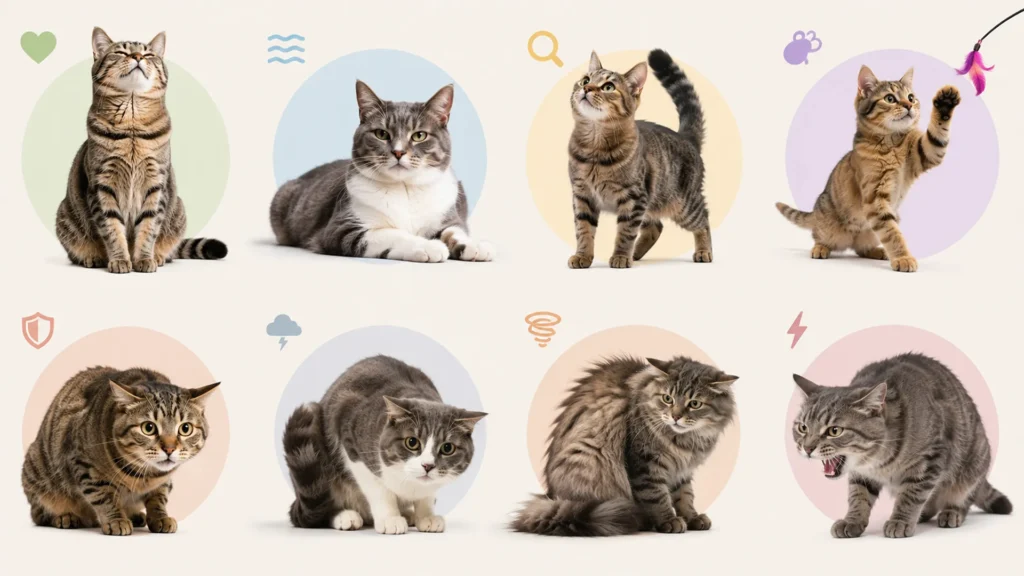
Cats experience many everyday emotions, including:
- Happiness: Relaxed body posture, gentle purring, slow blinking, and playful behavior often indicate contentment.
- Affection: Friendly cats may rub against people, head-butt, knead with their paws, or choose to sit nearby.
- Fear: A frightened cat may flatten its ears, crouch low, puff up its fur, or try to escape.
- Anxiety: Ongoing uncertainty may lead to excessive grooming, restlessness, or hiding.
- Curiosity: Investigating new objects, watching movement, and exploring unfamiliar spaces are common signs.
- Frustration: Cats may become impatient when they cannot reach prey, toys, or desired locations.
- Confidence: A confident cat usually walks with a relaxed posture, holds its tail comfortably upright, and explores without hesitation.
- Stress: Changes in the home, unfamiliar visitors, loud noises, or conflict with other pets can trigger stress-related behaviors.
How Cats Express Their Feelings
Cats communicate emotions through several forms of body language.
- Facial expressions: Relaxed eyes and slow blinks often indicate comfort, while wide eyes can signal excitement or fear.
- Tail position: A raised tail commonly signals confidence, while a puffed-up tail often indicates fear or defensive behavior.
- Ear movement: Forward-facing ears usually show interest, while flattened ears can signal fear, irritation, or aggression.
- Vocalizations: Meows, purrs, chirps, growls, and hisses each communicate different emotional states depending on the situation.
- Body posture: A relaxed body usually reflects comfort, while a crouched, tense, or arched posture may indicate stress, fear, or defensive behavior.
Looking at several body language signals together provides a more accurate understanding than relying on a single cue.
When Emotional Changes May Signal a Health Problem
Behavioral changes can sometimes be the first sign of illness or pain rather than a simple mood change.
Watch for signs such as:
- Sudden aggression without an obvious cause.
- Withdrawal from family members or other pets.
- Excessive hiding for long periods.
- Loss of appetite or refusing favorite foods.
If these changes appear suddenly, continue for more than a day or two, or are accompanied by other symptoms like vomiting, diarrhea, difficulty breathing, or changes in mobility, it is important to consult a veterinarian. Early medical evaluation can help identify underlying health problems before they become more serious.
How Cats Experience the World Through Their Senses
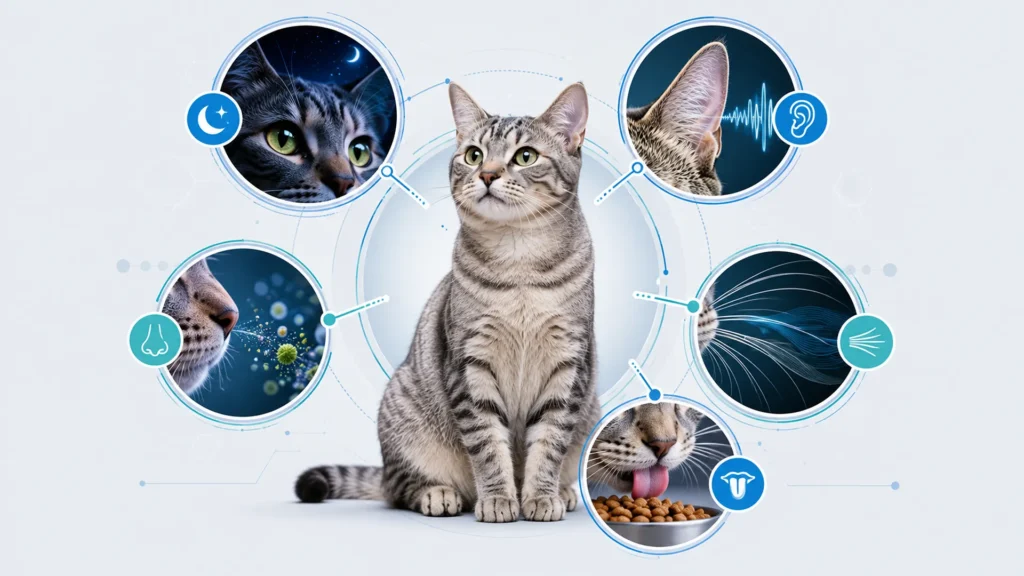
Cats don’t experience the world the same way humans do. While people depend heavily on vision, cats rely on a combination of sight, hearing, smell, taste, and their highly sensitive whiskers to understand everything around them. These senses work together to help them hunt, stay safe, communicate, and explore their surroundings.
Understanding how your cat experiences the world can make it easier to recognize normal behavior and meet its everyday needs.
Cat Vision
Cats are well known for their excellent vision in low light. Although they cannot see in complete darkness, their eyes are specially adapted to make the most of dim conditions, such as dawn, dusk, or moonlight. This is one reason cats are often most active during the early morning and evening.
Another strength of cat vision is motion detection. Cats are extremely good at noticing even the smallest movement, whether it’s a toy, an insect, or a tiny animal hiding in the grass. This ability helps them react quickly while hunting or playing.
Color perception is different for cats than it is for humans. They do see colors, but not the full range that people can. Shades of blue and yellow are generally easier for them to distinguish, while reds and greens appear much less vibrant.
Compared with human vision, cats have:
- Better night vision
- A wider field of view
- Stronger ability to detect movement
- Less sharp daytime vision than humans
- A more limited range of colors
These differences explain why your cat may spot a moving toy instantly but seem less interested in a colorful object that isn’t moving.
Cat Hearing
A cat’s hearing is one of its greatest strengths. Cats can hear a wider range of sounds than humans and are especially sensitive to high-frequency noises.
This remarkable hearing allows them to detect sounds that people cannot hear, including the tiny squeaks made by small rodents. They can also notice distant sounds long before humans become aware of them.
Their large, movable ears add another advantage. Each ear can rotate independently to help pinpoint exactly where a sound is coming from. Even while resting, a cat may turn its ears toward an unfamiliar noise to investigate it.
This combination of sensitive hearing and precise sound location makes cats highly effective hunters and helps them stay alert to potential danger.
Cat Sense of Smell
A cat’s sense of smell is much stronger than a human’s and plays a major role in daily life. While people often recognize things by sight, cats gather much of their information through scent.
Cats use smell to:
- Recognize familiar people and other animals
- Identify safe and familiar places
- Check whether food is fresh
- Detect changes in their environment
Scent is also an important form of communication. Cats leave scent marks by rubbing their cheeks, forehead, or body against furniture, objects, and even their favorite people. These scent glands leave behind chemical signals that other cats can detect.
Cats also use pheromones—natural chemical signals—to communicate information about territory, familiarity, and comfort. This silent form of communication helps reduce conflict and allows cats to understand their surroundings without direct interaction.
Cat Sense of Taste
Cats have a unique sense of taste compared with many other animals. One of the biggest differences is that they cannot taste sweetness because they lack the functioning taste receptors needed to detect sweet flavors.
Instead, cats are naturally drawn to foods that are rich in protein and animal-based nutrients. This reflects their evolution as obligate carnivores, meaning they are biologically adapted to eat meat.
Smell has a major influence on what a cat chooses to eat. Before taking a bite, a cat usually sniffs its food carefully. If the aroma is weak or unfamiliar, the cat may refuse it even if the food is nutritious.
This is why warming wet food slightly or offering fresh meals often makes them more appealing to picky cats.
The Role of Whiskers
Whiskers are much more than long hairs on a cat’s face. They are highly sensitive touch sensors that provide important information about the surrounding environment.
Whiskers help cats:
- Navigate in low-light conditions
- Detect nearby objects and subtle air movements
- Judge whether they can fit through narrow spaces
- Express emotions through their position
When a cat is curious or focused, its whiskers often point forward. Relaxed whiskers usually rest to the sides, while whiskers pulled tightly back against the face may indicate fear, stress, or discomfort.
Together with their other senses, whiskers help cats move confidently, react quickly, and communicate without making a sound. Understanding these remarkable sensory abilities gives you a better appreciation of how your cat experiences the world every day.

Can Cats Understand Humans?
Cats may seem independent, but research shows they understand more about people than many owners realize. While they don’t interpret language the way humans do, they learn to recognize familiar voices, routines, facial expressions, and emotional cues through daily interactions.
Do Cats Recognize Their Owners?
Yes. Cats can recognize their owners using a combination of sight, scent, voice, and daily routines. Studies have found that many cats can distinguish their owner’s voice from a stranger’s, even if they don’t always respond by coming when called. Their reaction may be as subtle as moving their ears, turning their head, or flicking their tail.
Can Cats Learn Their Name?
Yes. Most cats can learn to recognize their own name, especially when it is consistently paired with positive experiences like treats, meals, playtime, or affection. However, recognizing a name doesn’t mean a cat will always respond. Unlike dogs, cats often choose whether they want to interact at that moment.
Do Cats Understand Human Emotions?
Cats may not fully understand human emotions in the same way people do, but they are good at noticing changes in behavior, facial expressions, body language, and tone of voice. Many owners observe that their cats stay close when they are upset or stressed, although scientists believe this is more likely a response to noticeable behavioral changes rather than a true understanding of complex emotions.
How Cats Respond to Human Voice and Tone
Cats are especially sensitive to tone of voice. A calm, gentle voice can help them feel relaxed, while loud or angry tones may cause them to become cautious or hide. Over time, cats learn to associate certain words, sounds, and voice patterns with specific events such as feeding, playtime, or bedtime.
Fascinating Cat Abilities Explained
Cats have remarkable senses and behaviors that often inspire fascinating stories. Some of these abilities are supported by scientific research, while others remain based on personal experiences or popular myths. Knowing the difference helps us better understand what cats can—and cannot—do.
Can Cats Dream?
Scientific evidence suggests that cats do dream. Like humans and many other mammals, cats experience rapid eye movement (REM) sleep, the stage most closely linked with dreaming. During this time, you may notice twitching whiskers, moving paws, or small vocalizations, which are normal signs of active brain activity.
Can Cats Feel Jealous?
Cats can display behaviors that look like jealousy, such as pushing between their owner and another pet or seeking extra attention. However, researchers have not confirmed that cats experience jealousy as a human emotion. These behaviors are more commonly explained as competition for valued resources like attention, food, or favorite resting spots.
Can Cats Sense Illness or Pregnancy?
There is no strong scientific evidence proving that cats can directly detect illness or pregnancy. However, cats have an excellent sense of smell and are highly observant. They may notice changes in a person’s scent, hormones, routine, body temperature, or behavior, which can lead owners to believe the cat has sensed a medical or physical change.
Can Cats Predict Natural Disasters?
This topic is largely based on anecdotal reports rather than scientific proof. Some owners have reported unusual cat behavior before earthquakes or storms, and scientists believe animals may detect subtle environmental changes such as ground vibrations, air pressure shifts, or unusual sounds. However, there is no reliable evidence that cats can accurately predict natural disasters before they happen. These stories remain interesting observations rather than proven scientific facts.
How to Support Your Cat’s Mental and Emotional Well-Being
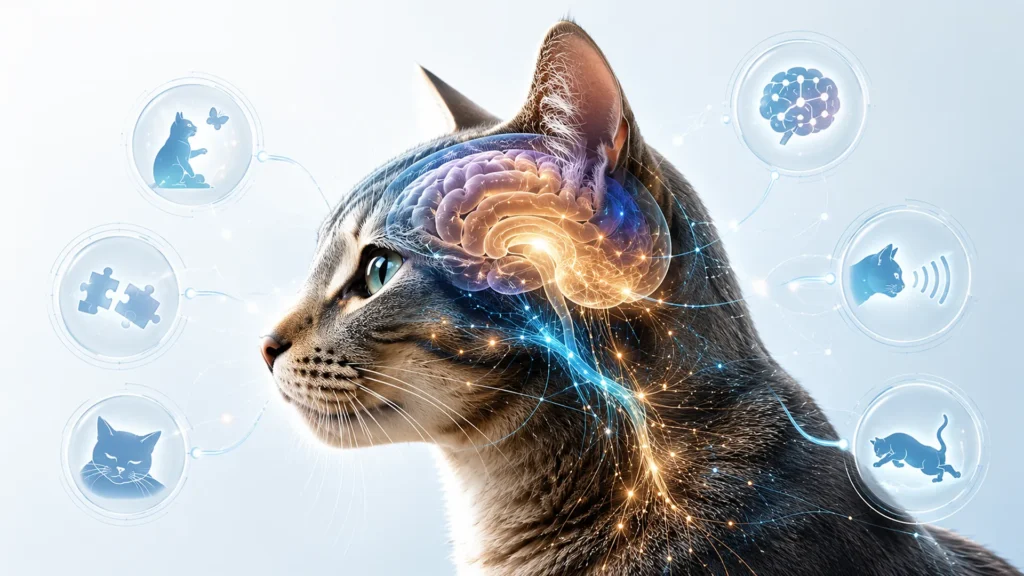
A cat’s mental and emotional health is just as important as its physical health. Cats are naturally curious and intelligent, and they need regular opportunities to explore, play, and feel secure. A supportive environment helps prevent boredom, reduces stress, and encourages healthy behavior throughout every stage of life.
Daily Mental Enrichment
Simple daily activities can keep your cat’s mind active and satisfied.
- Puzzle feeders: These encourage your cat to work for food, providing mental stimulation while slowing down eating.
- Interactive toys: Wand toys, balls, toy mice, and rotating toys encourage chasing, pouncing, and problem-solving. Short play sessions every day help satisfy natural hunting instincts.
- Climbing spaces: Cat trees, shelves, and window perches let cats climb, observe their surroundings, and feel safe from above. Vertical space is especially valuable for indoor cats.
Changing toys occasionally and introducing new challenges can keep enrichment interesting without overwhelming your cat.
Building Trust and Confidence
Cats thrive when they know what to expect.
- Keep a consistent routine for feeding, playtime, and rest.
- Use positive interactions such as gentle petting, play, and treats instead of punishment.
- Provide safe hiding spaces, like covered beds or quiet corners, where your cat can retreat whenever it wants privacy.
Allow your cat to approach people at its own pace. Respecting boundaries helps build long-term trust.
Reducing Stress in Multi-Cat Homes
In homes with multiple cats, make sure each cat has access to its own food, water, litter box, resting spots, and climbing areas. Providing enough resources reduces competition and helps prevent conflict. Watch for signs of tension, such as blocking access to resources, staring, or repeated chasing, and give cats space when needed.
Frequently Asked Questions
Are cats smarter than dogs?
Cats and dogs are intelligent in different ways. Cats excel at independent problem-solving, hunting skills, and adapting to their environment, while dogs often perform better in cooperative tasks involving people. Comparing intelligence directly isn’t very meaningful because they evolved for different lifestyles.
Do cats remember people after years apart?
Yes. Cats can remember familiar people for long periods, especially if they formed a strong bond through regular care and positive experiences. Recognition may depend on scent, voice, and routine rather than appearance alone.
Can cats recognize faces?
Yes, cats can recognize human faces, particularly those of people they know well. However, they rely even more on scent, voice, body language, and daily routines to identify individuals.
Do cats understand kisses?
Cats do not naturally interpret kisses the way humans do. Some cats learn that kisses are a sign of affection because they associate them with gentle handling and positive experiences, while others may prefer different forms of interaction.
Can cats miss their owners?
Yes. Many cats form close attachments to their owners and may show changes in behavior when separated, such as becoming quieter, more vocal, or seeking familiar scents. Every cat expresses attachment differently.
Why does my cat stare at me?
A cat may stare because it is curious, waiting for food, asking for attention, or simply observing you. A relaxed stare with slow blinking often signals comfort and trust, while a fixed stare with tense body language may indicate fear or uncertainty.
Can cats understand words?
Cats can learn to recognize certain words, especially their names and words linked to daily routines like “food,” “treat,” or “play.” They respond mainly by connecting sounds with experiences rather than understanding language like humans do.
Do cats know when you’re sad?
Cats may notice changes in your voice, facial expressions, body language, and daily habits. Some cats respond by staying close or seeking contact, although individual personalities vary.
How good is a cat’s memory?
Cats have strong memories, especially for places, routines, and experiences that are important to their survival. Positive and negative experiences can both be remembered for a long time, which is why consistent, gentle handling matters.
Do older cats lose cognitive ability?
Yes. Like people, some senior cats can develop age-related cognitive decline. Signs may include confusion, changes in sleep patterns, increased vocalization, wandering, or forgetting familiar routines. If you notice these changes, a veterinarian can help rule out medical conditions and recommend appropriate care.