Every cat guide tells you the same thing: ears back means angry, tail up means happy. Then your cat’s tail is standing straight up and she hisses at you anyway, and you’re left wondering which article lied to you.
None of them did, exactly. They just left out the part that matters most: cats don’t send one signal at a time. They send several at once, and you have to read the combination to know what’s actually going on. After years of watching cats get misread by well-meaning owners, I’ve come to think this is the single biggest gap in most pet advice — it treats body language like a vocabulary list instead of a language. This guide uses what I call the Cluster Method: instead of fixating on one body part, you check two or three signals together, then decide what to do about it.
Why Single Signals Are Misleading
Assuming a flicking tail always means anger, or pinned ears always mean aggression, is the fastest way to misread a cat. The same physical movement can mean completely different things depending on what else the cat’s body is doing.
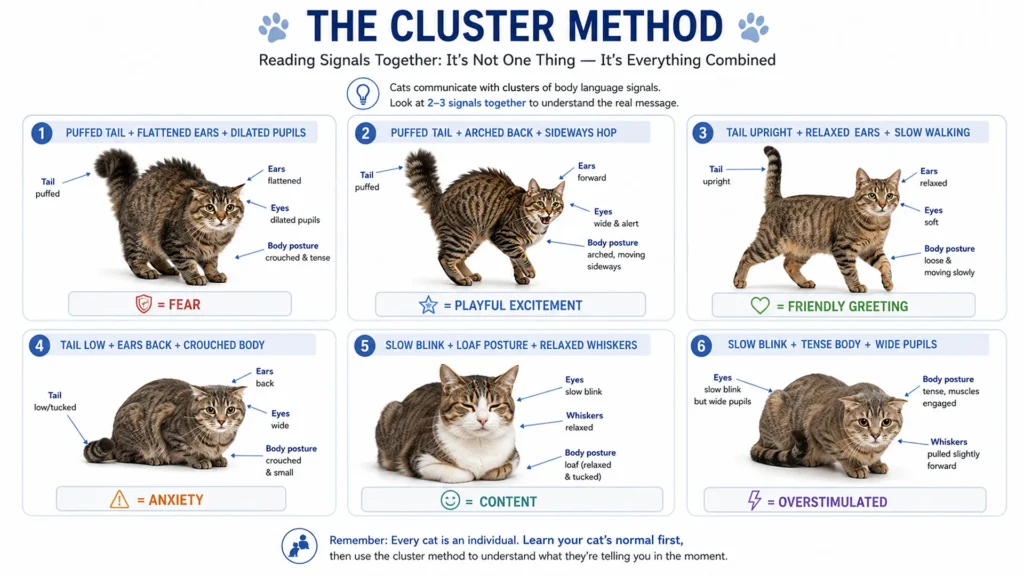
That’s why body language only makes sense in combination. The Cluster Method asks you to watch three zones at once:
- Tail position and motion
- Ear angle
- Eyes and whiskers
Track these three together and most of the guesswork disappears.
The Building Blocks: What Each Body Part Signals on Its Own
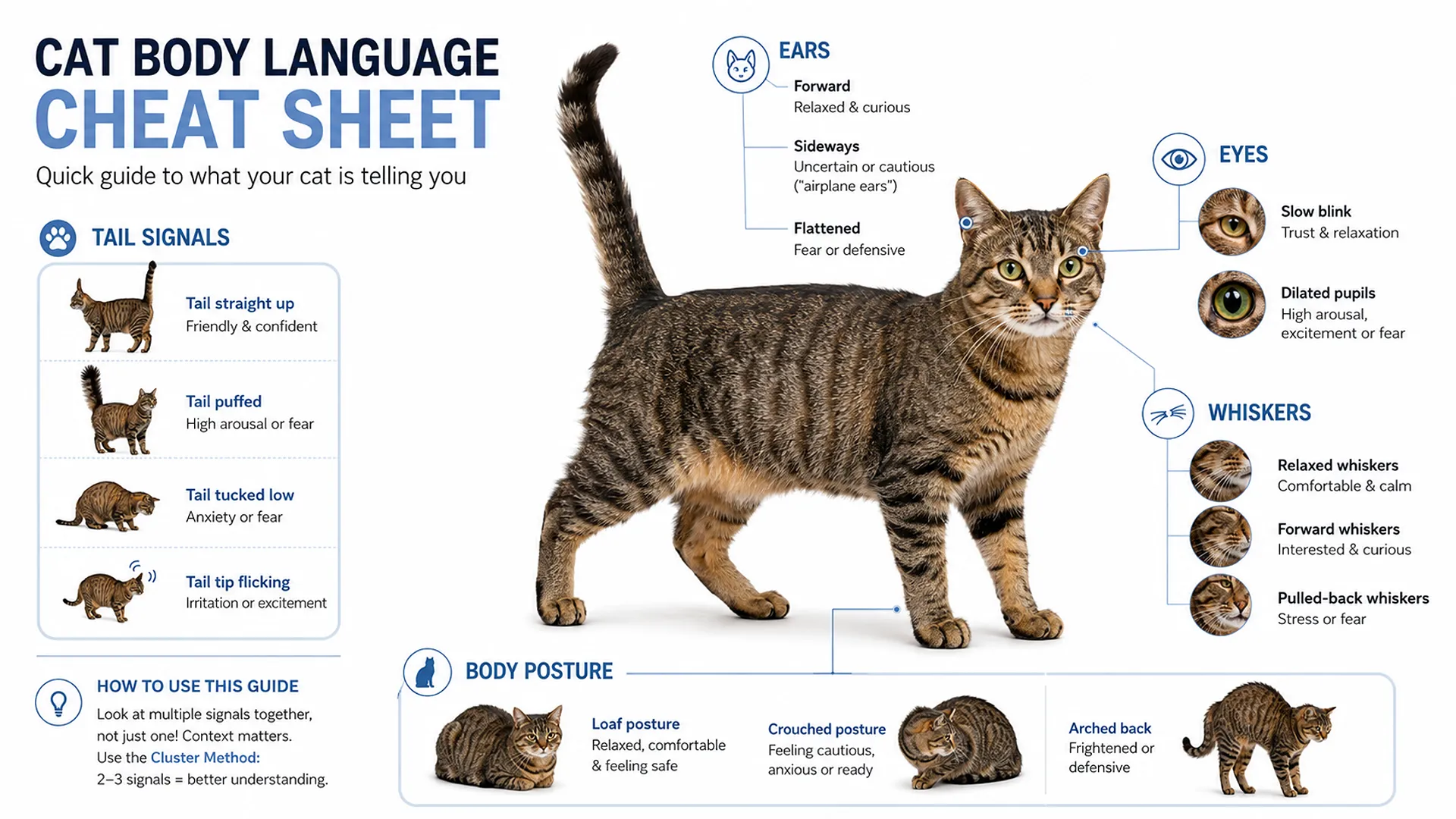
Tail. A high, upright tail means confidence and friendliness. Puffed out like a bottle brush means your cat feels threatened or startled badly. Low or tucked means fear or submission. Rapid flicking at the tip shows rising agitation or sharp focus. Wrapped tightly around the body signals defensiveness, self-soothing, or just being cold.
Ears. Forward-facing ears mean engaged, curious, relaxed. Sideways — the “airplane” position — signals suspicion or annoyance. Flattened against the skull means real fear or defensive aggression. Swiveling ears just mean your cat is tracking sound.
Eyes and whiskers. A slow blink means trust. Dilated pupils mean high arousal, which could be fear, play, or simply a dim room. A hard, unblinking stare is a challenge. Whiskers pushed forward mean curiosity or predatory focus; pulled back tight against the cheeks mean fear.
Body posture. The loaf position, paws tucked under the chest, means contentment. An arched back with raised fur is a bluff to look bigger. A low crouch means your cat wants to hide or is winding up to pounce. Belly-up can mean total trust — or it can mean the opposite, which we’ll get to.
The Cluster Method: Reading Signals Together
Here’s where the individual signals above start to mean something. Combine them and you get a real read:
| Signal Combination | What It Actually Means |
|---|---|
| Puffed tail + flat ears + dilated pupils | Deep fear and self-defense, not unprovoked aggression |
| Puffed tail + arched back + sideways hop | Playful excitement, mock-threats |
| Tail up + slow trot + soft chirp | Friendly, confident greeting |
| Tail low + ears back + crouched body | High anxiety, wants space now |
| Slow blink + relaxed whiskers + loaf posture | Trust and contentment |
| Slow blink + tense body + wide eyes | Overstimulation, not affection |
When the signals conflict — say, a high tail next to tense whiskers — trust the face first. Ears, eyes, and whiskers show emotional intensity faster than the tail does. This is the part most owners skip, and it’s the part I’d argue matters most.
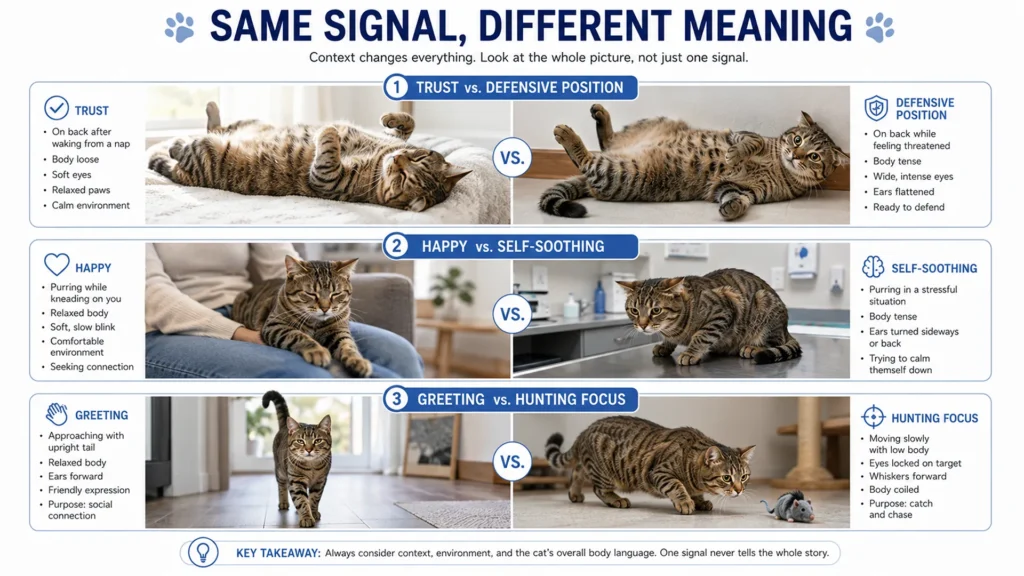
Context-Flip: Same Signal, Opposite Meaning
Belly-up. Roll onto her back after a nap, soft eyes, loose paws — that’s pure trust. Flip belly-up mid stare-down with a hand or another pet, ears pinned, claws ready — that’s a defensive stance, not an invitation. Touch the wrong one and you’ll find out fast.
Purring. Kneading a blanket while purring on your lap is straightforward happiness. Purring on the vet’s exam table, or while nursing an injury, is something else entirely — cats purr at frequencies that help them self-soothe and manage pain, not just express joy.
Slow approach. A slow walk with a raised tail, forward ears, and a loose gait is a confident greeting. A low, flattened creep with a fixed stare is a stalk, whether it’s predatory or redirected play aggression.
What To Do Next: A Response for Every Signal
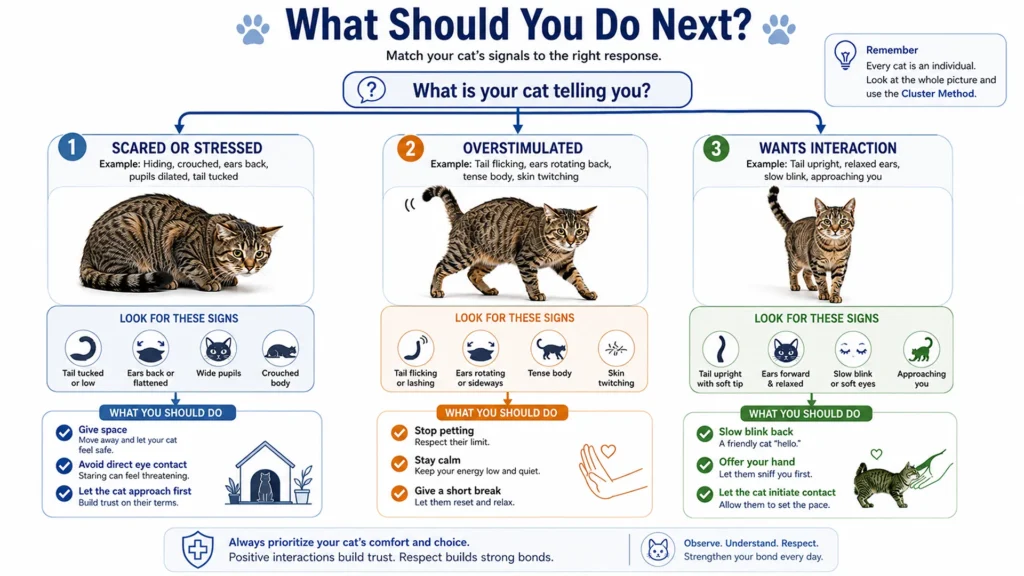
If your cat is scared or stressed, give them space immediately. Skip direct eye contact — cats read that as a threat. Don’t reach toward their face or corner them. Turn your body slightly sideways, lower your voice, and let them come out on their own schedule.
If your cat is overstimulated, catch the early cues before you get bitten: a twitching tail tip, rippling skin along the back, ears rotating backward mid-pet. Stop touching, freeze your hands, and step back quietly.
If your cat is inviting interaction, offer a slow blink back. Extend a finger at nose height, keep some distance, and let them close the gap and rub against you first.
Edge Cases: When the Standard Rules Don’t Apply
Not every cat fits the blueprint above.
- Flat-faced breeds (Persians, Exotics): pupil dilation is harder to spot, and subtle whisker or skin movement gets lost in the extra fur and face shape.
- Tailless breeds (Manx): losing the tail means losing a major signal. Watch ears and micro-postures more closely.
- Deaf cats: they lean on your body language and on vibration. Their startle response can look more dramatic than it is, so slow, visible hand movements matter.
- Senior or arthritic cats: a stiff walk or hunched back is often joint pain, not fear or a mood swing. Don’t assume the worst.
Quick-Reference Cheat Sheet
| Signal Cluster | Mood | Recommended Action |
|---|---|---|
| Tail high + ears forward + loose posture | Happy / Friendly | Greet warmly, offer hand for scenting |
| Tail tucked + ears flat + crouched low | Scared / Anxious | Give space, lower voice, don’t reach |
| Flicking tail + ears side-turned + wide eyes | Overstimulated | Stop touching, freeze hands, disengage |
| Belly exposed + tense body + claws out | Defensive | Don’t touch the belly, step back |
FAQ
Why does my cat’s tail twitch when I pet it?
Usually it’s overstimulation building. Her nerve endings are getting overloaded, and the twitch is a warning to stop before she reacts defensively.
Is a purring cat always happy?
No. Purring usually means contentment, but cats also purr to self-soothe when they’re frightened, sick, or in pain. Check the rest of the body before you assume.
Why does my cat show its belly but not want it touched?
The belly exposure is about trust, not an invitation. Touching that vulnerable spot triggers a defensive instinct, and that’s when you get grabbed or bitten.
How can I tell if my cat is in pain versus just relaxed?
A relaxed cat has soft eyes, loose limbs, a neutral posture. A cat in pain sits hunched, holds tension around the eyes and mouth, flattens its whiskers, and avoids you.
Conclusion
Reading a cat accurately means checking the whole cluster — eyes, ears, body, tail — together, in context. Once you stop relying on single signals, you’ll catch things you used to miss, and you’ll respond in a way that actually builds trust instead of accidentally pushing your cat away. Keep this guide handy, or pass it along to another cat owner who’s still going by the old one-signal-at-a-time rules.