

You’re half awake, shuffling to the kitchen in socks, and a gray streak shoots out from under the couch. It grabs your ankle. A quick bite, a kick of the back legs, and it’s gone again before you’ve finished yelping. If that’s your morning, you’ve probably asked it more than once. Why does my cat attack my feet?
Relax a little. Your cat doesn’t hate you. Ankle ambushes are one of the most common complaints in cat homes, and like a lot of the odd habits we cover in our cat behavior guides, this one makes sense once you see it from the cat’s side. Feet move. Cats chase things that move. That’s most of it, honestly, though there are a few other reasons worth knowing about.
Short answer: Most cats attack feet because moving toes and ankles trigger their hunting instinct. It’s usually play. Boredom and a cat’s natural dawn and dusk energy make it worse. Now and then the cause is overstimulation or pain. Daily play and a better target fix most cases.
Is It Normal for a Cat to Attack Your Feet?
Yes. Very.
Even the laziest lap cat is built to hunt. Stalk, crouch, pounce, bite. A cat living outside would spend a good part of its day doing exactly that. Indoors there’s nothing to catch, so the urge looks around for the next best thing. A swinging shoelace works. So does the heel of someone walking past the sofa.
Kittens and young cats do it the most. Many grow out of the worst of it by around two, though a cat who’s never had a proper outlet may keep at it for life.
Not every attack is a game, though. A cat that’s hurting or upset can go for feet too, and that needs a different response. More on that further down.
Why Does My Cat Attack My Feet? 7 Common Reasons
Usually it’s one of these. Sometimes two at once. It helps to notice when it happens, since a 6 a.m. ankle grab and a swat while you’re petting the cat have very different causes.
1. Your Feet Move Like Prey
Cats are tuned to small, jerky movement. A mouse scurries in short bursts and stops. Your toes wiggling under a desk do pretty much the same thing. So does a foot that suddenly appears around a doorway.
Your cat doesn’t sit there thinking about it. The movement flips a switch, and the body goes into hunting mode before the brain catches up. That’s why the attack so often comes from hiding, under a bed or behind a chair. Ambushing is a big part of how cats hunt, and yours is practicing on you.
2. Rough Play, Especially in Kittens
In a litter, kittens learn to play by wrestling each other. They bite and kick, and a sibling lets out a squeal when a bite goes too far. A kitten that left its litter early, or that’s the only pet in the house, misses a lot of that feedback. So it wrestles you instead. Mostly your feet, since they’re at kitten height.
Young cats also have a lot of energy and not much self-control. If yours is still small, you’ll probably notice other attention-seeking habits too, like a kitten that meows constantly. It’s the same restless phase.
3. Boredom and Extra Energy
An indoor cat that sleeps all day while you’re at work has a full tank by evening. And nowhere to spend it. When you walk in and start moving around, your feet become the entertainment.
Knocked-over cups and midnight zoomies are classic signs of a bored cat. Clawing at the paint is another one. If you’ve seen that as well, our piece on why cats scratch the wall explains how closely the two habits are linked.
4. They Want Your Attention (or Breakfast)
Cats learn fast. If grabbing your ankle got a reaction yesterday, it’ll probably happen again today. Even a shout counts as attention to a cat who’s been ignored all afternoon.
Food fits in here as well. A lot of foot attacks happen first thing in the morning, and that’s no accident. Cats are crepuscular, meaning they’re most active around dawn and dusk. A hungry cat at sunrise plus a pair of feet heading toward the kitchen is a tempting combination. Fill the bowl right after a bite, and your cat learns that biting works.
5. Toes Under the Blanket

Feet under the covers are almost too perfect. You can’t see them, they twitch every now and then, and the blanket makes a little shifting bump. To a cat, that’s something small rustling in long grass.
Night attacks often line up with evening restlessness, the same energy behind a cat that meows at night or races down the hallway at 2 a.m. Annoying? Sure. But very normal.
6. Someone Taught Them Feet Are Toys
This one’s a bit awkward. A lot of cats learned to attack feet from the people who love them. Wiggling your toes at a tiny kitten is adorable. Letting it chew your socks seems harmless. Then the kitten grows into a ten-pound cat with real teeth, and the game it learned hasn’t changed.
Your cat has no way of knowing that feet were fun last year and off limits now. Consistency matters more than anything here, for everyone in the house.
7. Overstimulation or Redirected Aggression
Sometimes the attack isn’t about play at all. Some cats get overstimulated by petting, and once they hit their limit they bite whatever’s closest. If your feet are nearby, that might be your toes. We explain how these bites differ from softer nibbles in why your cat bites you gently.
Redirected aggression is a little different. Your cat spots another cat through the window, or hears something scary, and gets worked up with no way to deal with it. You walk past, and your ankle takes the hit. These attacks tend to come out of nowhere, and they’re usually harder.
Is It Play or Real Aggression?
Playful attacks and angry ones can look alike for a second, but the body language gives it away. Here’s a rough guide.
| Play | Real aggression | |
|---|---|---|
| Body | Low crouch, a wiggling rear end before the pounce | Stiff and tense, often hunched or side-on |
| Ears | Forward and alert | Flat or turned back |
| Claws | Mostly sheathed, light grabs | Out, scratches that break skin |
| Sounds | Quiet, maybe a little chirp | Hissing or growling |
| Afterward | Runs off, comes back for more | Keeps its distance, stays tense |
The tail helps too. A playful cat’s tail often twitches with excitement, while a lashing, thumping tail usually means your cat is irritated. Our guide to cat tail meanings goes into the details. And if the attacks come with hissing, read up on why cats hiss, because that’s a clear request for space.
Could It Be a Health Problem?
Most foot attacks are behavioral. Still, pain changes how cats act. A cat with sore joints may lash out when it gets bumped, and feet are usually what bumps it. Dental pain and old injuries can do the same.
In older cats, an overactive thyroid is worth thinking about. Hyperthyroidism can leave a cat restless and short-tempered. A senior cat that suddenly starts going after your ankles and seems hungrier than usual should see a vet.
The same goes for any sudden change. A cat who never bothered your feet and now attacks them hard deserves a checkup before you treat it as a training problem. The ASPCA’s guide to aggression in cats is a good read if you want to understand the different kinds.
How to Stop Your Cat From Attacking Your Feet
You can’t switch off the hunting instinct, and you wouldn’t want to. The goal is to give it somewhere better to go than your ankles. Here’s what tends to work.
Play With Them Every Day
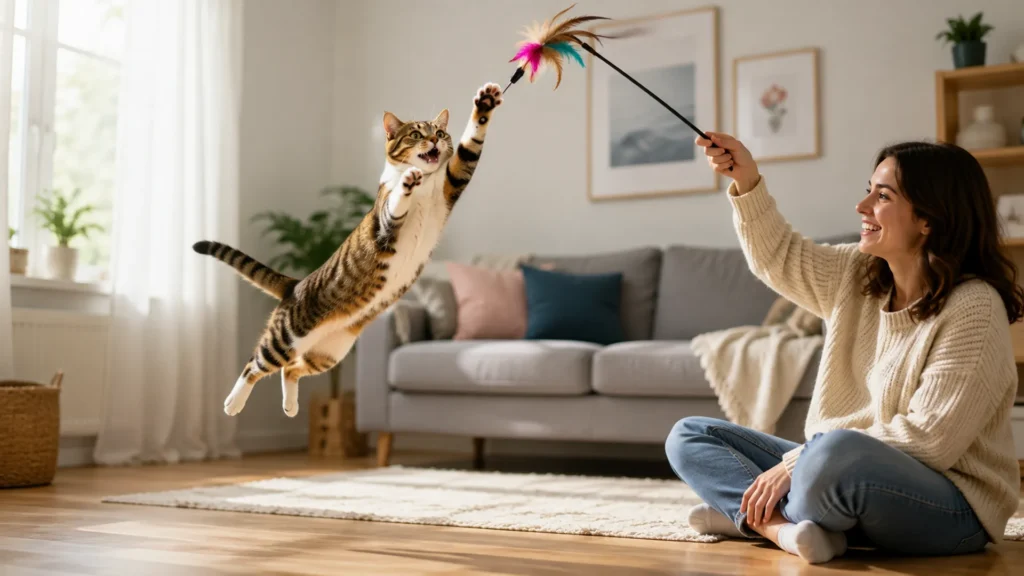
Two short play sessions a day make a bigger difference than almost anything else. Ten to fifteen minutes each, with a wand toy or something on a string that moves like prey. Let your cat stalk it for a while and actually catch it at the end.
Timing matters. Play before the times your cat usually attacks. If ambushes happen when you get home, play then. If it’s bedtime, play right before bed and follow it with a small meal. Hunt, catch, eat, sleep. Cats like that order.
Give Them a Kicker Toy
A kicker is a long, soft toy a cat can hug with its front paws and bunny-kick with the back ones. It scratches the exact itch your ankle is scratching. Keep one near the spots where ambushes happen. When you see the crouch and the wiggle, toss it in front of your cat before it launches.
Go Still
When your cat grabs your foot, stop moving. Pulling away makes you act more like prey, and prey that struggles is more fun. Freeze, wait until it lets go, then calmly walk off or hand it a toy. No yelling. It’s boring, and boring is the point.
Keep Hands and Feet Out of Games
From now on, every game uses a toy. That goes for everyone, including visitors and kids who think toe-wiggling is hilarious. One person playing with feet undoes a lot of work.
Fix the Morning Ambush
If the attacks happen around breakfast, try an automatic feeder set for a little before you wake up. Your feet stop being linked to food. And never feed straight after a bite. Wait until your cat is calm, even if it’s only a minute.
Make Bedtime Boring for Toes
For night attacks, tuck your feet under a heavier blanket, or keep the cat out of the bedroom for a few weeks while you reset the habit. A puzzle feeder outside the door gives it something else to do. Most cats lose interest once the game stops paying off.
What Not to Do
Don’t push your cat away with your foot, and never hit it. That can turn a game into real fear. Some cats even get rougher.
Spray bottles and loud punishments aren’t a great idea either. Your cat won’t connect the squirt with attacking feet. It’s far more likely to connect it with you.
And don’t give up after a few days. A habit like this took months to form. Give the new routine a few weeks before you judge it.
Frequently Asked Questions
Why does my cat attack my feet at night?
Cats are most active around dawn and dusk, and feet moving under a blanket look a lot like hidden prey. A play session and a small meal before bed usually calm things down.
Why does my cat attack my feet when I walk?
Feet passing by set off the chase instinct, a bit like a mouse running past. Cats often ambush from under furniture because that’s how they would hunt. Daily play and a kicker toy near those spots help a lot.
Will my kitten grow out of attacking feet?
Many kittens calm down somewhere between one and two years old, especially with regular play. If feet were part of their games early on, though, the habit can stick unless you redirect it to toys.
Why does my cat only attack my feet and not other people’s?
Usually it’s the person the cat spends the most time with, or the one who reacts the most. If you were the one who played with your feet when it was small, you’re the obvious target.
Is my cat attacking my feet a sign of affection?
Sometimes, in its own way. Cats play with people they trust and feel safe around. You don’t have to put up with bites, though. You can keep the bond and move the game onto a toy.
Final Thoughts
So, why does my cat attack my feet? Most of the time it’s a hunter with nothing to hunt, and your ankles just happen to be in the way. Give that energy somewhere better to go and stay calm when it happens. Most cats ease off within a few weeks once play is part of the day.
If the attacks start suddenly or get much harder, a vet check is the smart first step.


Pingback: Why Does My Kitten Meow So Much? 10 Reasons and Fixes
Pingback: Why Does My Cat Bite Me Gently? 6 Reasons and Warning Signs