Picture this: it’s 6am, your cat is doing figure-eights around your ankles, meowing like she hasn’t eaten in a week, and you’re standing there with the food scoop wondering — did I already feed her? Is this normal? Am I overfeeding her?
If that sounds familiar, you’re in good company. This is genuinely one of the questions I get asked most, and it’s also one where the internet gives you five different answers depending on which site you land on.
So let’s cut through it. The short version: kittens under six months need 3–4 small meals a day. Most adult cats are fine on two. Older cats often do better with smaller meals spread out. But — and this is the part most articles skip — there’s actually some solid research on this that complicates the “just feed twice a day” advice you’ll see everywhere. More on that below.
How Often Should You Actually Feed Your Cat?
Here’s the thing nobody wants to hear: there’s no single magic number. How often you should feed your cat depends on a handful of things — their age, their health, their weight, and honestly, your own schedule too. A three-month-old kitten and a twelve-year-old cat with kidney issues are not eating the same way, and they shouldn’t be.
You’ve probably also noticed the advice online doesn’t line up. Most vets will tell you twice a day for an adult cat, full stop. But there’s research suggesting once-a-day feeding might actually help some cats manage their weight better than the twice-a-day standard. So who’s right?
Honestly, it depends on the cat you actually have — not the one in a generic blog post.
What Cats Would Eat If You Weren’t Involved
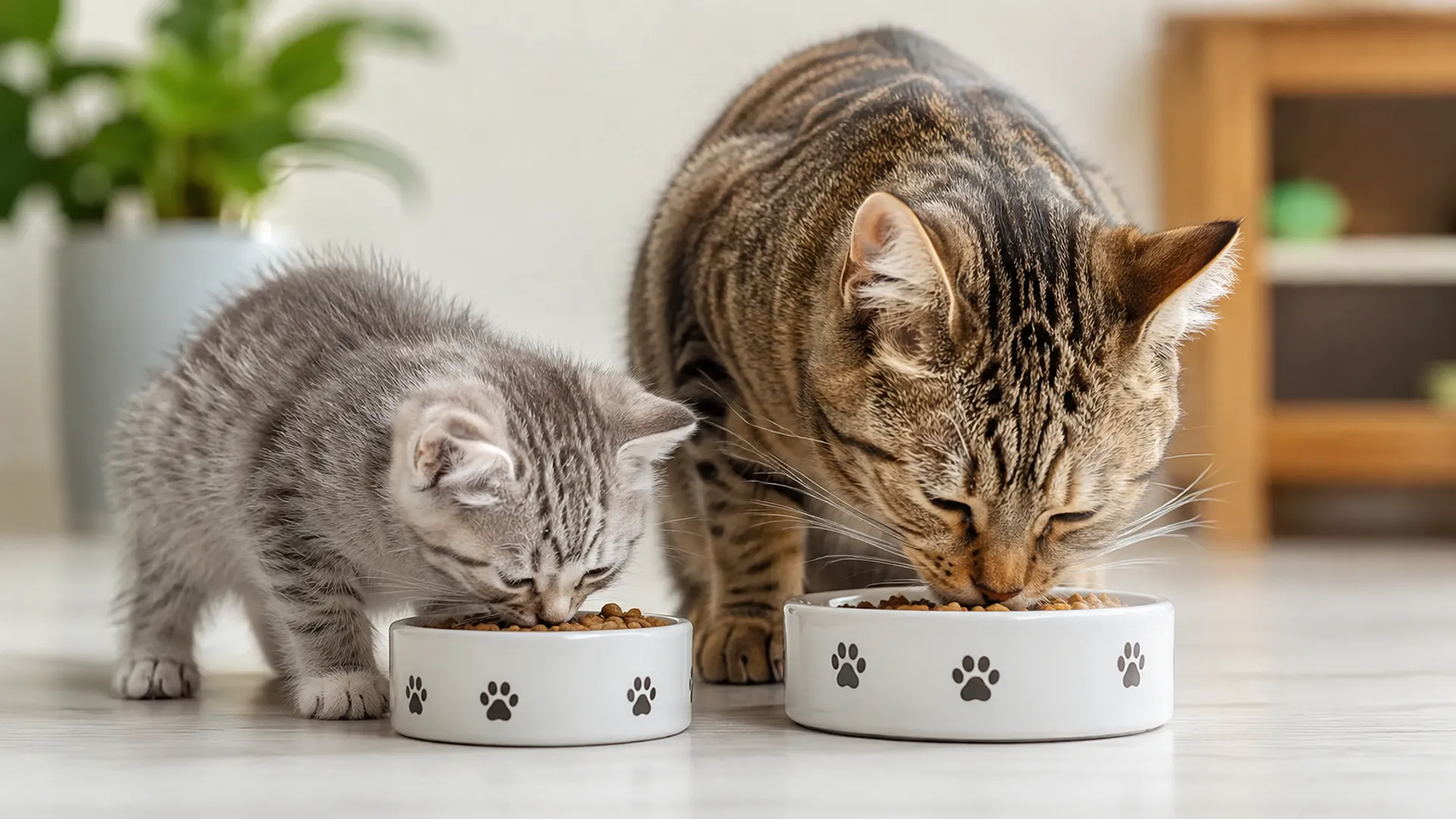
Before getting into schedules, it’s worth knowing how cats eat when nobody’s filling a bowl for them, because it explains where a lot of this advice comes from.
A cat in the wild isn’t sitting down to breakfast, lunch, and dinner. It’s hunting small prey — mice, birds, whatever it can catch — all day and night, a little at a time. Some research puts this at somewhere between 10 and 16 tiny “meals” over 24 hours. Their stomachs evolved for that. Small, frequent, not huge and occasional.
That’s basically why most vets land on “feed your cat at least twice a day.” It’s closer to what cats are built for, and it helps avoid the nausea that can come from too long a gap between meals — you may have seen this yourself if your cat’s ever thrown up bile on an empty stomach first thing in the morning.
But here’s where it gets more interesting than the average pet-food blog lets on. A study out of the University of Guelph looked at healthy indoor cats switched to once-a-day feeding, and found they lost weight and held onto muscle mass better than cats eating multiple times a day. The theory is that a longer stretch between meals leaves them more satisfied, so they beg less and don’t graze unnecessarily.
Now — don’t go switching your cat to one meal tomorrow based on that. It was a small, short-term study, and it doesn’t apply across the board. Kittens, senior cats, and anything with a condition like diabetes genuinely need more frequent feeding, not less.
My honest take: twice a day is still the safest default for most cats. But if you’ve got a healthy adult cat that’s carrying extra weight and nothing else has worked, once-a-day feeding isn’t some fringe idea — just loop your vet in and ease into it rather than switching cold turkey.
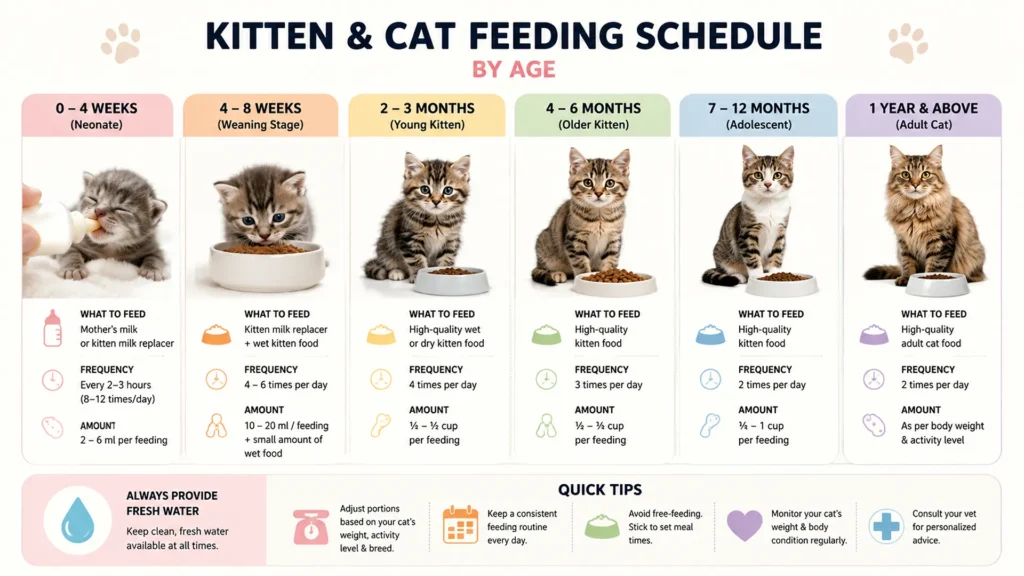
Feeding by Age
| Life Stage | Age | How Often |
|---|---|---|
| Kitten | 0–6 months | 3–4 meals a day |
| Adult | 6 months–7 years | 2 meals a day (3–4 smaller if needed) |
| Senior | 7+ years | 2–3 smaller meals a day |
Kittens grow fast, and their stomachs are small, so they need to eat often to keep up. Four meals a day is pretty standard until around four months, then you can start easing that down.
Adult cats usually settle into two meals once they’ve stopped growing. If yours is a picky eater, or gets loud and pushy right before dinner time, splitting the same amount of food into three or four smaller portions can take the edge off the begging without actually feeding them more.
Senior cats tend to do better with smaller meals spread across the day. Aging brings dental issues, slower digestion, sometimes a smaller appetite altogether — a couple of light meals is usually gentler than two big ones.
Does Your Cat’s Health Change the Answer?
Yes, and this is where a lot of the generic advice falls apart. Age isn’t the only factor — if your cat has a health condition, that should shape the schedule just as much, if not more.
Diabetic cats need meal timing that lines up with their insulin — skip or delay a meal and you can throw off their blood sugar. Cats with kidney disease tend to do better on smaller, more frequent meals of a renal diet, since bigger meals put more strain on kidneys that are already working overtime.
Overweight cats often benefit from smaller portions spread out, mostly because it keeps the begging manageable while they’re on a calorie-restricted diet. Cats recovering from surgery are usually put on smaller, more frequent meals short-term to go easy on digestion while they heal. And hyperthyroid cats often eat more than usual, so their feeding pattern may need adjusting alongside whatever treatment they’re on.
If your cat’s got a diagnosed condition, treat all of this as a starting point for a conversation with your vet, not a replacement for one.
If You’ve Got More Than One Cat
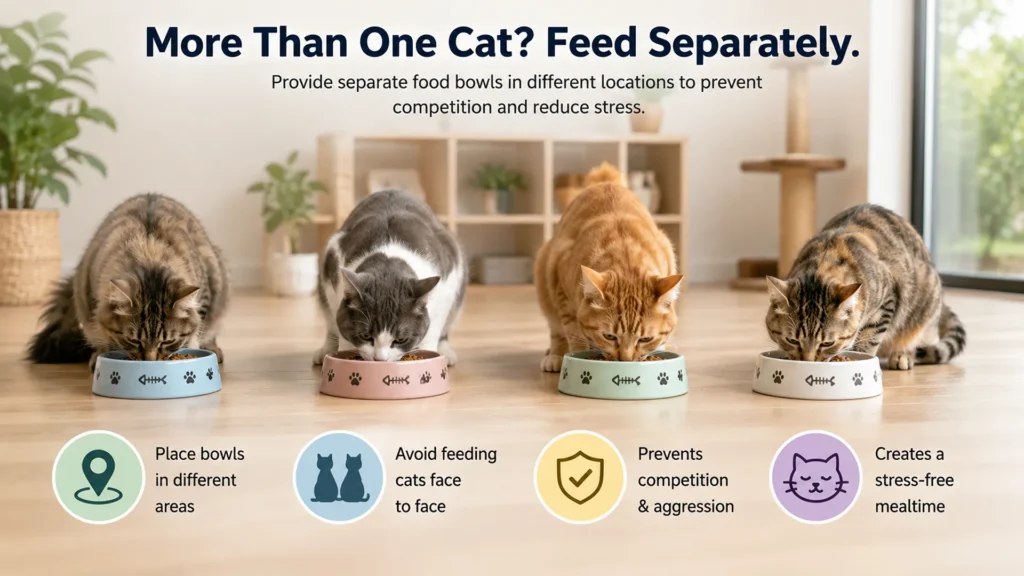
Feeding gets trickier once you’ve got multiple cats, especially if they’re different ages or on different diets — a kitten and a senior, say, or a healthy cat living alongside one that’s diabetic.
A few things that genuinely help: give each cat its own space to eat, ideally in separate rooms, so nobody’s competing. Microchip feeders are worth it if one cat needs to be kept off another’s food — they only open for the cat wearing the matching tag. Timed feeders with separate compartments work well if your cats are on different schedules and you can’t always referee mealtime yourself. And keep an eye out for food guarding — if one cat scarfs their food and then hovers near the other’s bowl, that’s usually anxiety or territorial behavior, and separate feeding spots tend to fix it.
Free Feeding, Scheduled Meals, or a Bit of Both
| Style | What It Is | Works Best For |
|---|---|---|
| Free feeding | Food out all day, usually dry | Multiple healthy cats, no weight concerns |
| Scheduled feeding | Set meals, set times | Weight management, mixed diets, tracking intake |
| Combo feeding | Scheduled wet + a little free-fed dry | Structure without cutting out snacking entirely |
Free feeding is the easy option, but it’s hard to know how much any one cat is actually eating — which becomes a real problem in multi-cat homes or with a cat that’s prone to overeating. Scheduled feeding gives you way more control and makes it much easier to catch an appetite change early, which is often the first sign something’s wrong health-wise. A lot of owners end up somewhere in between with combo feeding, and honestly, that’s a perfectly reasonable place to land.
Does Wet vs. Dry Food Change How Often You Feed?
A bit, yeah. Wet food spoils fast once it’s out, so it naturally pushes you toward set meals instead of free feeding. It’s also a decent source of hydration, which matters more than people realize for cats prone to urinary or kidney trouble.
Dry food can sit out all day without going bad, which is why it’s the default for free feeding. The catch is it’s easy to overdo — it’s calorie-dense, and cats can plow through it fast without feeling full right away.
A lot of vets land on a mix: scheduled wet meals for hydration and portion control, with a small measured amount of dry food available between meals if your cat wants it.
Changing Your Cat’s Schedule Without Starting a Riot
Cats do not love change, and if you’ve ever tried to move a mealtime by even twenty minutes, you already know this. Sudden shifts in feeding can lead to stress, nonstop begging, or vomiting if they eat too fast once food finally shows up. Slow and boring is the way to go here.
If you’re moving a kitten from four meals down to two around the six-month mark, drop one meal every couple of weeks instead of all at once, and bump up the portions slightly at the meals that remain so the total calories stay about the same. Keep half an eye on their weight and energy while you do it.
Switching from free feeding to set meals works best if you ease into it — start by picking up the bowl for short stretches, thirty minutes or so, rather than pulling food cold turkey. Shorten that window gradually over a week or two, and try to feed at the same times each day so your cat starts to expect it.
If you’re just shifting meal times, move them by fifteen or twenty minutes every couple of days instead of jumping straight to the new schedule. Keep the food and portions the same while you’re doing this — one variable at a time. And brace yourself for a few days of complaining. It really does settle once the new routine sticks.
Feeding a Cat When You’re Out All Day
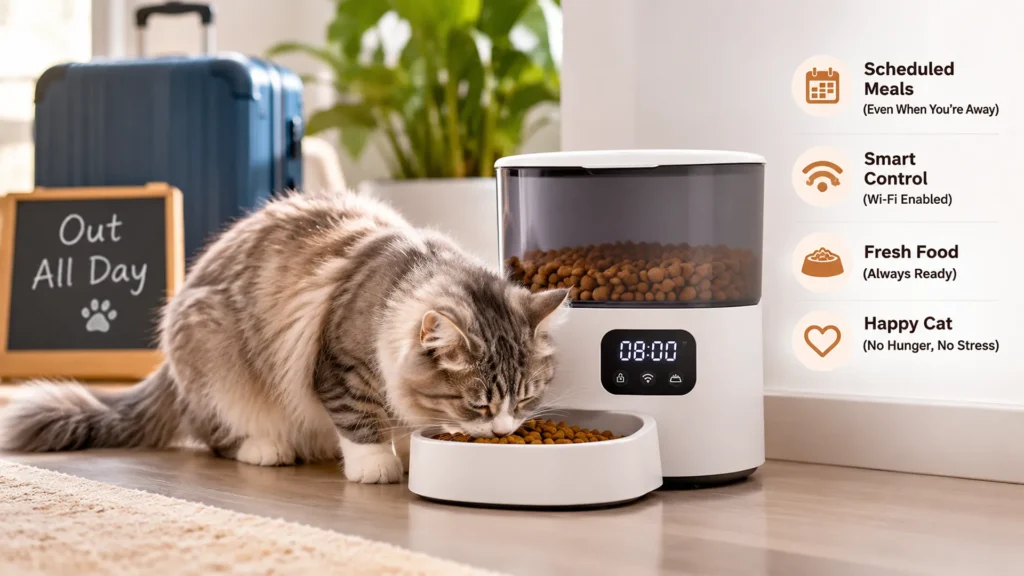
If a nine-to-five doesn’t leave room for two perfectly timed meals, an automatic feeder solves most of this. Timed dry-food dispensers portion things out on schedule whether you’re home or not, and plenty of them sync with an app so you can actually see how much your cat’s eating over time.
Portion-control feeders are especially handy if weight’s a concern, since they take the guesswork out of “how much is a scoop, really.” Wet food’s a bit trickier since it can’t sit out all day, but some feeders have a cooling compartment or ice pack built in to keep a midday meal fresh until it’s dispensed.
Signs Something’s Off With Your Cat’s Schedule
Throwing up not long after eating usually means they’re eating too fast or too much in one go — smaller, more frequent portions tend to help. A lot of begging or waking you up overnight can mean meals are too spread out, or the portions are too small to actually satisfy them.
Weight creeping up or down over a few weeks is worth tracking and mentioning to your vet if it keeps going. And a sudden change in appetite — eating a lot more or a lot less than usual — is often a sign of something medical, not just a mood.
A Few Sample Schedules
| Situation | Sample Schedule |
|---|---|
| Kitten (3 months) | 7am, 12pm, 5pm, 9pm |
| Healthy adult, working 9–5 | 7am, 6pm |
| Adult that begs a lot | 7am, 1pm, 6pm |
| Senior cat | 7am, 1pm, 7pm (smaller portions) |
| Diabetic cat | Fixed times aligned with insulin — per your vet |
Quick Questions People Ask
Can I feed my cat once a day?
For some healthy adult cats, sure — there’s research showing it can help with weight. It’s not right for kittens, seniors, or cats with health issues, and any switch should happen slowly, not overnight.
Is free feeding actually bad for cats?
Not automatically, but it makes it a lot harder to know how much your cat’s eating, and it can lead to overeating in cats who are prone to it. It tends to work best with multiple healthy cats and no dietary restrictions in the mix.
Why does my cat wake me up for food at 5am?
It’s a learned habit, plain and simple. If meowing has gotten them food before, they’ll keep doing it — because it works. Adjusting the timing or portion size, and not caving to the 5am meowing, usually breaks the cycle over time.
How long can a cat actually go without eating?
Technically, a healthy adult cat can survive one to two weeks without food. That doesn’t mean you should test it. Going too long without eating can trigger a serious liver condition called hepatic lipidosis, sometimes within just a few days.
Should I feed my cat before or after I eat?
Doesn’t matter medically — this one’s really about your own sanity and cutting down on begging while you’re trying to eat dinner. Whatever order keeps the peace in your house is the right one.
When It’s Worth Calling the Vet
If your cat’s appetite changes out of nowhere, their weight shifts without an obvious reason, or the throwing up or begging ramps up noticeably, it’s worth a call. Feeding frequency is a genuinely useful tool for managing your cat’s weight and health — it just works best when your vet knows what you’re doing, especially if your cat already has something going on medically.