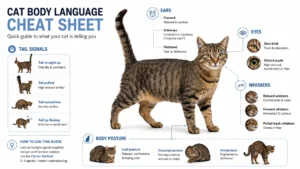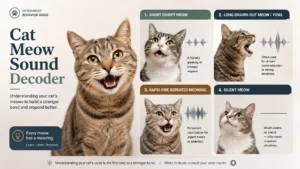
You’re petting your cat, they’re purring, everything’s calm. Then out of nowhere, a nip. It wasn’t out of nowhere. Your cat was almost certainly telling you this was coming — you just didn’t catch the signal. That’s the core problem with how most people read cat body language: they look for one cue instead of the whole picture. A cat rarely tells you how it feels with a single signal. It layers cues together, and the meaning changes depending on what’s happening around it. Once you learn to read combinations instead of single signs, catch overstimulation before it turns into teeth, and figure out what’s actually normal for your specific cat, the relationship gets a lot less confusing for both of you.
Why “Happy Tail vs. Angry Tail” Charts Don’t Actually Work
Search this topic online and you’ll find the same charts everywhere: tail up means happy, tail swishing means angry, ears back means scared. Simple, tidy, and honestly not that useful.
The problem is these charts treat body parts like individual words instead of full sentences. A cat can hold its tail straight up — normally a friendly, confident signal — while also having a tense body, blown pupils, and stiff legs. That’s not a happy cat. That’s a cat on high alert. If you go by the tail alone, you’ll misread the whole situation. Context and combinations of cues matter more than any single body part ever will.
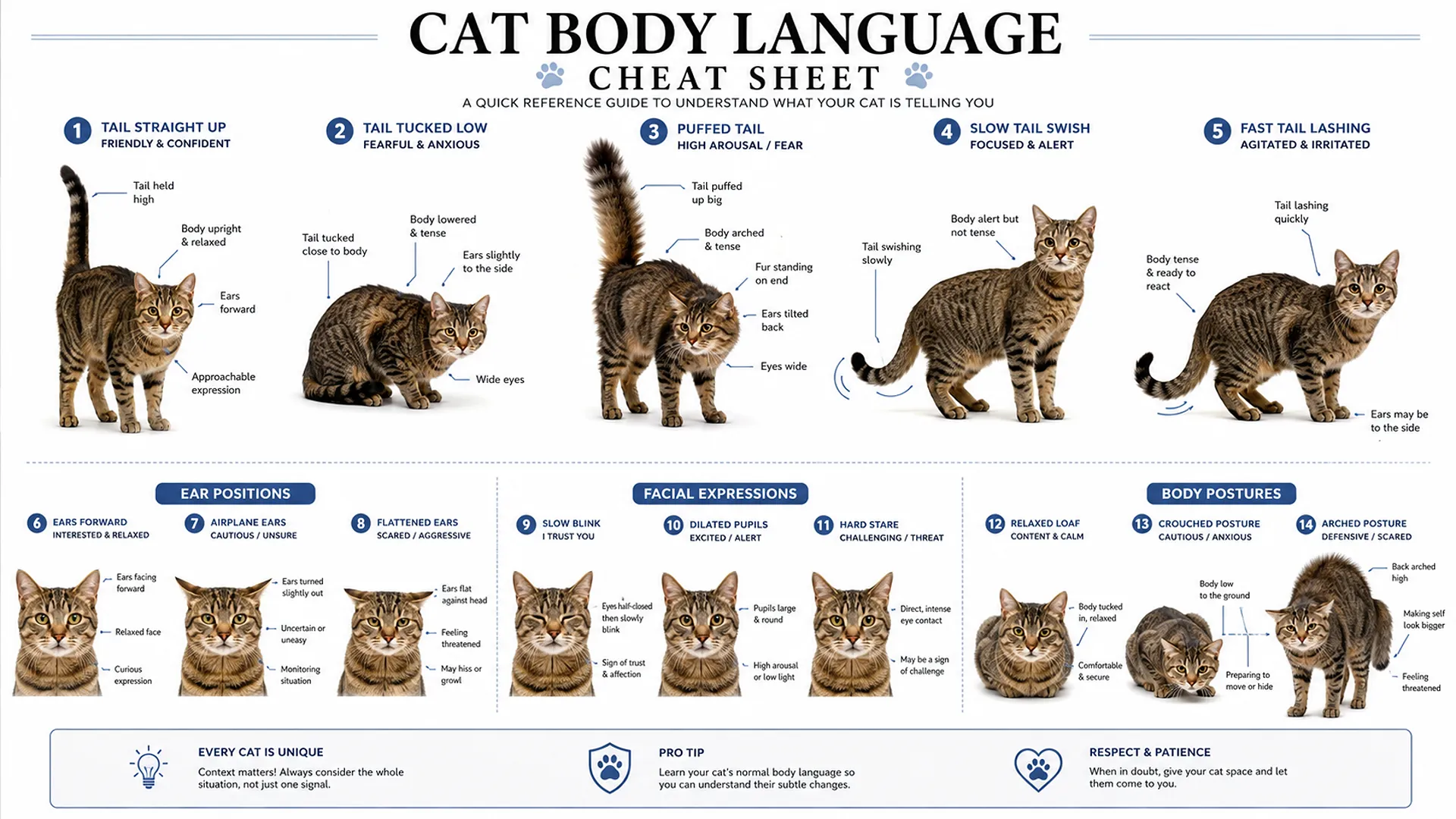
The Core Signals (Quick Reference)
Here’s what individual body parts typically communicate on their own, before you start combining them.
Tail
- Rigid, straight up: friendly, confident greeting, often with a curl at the tip
- Low or tucked: fear, submission, feeling threatened
- Puffed (piloerection): fear or sudden surprise, trying to look bigger
- Slow lash vs. fast lash: a gentle sway means mild interest or relaxation; a sharp, fast swish means frustration or high arousal
Ears
- Forward: curious, relaxed, engaged
- Sideways (“airplane ears”): uneasy, suspicious, mildly agitated
- Flat back: real fear, defensive aggression, severe distress
- Swiveling: actively listening, processing sound around them
Eyes and pupils
- Slow blink: trust and affection
- Dilated vs. constricted: dilated means excitement, fear, or low light; constricted means sharp focus, arousal, or possible aggression
- Hard stare, no blinking: a challenge, not a friendly look
Body and posture
- Loaf: relaxed and comfortable
- Exposed belly: trust, but rarely an invitation to touch it
- Arched back with raised hair: fear or defense; arched back with smooth hair is just a stretch after waking up
- Crouch: tense, low, ready to hunt or flee
Vocalizations
- Chirp or trill: friendly greeting
- Yowl: stress, disorientation, pain, or territorial display
- Silent meow: a soft request for attention
- Growl: a direct warning to back off
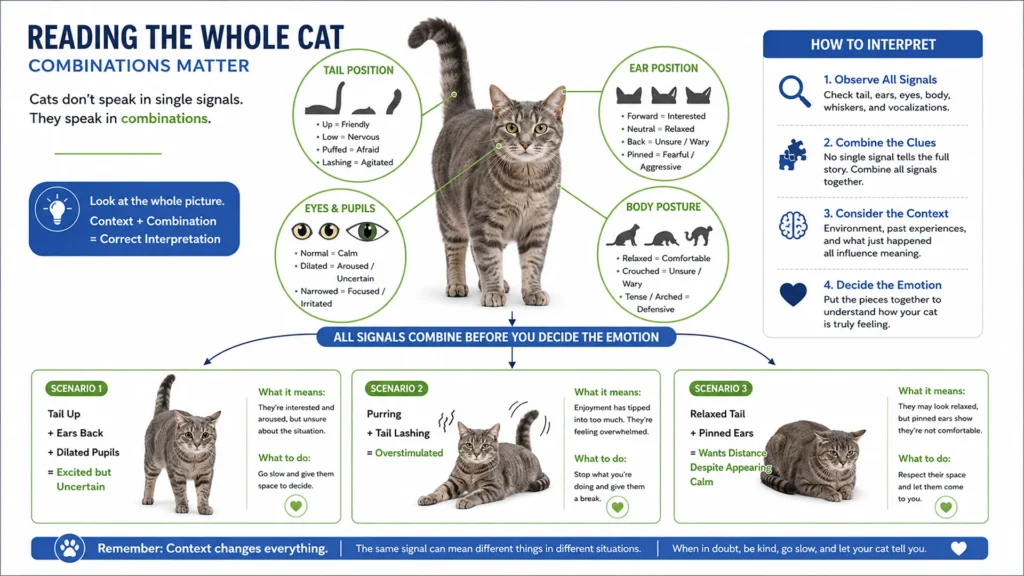
Reading the Whole Cat: A Combinatorial Example
Say a cat is walking toward you with its tail straight up. Basic-chart logic says: happy cat, go pet it.
Now look closer. Ears turned slightly back. Pupils dilated. Gait stiff instead of loose. That changes everything. The tail says “I want to check this out.” The ears, eyes, and stiff walk say “I’m not sure this is safe.” Put together, this isn’t a relaxed greeting — it’s a cat approaching with real uncertainty. Reach in fast to pet it and you might get scratched for your trouble. One good signal doesn’t override three cautious ones.
When Signals Conflict: Decoding Mixed Messages
Cats send mixed signals constantly, usually because they’re caught between two competing feelings — curiosity and fear, affection and physical discomfort, that kind of thing.
Relaxed tail, pinned ears. Your cat is lounging, tail still and loose, but their ears snap flat the second a door slams or a stranger walks in. Body’s calm, brain’s on alert. They’re monitoring a threat without feeling the need to run yet.
Purring with a lashing tail. Cat’s on your lap, purring loud, but the tail is thumping the couch cushion. Purring isn’t a pure happiness signal — cats also purr to self-soothe when stressed or in pain. That lashing tail is the more honest read here.
Approaching but crouched low. Cat is inching toward you, belly close to the floor, eyes locked on your hand. That’s curiosity fighting caution. They want whatever you’re offering, food or attention, but they haven’t fully decided the situation is safe.
The rule I go by, and the one worth remembering: when signals disagree, trust the more defensive or higher-arousal one. Relaxed tail plus pinned ears means proceed carefully, not proceed normally. It’s a small habit that will save you a scratch more than once.
Overstimulation and Petting-Induced Aggression: Why Cats “Randomly” Bite
A cat turning around to bite mid-pet feels random. It almost never is.
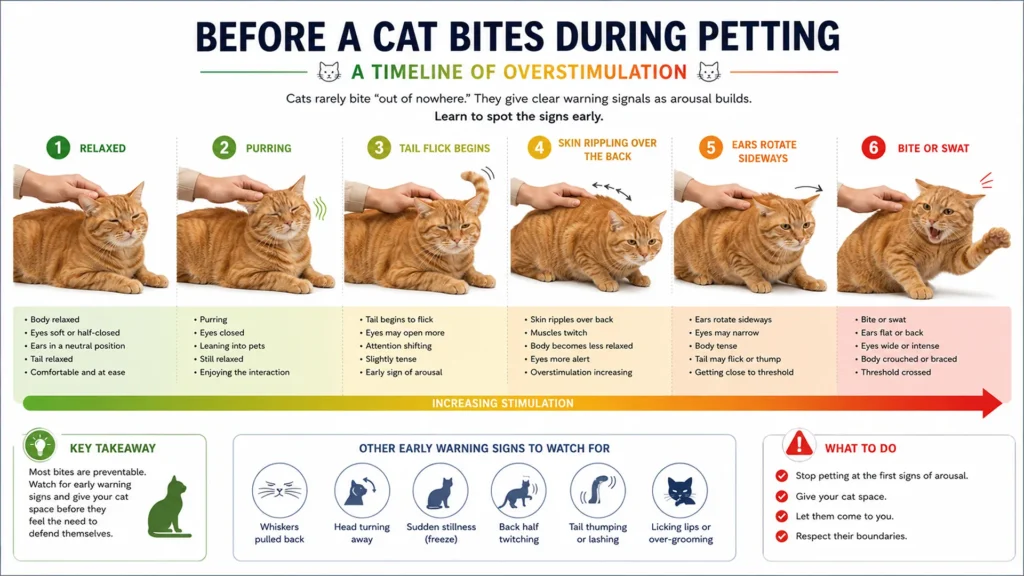
Think of stimulation as cumulative. Every stroke sends sensory input to the nervous system, and it builds — like a glass filling with water. It feels good at first. Past a certain point, the same touch that felt good now feels like too much, and the cat stops it the only way it knows how.
The sequence looks like this: petting starts, sensory input builds, threshold gets reached, warning signs appear, then the bite.
Warning signs in the 30 seconds before a bite:
- Skin rippling along the back
- Tail tip twitching, jerking, or thumping
- Ears rotating back or flicking toward your hand
- A sudden head turn to track your hand
- Muscles going rigid under your palm
Keep sessions short and stick to lower-risk zones — cheeks, chin, base of the ears. Skip the belly and the lower back near the tail; those spots trigger overstimulation fastest in most cats. If a bite or grab does happen, freeze. Don’t yank your hand back — that triggers the chase-and-catch instinct and usually makes it worse. Go limp, stay quiet, let the cat disengage on their own terms.
Cat-to-Cat vs. Cat-to-Human Communication
Cats don’t talk to us the way they talk to each other. Adult meowing is almost entirely a human-directed behavior — cats developed it to get our attention, and the tone tends to mimic a human infant’s cry, which is a big part of why it works on us so well.
Between cats, communication is quieter, built more on posture and scent than sound. A slow blink between two cats signals non-aggression. Directed at a person, it reads as something closer to affection or trust. Same goes for tail signals — a quick-twitch upright tail is a standard greeting between cats, but around humans, cats often add a chirp or meow on top of it to get a faster reaction.
Your Cat’s “Normal” Isn’t Universal
General rules give you a starting point, not a finished picture. Every cat has its own baseline, shaped by personality, breed, and history, and knowing that baseline is what lets you catch something wrong before it becomes a vet visit.
A one-week baselining framework. Spend a week watching your cat during normal routines and note:
- Resting tail position when walking around casually
- Typical ear posture — straight up, angled, forward-pitched
- Pupil size in daylight versus evening light
- Resting posture — sprawled out or curled tight
Breed and individual variation matters more than people give it credit for. A Siamese yowling and chattering is just being a Siamese; the same volume out of a quiet British Shorthair would be a red flag. A cat with a bobbed tail loses a big part of its signaling toolkit, so it leans harder on ears and body tension instead. Age, past trauma, and health all shape how a given cat expresses itself, so comparing your cat to a chart — or to someone else’s cat — only gets you so far.
What to Do Next: Action Steps by State
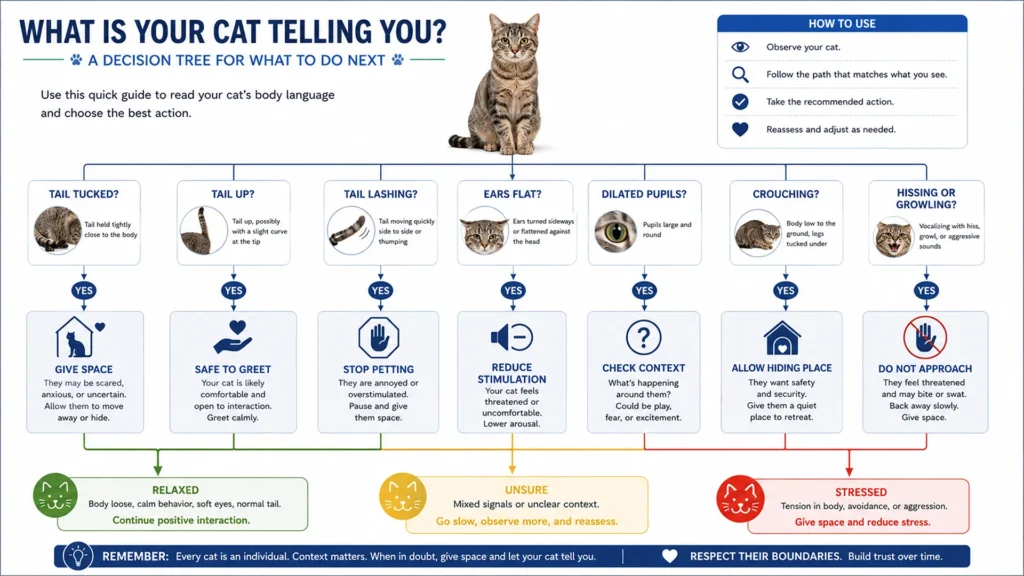
Reading the signals only helps if you know what to do with them.
De-escalating a fearful cat
- Give space — never corner them or force contact
- Sit or lie on the floor so you look smaller
- Soften your gaze; direct eye contact reads as threatening
- Make sure there’s a clear path to a hiding spot or high perch
Redirecting play aggression
- Freeze completely if a cat targets your hands or feet during play — that ends the “game” faster than pulling away
- Use wand toys to keep distance between your hands and their claws
- Build in regular, energetic play sessions before meals to burn off hunting drive
Safe approach protocol for an unfamiliar or anxious cat
- Extend one finger at the cat’s eye level, a few feet away
- Let them come to you and bump your finger with their cheek or nose
- Pet once or twice, then pause. If they lean back in, keep going. If they hold still or pull away, stop there.
The Science Behind Cat Body Language
This isn’t guesswork anymore. Vets use the Feline Grimace Scale (FGS) to assess acute pain by scoring five facial features: ear position, orbital tightening, muzzle tension, whisker change, and head position.
| Facial Feature | Low Stress / Pain | High Stress / Pain |
|---|---|---|
| Ears | Forward and relaxed | Flat or turned out |
| Eyes | Open and round | Squinted or tight |
| Muzzle | Relaxed and round | Tense or flattened |
| Whiskers | Loose and curved | Straight and stiff |
Shelters and clinics also use standardized tools like the Cat-Stress-Score (CSS) and the Fear, Anxiety, and Stress (FAS) scale, which track posture shifts, pupil changes, and body compression closely enough to tell a passing scare from chronic, ongoing stress.
FAQ: When Body Language Signals a Vet Visit
How can I tell if my cat’s body language means they’re sick or in pain?
Cats hide illness instinctively — it’s a survival trait, not stubbornness. Watch for subtle, persistent shifts rather than dramatic ones:
- Hiding or freezing in a corner or under furniture for long stretches
- Squinted eyes, a lowered head, whiskers pulled flat against the cheeks (key markers on the Grimace Scale)
- A normally affectionate cat suddenly growling or swiping when touched in one specific spot, often the lower back or belly
- Grooming stopping entirely, or fixating obsessively on one joint until the fur thins
Any of these lasting more than 24 hours is worth a vet call. Urinary tract infections, arthritis, and dental pain are common culprits, and cats are good at masking all three until it’s fairly advanced.
Key Takeaway
Reading cat body language well comes down to one habit: look at combinations, not single signals, and judge them against your own cat’s baseline rather than a generic chart. Catch the small warnings early, respect what they’re telling you, and the trust builds itself from there.