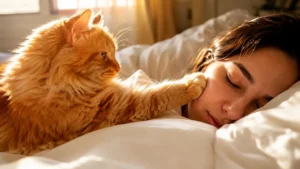
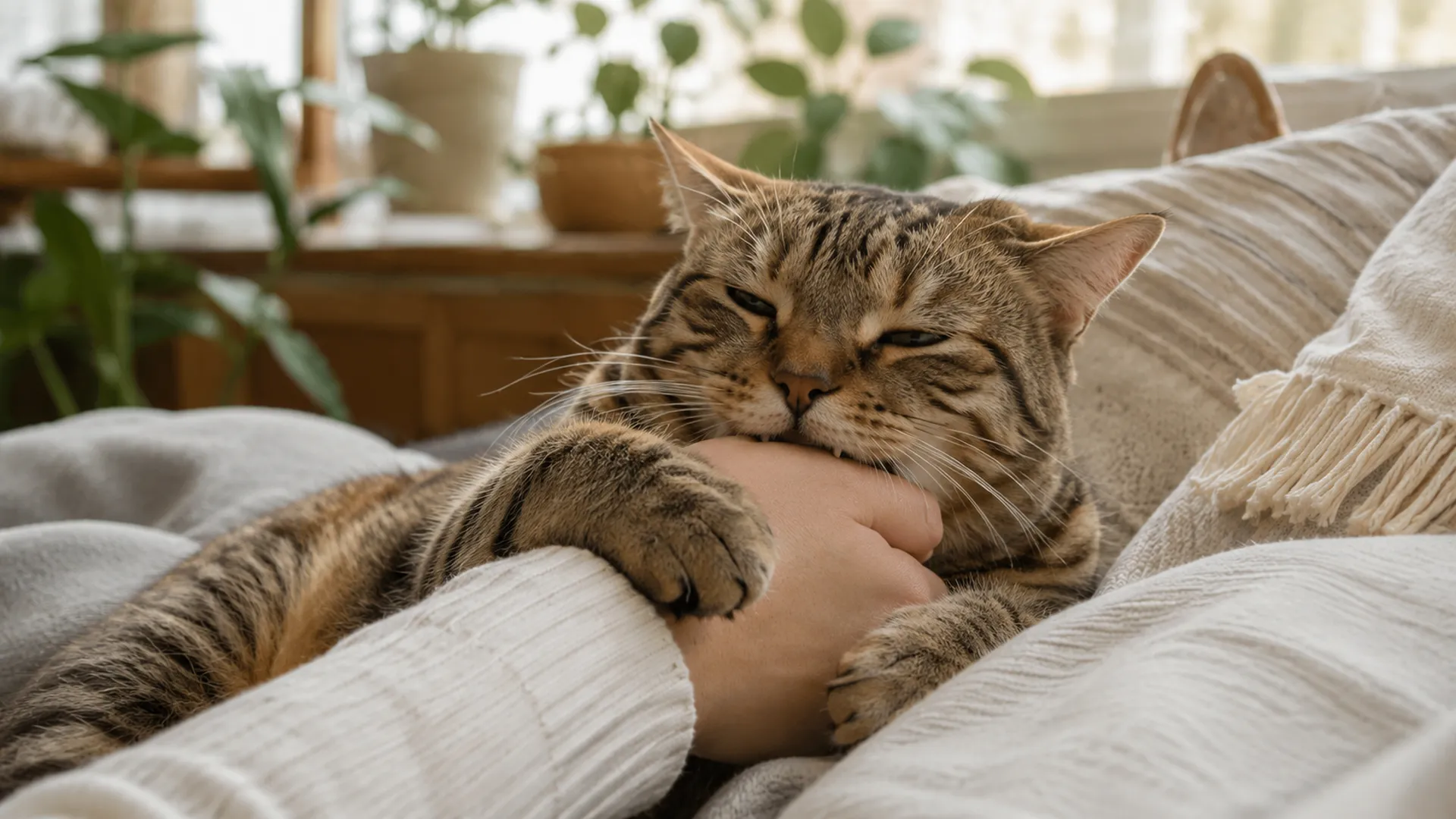
If you’ve been asking yourself “why does my cat bite me gently,” the answer is usually a nice one: affection, grooming, or a bid to play. That same soft bite can also mean your cat’s had enough petting, though. Or that something hurts.
The bite on its own won’t tell you which. The rest of your cat will, and so will whatever happened a few seconds before.
You know the moment. Cat on your lap, purring away, and then your hand is suddenly in their mouth. No hiss, no blood. Just a quick little clamp and release, and a look that tells you nothing. Below you’ll find a bite decoder, the situations owners ask about most, and the signs that mean you should call the vet.
Why Does My Cat Bite Me Gently? Love Bites vs. Petting-Induced Aggression
Type “why does my cat bite me gently” into Google and read a few of the results, and you’ll notice something odd. They don’t agree with each other. Some vets and pet sites use “love bites” and “petting-induced aggression” to mean the same thing, while others treat them as two different behaviors entirely. It’s easy to finish reading more confused than when you started.
Here’s how I separate them.
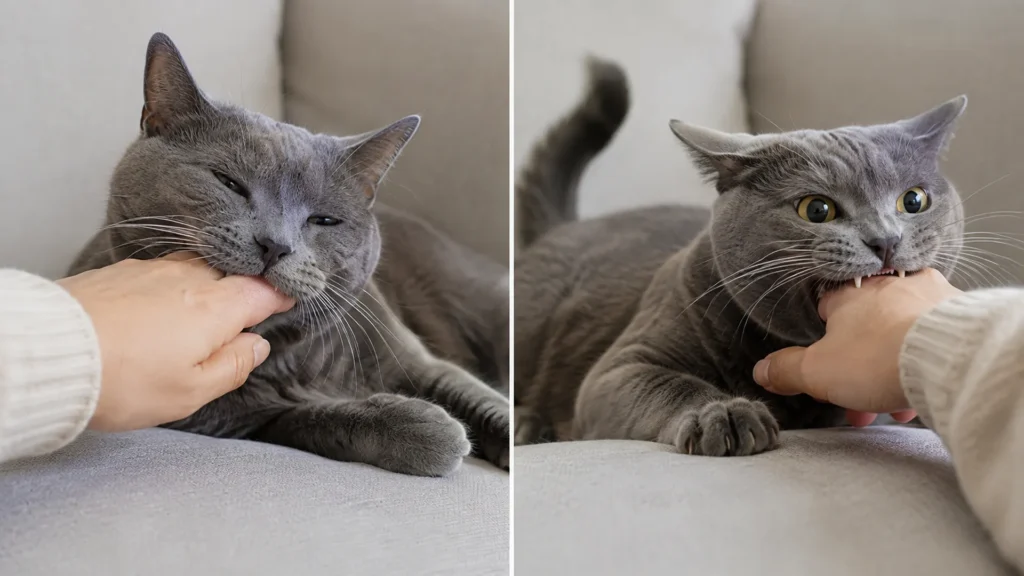
A love bite is controlled mouthing. Your cat deliberately holds back, so the skin stays intact. Their body is loose, and they’ll often go straight back to licking you or kneading.
An overstimulation bite starts out the same way, with a relaxed cat enjoying some attention. Then they hit their limit on touch, and the bite means “stop.” It might be just as gentle as a love bite. The message is the opposite.
That’s why pain level is a bad guide. A soft nip can still be a polite “okay, that’s enough.” You have to read the situation around it.
Why Does My Cat Bite Me Gently? 6 Common Reasons
Nearly every answer to “why does my cat bite me gently” lands in one of these.
They’re grooming you (allogrooming)
Cats groom each other to bond, and mother cats clean their kittens with a mix of licking and tiny nibbles. If your cat licks you a few times and then nips, congratulations, you’ve been added to the grooming rota. The rhythm is pretty recognizable: lick, lick, lick, nibble, back to licking.
Affection and bonding
Some cats simply say “I like you” with their mouths. You’ll usually get these bites during quiet, cozy moments, often with purring, kneading or slow blinks thrown in. If your cat’s relaxed and the bite is soft, take the compliment.
They want to play
Underneath the fluff, your cat is a hunter. Hands that move and toes that wiggle under a blanket look an awful lot like prey. A play bite tends to come after a crouch, a bum wiggle, big eyes or a sudden pounce. It isn’t personal.
They want your attention
Sometimes a nip is just a tap on the shoulder. Your cat wants food, or a game, or for you to keep doing whatever you just stopped doing. You’ll notice it most when your eyes are on your phone or laptop instead of them.
They’ve had enough (overstimulation)
A bite can simply be your cat closing the petting session. This is one of the most common reasons for a sudden nip. There are almost always small warning signs first, and the decoder below shows you what they are.
Kittens are teething and learning
Kittens explore everything with their mouths, and teething makes them chew even more. They’d normally learn bite control from their mother and littermates. Please don’t let your hands become toys, even with a tiny kitten. It’s adorable at 10 weeks. It’s much less adorable at two years.
The 5-Second Bite Decoder
The quickest way to answer “why does my cat bite me gently” for your own cat is to stop staring at the teeth. Look at the whole animal, think back to what happened just before, and find the row that fits.
| What it means | Tail | Ears | Eyes/pupils | Sound | Bite pressure | Just before the bite | What to do |
|---|---|---|---|---|---|---|---|
| Affection | Relaxed, still or gently curved | Forward, relaxed | Soft, may slow blink | Purring | Very light | Calm cuddling | Enjoy it, or move your hand away gently if you don’t like it |
| Grooming | Relaxed | Forward | Soft, half-closed | Purring or quiet | Light, nibbly | Licking you | Nothing needed. It’s a bonding moment |
| Play | Twitching tip, raised or swishing | Forward, alert | Wide, pupils may be large | Quiet or chirping | Light to medium, may grab with paws | Your hand or feet moving | Freeze, then redirect to a toy |
| Overstimulation | Flicking or thumping | Turning sideways or back | Pupils getting bigger | Purring may stop | Quick nip | Long petting session | Stop petting, give space |
| Warning/fear | Low, tucked, or lashing | Flattened | Wide, dilated | Hissing or growling | Firmer | Being handled, cornered, or startled | Back off calmly, give an escape route |
| Possible pain | Tense | Back or sideways | Tense, may squint | May stop purring | Quick, targeted | Touching one specific spot | Note the spot and check with your vet |
The shortcut version:
- Went straight back to licking or snuggling? Probably a love bite.
- Tail started twitching, or the skin rippled along the back, just before? Probably overstimulation.
- Hissing, ears pinned flat, trying to get away? That’s a warning. Here’s more on what cat hissing means.
Other signals, like headbutting, can tell you a lot about how your cat feels about you too.
When Gentle Biting Means Pain
Cats are ridiculously good at hiding pain. Rather than hiss or bolt, some will just give a quick nip to protect a sore spot. So if “why does my cat bite me gently” is a new question for you, and this never used to happen, rule out pain before you start treating it as a behavior issue. It’s the step owners skip most often, and I think it’s the most important one in this whole article.
Where they bite you, and what it can point to
Try to notice where your hand was at the time. Your vet will find that useful.
- Face or mouth area. Biting when you touch the cheeks, chin or jaw, particularly if your cat used to love that, can be a sign of dental pain.
- Hips, back or lower spine. Biting when you stroke these areas could suggest joint pain such as arthritis, which is common in older cats.
- Along the back, with rippling skin. Some cats have very sensitive skin, and skin problems can make being touched uncomfortable.
These are clues to pass on to your vet. They aren’t diagnoses.
Call the vet if…
Sometimes the only person who can really answer “why does my cat bite me gently” is your vet. Book a visit if any of these sound familiar:
- The biting started out of nowhere, or it’s getting more frequent or harder.
- It’s happening alongside other changes, like eating less, grooming less (or way more), or different litter box habits.
- Your cat avoids being touched in one particular spot, or reacts every single time you touch it.
- Your senior cat has started biting when they never did before.
- Your cat just seems off. More hiding, less playing, less interest in you.
A cat can’t tell you something’s wrong. A sudden change in behavior is often as close as they get.
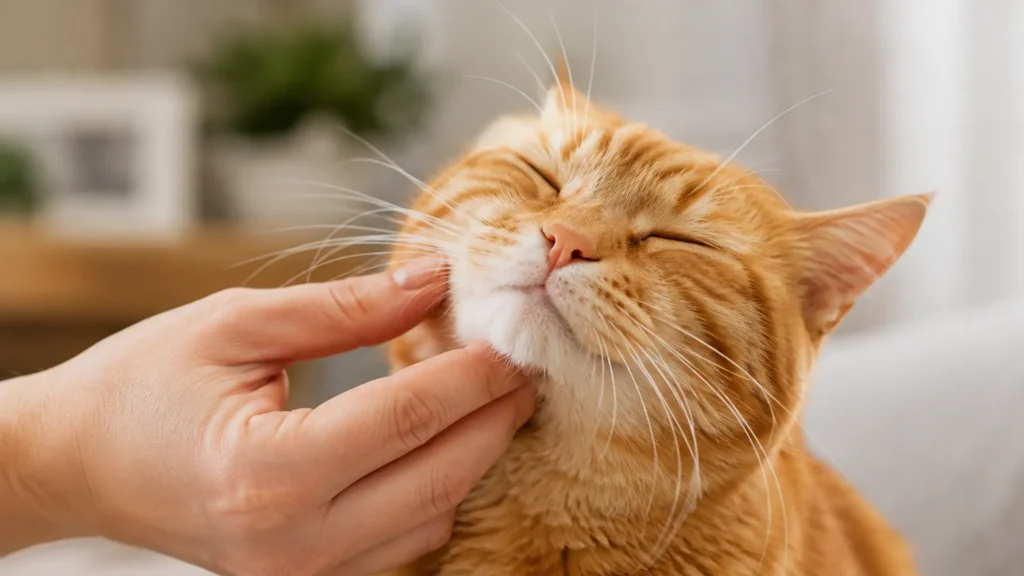
Your Cat’s Petting Budget: How to Pet So They Stop Biting
Every cat has a petting budget, a certain amount of touch they enjoy before it tips over into too much. Some cats could take an hour of it. Others are done after three strokes. For a lot of owners, “why does my cat bite me gently” really comes down to this: they’ve gone over budget without noticing.
There’s actual research on it. In a 2021 study, researchers from Nottingham Trent University and Battersea Dogs and Cats Home put together cat interaction guidelines built around a “CAT” acronym. They tested them with 100 cats waiting to be rehomed and 120 members of the public. When people followed the guidelines, the cats were significantly less likely to behave aggressively, and they were more affectionate too.
What CAT stands for:
- C: Choice and control. Let your cat decide when contact starts and when it stops. Hold your hand out and wait. If they rub against it, great. If they wander off, let them.
- A: Attention. Keep an eye out for early signs they’re losing interest: a flicking tail, ears turning back, twitching skin, their head turning toward your hand, or purring that suddenly cuts out.
- T: Touch. The guidelines keep touch mostly to the cheeks and temples. Under the chin and the base of the ears are usually safe as well. Leave the belly and the base of the tail alone, and skip those long head-to-tail strokes.
If I could get owners to adopt just one habit, it’d be pause-and-check. Pet for a few seconds, then stop. Does your cat lean in, rub against you, nudge your hand? Keep going. No reaction? That’s your answer. I genuinely think this one habit would fix most gentle-biting complaints.
How to Respond in the Moment
Working out why does my cat bite me gently can wait. When the teeth are already on your hand, this is what helps.
- Freeze. Yanking your hand back makes it look even more like prey, and a soft bite can turn into a hard one.
- End it calmly. Once your cat lets go, stop petting and ease away.
- Redirect. If it was a play bite, give them a wand toy or a kicker toy they can bite as hard as they want.
- Never punish. Yelling, tapping their nose or shoving them away teaches your cat to be wary of hands, and a nervous cat bites more, not less.
- Reward the calm moments. When your cat enjoys some gentle petting without biting, a soft word or a treat goes a long way.
Common Scenarios, Answered
“Why does my cat bite me gently” usually comes with a follow-up detail attached. These are the ones owners ask about most.
Why does my cat bite me gently, then lick me?
You’re being groomed. It’s the same lick-and-nibble routine cats use on each other and on their kittens. A relaxed cat that goes back to licking afterward is showing affection and trust.
Why does my cat bite me gently at night?
Cats are naturally most active around dawn and dusk, so their energy tends to spike right when you’re trying to sleep. Night nips are usually boredom, hunger or a request to play. A good play session before bed followed by a small meal helps a lot.
Why does my cat bite me gently when I stop petting?
This one means “hey, don’t stop,” which is the reverse of overstimulation. If you don’t want to encourage it, wait until your cat settles down before you start petting again. Otherwise they learn that a bite gets results.
Why does my cat bite me gently on the nose or face?
Cats groom each other’s heads and faces, so a face nibble puts you firmly in the inner circle. It’s sweet. Their mouths do carry bacteria, though, so it’s worth gently discouraging bites near your eyes and mouth
Conclusion
So, why does my cat bite me gently? Usually because they trust you. Watch the whole cat rather than just the teeth, keep the decoder handy, and try not to overspend the petting budget. If the biting pattern suddenly changes, have a chat with your vet. And if you want to get better at reading your cat in general, our guide to cat anxiety is a good next stop.