So how often should cats drink water, really? About 5 to 6 times a day, in small sips — nothing like the one big bowl-draining gulp session you’d see from a dog after a walk. And if you’ve spent the last twenty minutes with a search bar full of ounces and milliliters, trying to work out whether your cat’s drinking “enough,” I get it, but you’re making this harder than it needs to be.
How Often Should Cats Drink Water? The Quick Answer
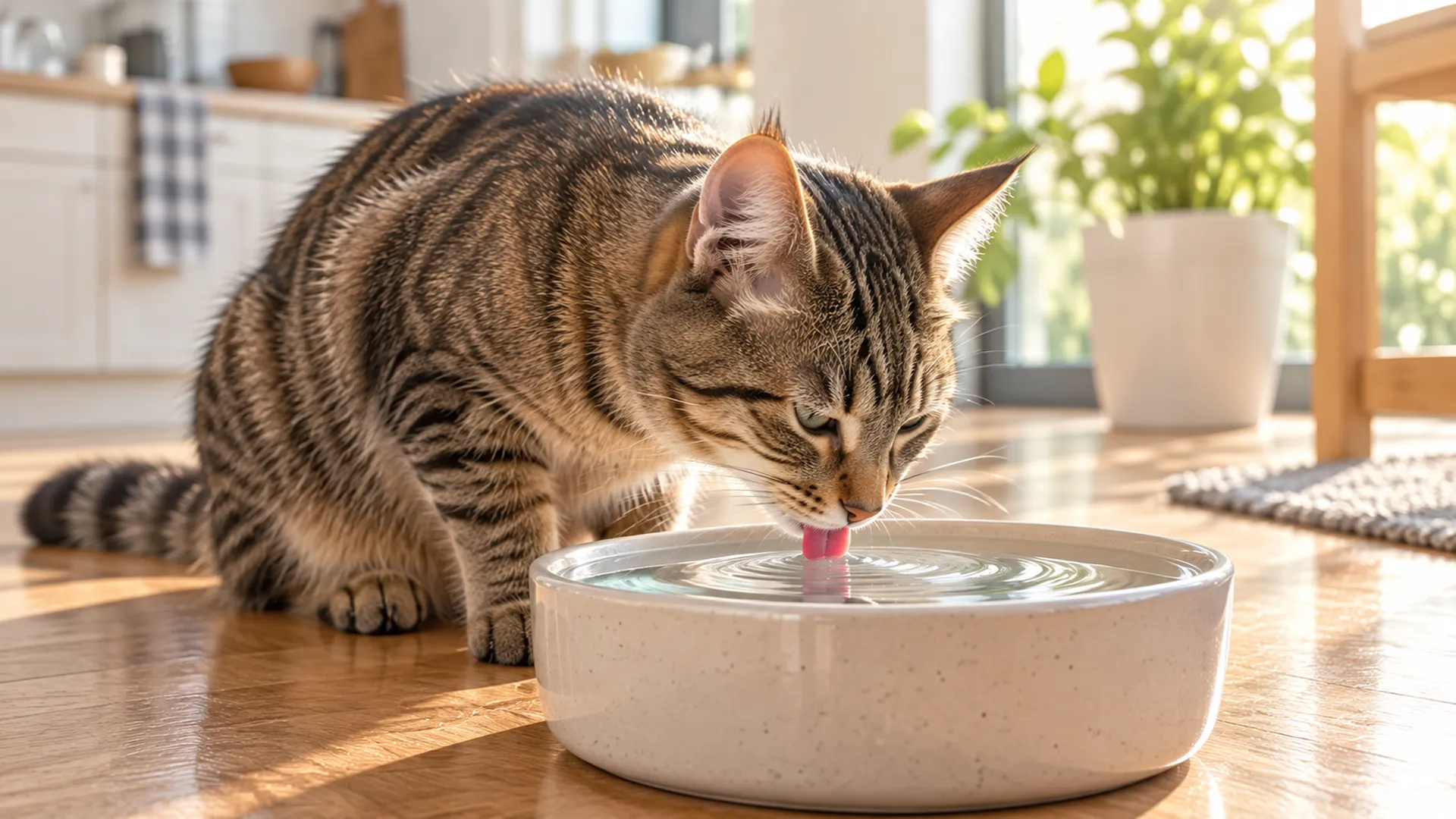
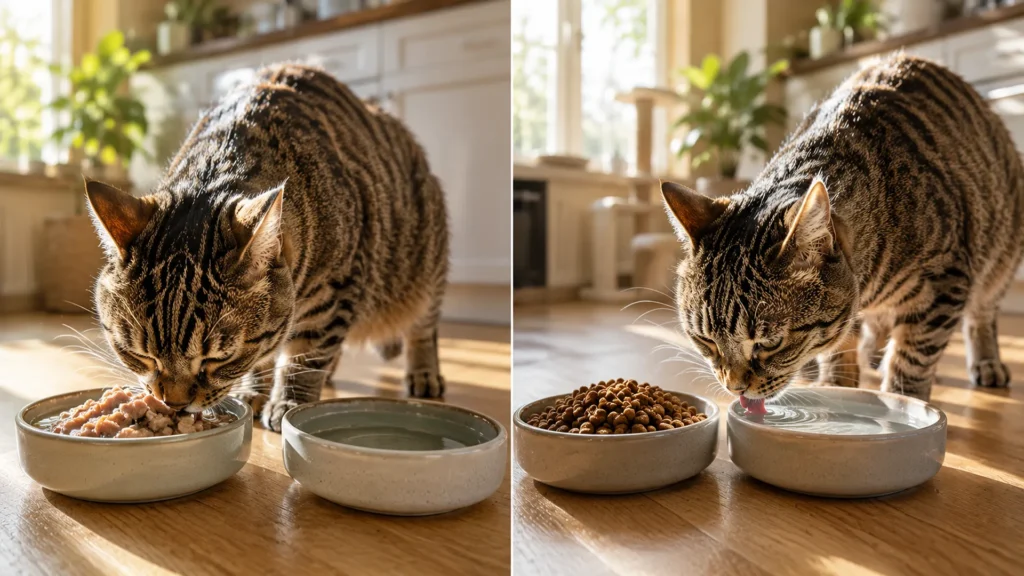
A healthy cat wanders over to its water bowl 5 or 6 times a day. Small sips, spread across the day, never one long drink the way a dog does it. Diet throws a wrench in that number, though. A cat mostly on wet food is pulling a lot of hydration straight from its meals and just doesn’t need to drink as often. Dry kibble doesn’t offer that cushion, so a dry-fed cat has to make up the gap at the bowl. There’s a reason for all of it, so let’s get into it.
Why “How Often” Matters More Than “How Much”
Every vet site out there wants to hand you a number — ounces per day, milliliters per kilogram, pick your unit. Fine, in theory. But I don’t know a single person measuring their cat’s water in a graduated cylinder before heading out the door in the morning.
What you actually notice is behavior. Did your cat swing by the bowl a couple times today, same as any other day? Or has it genuinely been since yesterday since you last saw them drink? You’ll catch that shift long before you’d ever spot a two-ounce shortfall on some scale.
A sudden drop-off in how often your cat drinks — or a sudden jump — becomes obvious fast, once you actually know what’s normal for your cat specifically. That’s the whole game here. Learn the pattern. Forget the math.
A Cat’s Natural Drinking Rhythm
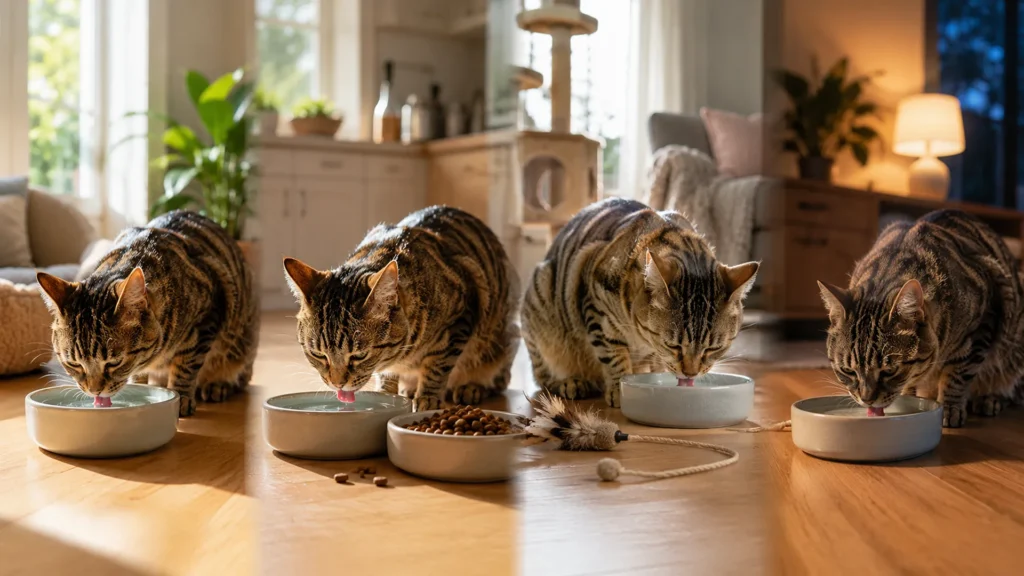
Cats aren’t drinking at random moments throughout the day. There’s a loose rhythm underneath it all, tied to sleep, meals, how much they’ve been moving around — and once you’ve watched for it a few days running, you start noticing it without even trying. This rhythm is basically the backbone of the whole how often cats should drink water question.
Morning, right after waking
After a long stretch asleep overnight, most cats grab a light sip not long after getting up, usually somewhere around their first meal of the day.
Right after meals
Drinking tends to pick up right after eating, especially with dry kibble, since there’s next to no moisture in that food to fall back on.
After play or activity
A round of zoomies or a play session is often followed by a quick pass at the water bowl — same instinct that has you grabbing a glass of water after a workout.
Overnight
Cats aren’t big nighttime drinkers, generally speaking. Most of the day’s intake happens while they’re up and moving around, with maybe the odd sip somewhere in the middle of the night.
A simple 24-hour graphic — morning, post-meal, post-play, overnight — would lay this pattern out at a glance if you’re putting this together visually.
Why Cats Drink Less Than Dogs
Not a personality thing. Just inheritance.
Domestic cats trace back to desert-dwelling ancestors that pulled most of their water from prey rather than puddles or open streams. Their bodies ended up with a genuinely low thirst drive compared to most mammals as a result. They’re just not built to go hunting for water the way a dog is.
That same ancestry explains something practically every cat owner has watched play out: the obsession with a dripping faucet over a perfectly full bowl sitting quietly in the corner. In the wild, still water was more likely stagnant, maybe even unsafe. Moving water reads as fresh. So when your cat strolls right past a full bowl to go drink from the tap instead, that’s not attitude — that’s a few thousand years of survival instinct still doing its job.
How Much Water Should a Cat Actually Drink? (And Why the Numbers Never Match)
Go looking around and you’ll dig up four different formulas, all sounding equally official, none quite agreeing with each other. Nobody got it wrong here, to be fair. Water needs genuinely shift cat to cat, and every source just rounds a little differently.
| Guideline | For a 10 lb (4.5 kg) cat | Basis |
|---|---|---|
| ~4 oz per 5 lbs body weight | ~8 oz/day | Common vet estimate |
| 3.5–4.5 oz per 5 lbs body weight | ~7–9 oz/day | More conservative range |
| Flat 5–10 oz/day | 5–10 oz/day | General size-based range |
| 60 ml/kg/day | ~270 ml (~9 oz)/day | Metric vet guideline |
Put them side by side and they all settle somewhere between 7 and 10 ounces for an average 10-pound cat. Different units, different rounding, same rough neighborhood. Use it as a range to check yourself against, not some number you’re required to hit exactly. Chasing that kind of precision is, frankly, a waste of your time.
The rule I actually use: match food to water
Forget the chart, honestly. The simplest guideline going, and it comes straight from the ASPCA, is that a cat should take in roughly the same volume of water as food each day, combined. Wet-food cat? Most of that water’s already in the bowl at dinner. Dry-food cat? More of it needs to come from the water bowl on its own. One sentence, and it does what four competing formulas couldn’t.
What Actually Changes How Often Your Cat Drinks
Wet food vs. dry food
Wet food runs somewhere around 70 to 80 percent moisture. Dry kibble sits way down near 7 to 12 percent. So a dry-fed cat drinking more often than a wet-fed one isn’t a red flag at all — just arithmetic playing out.
Weather
More drinking once summer hits, less once it cools off again. Perfectly normal on its own, not something to lose sleep over.
Activity level
A cat tearing through the house all afternoon burns through hydration a lot faster than one that’s asleep for eighteen hours straight. More activity, more bowl visits. Not complicated.
Where the bowl sits, and how fresh it is
Comes right back to that contamination instinct again — cats drink more from clean, fresh water kept well away from food and the litter box. A stale bowl shoved in some random corner can suppress drinking even when a cat’s genuinely thirsty. Of everything on this list, this is the one thing owners actually control, and the one I see people mess up most often.
Does How Often Cats Drink Water Change by Life Stage?
Kittens
Higher water turnover relative to their size, more frequent small sips throughout the day. Worth watching closely especially during the switch off nursing.
Adult cats
The 5–6 times a day baseline holds steady here, nudged up or down by diet and activity like described above.
Senior cats
Older cats often drink more often as kidney function starts shifting with age. Some of that bump is expected. A sharp, sudden jump isn’t — that one earns a vet visit, not a shrug and a “guess they’re just getting old.”
Pregnant or nursing cats
Water needs climb noticeably during pregnancy, and even more so once nursing starts. More frequent drinking here is normal, even necessary — not a symptom of anything going wrong.
Signs Your Cat Isn’t Drinking Enough
Watch for these stacking up together, not just one showing up on its own:
- Dry or tacky gums
- Skin that’s slow to spring back after a gentle pinch
- Low energy, less interest in play than usual
- Less litter box activity, or noticeably drier stools
- Fewer trips to the water bowl than you’re used to seeing
A handful of these piling up at once is your cue to call the vet. Don’t just sit around waiting to see.
Signs Your Cat Is Drinking More Than Usual
A spike matters just as much as a drop, if not more. The usual suspects behind an increase:
- Diabetes, often paired with more urination and weight change
- Kidney disease, more common as cats get older
- Hyperthyroidism, usually alongside weight loss despite eating more
- UTIs, typically with frequent, small urinations
One hot afternoon isn’t a pattern. A sustained increase over a week or longer is the kind of thing worth getting checked out.
How to Actually Get Your Cat Drinking More
Skip the generic listicle advice floating around everywhere. These actually work because they lean into the instincts already covered above, instead of fighting them.
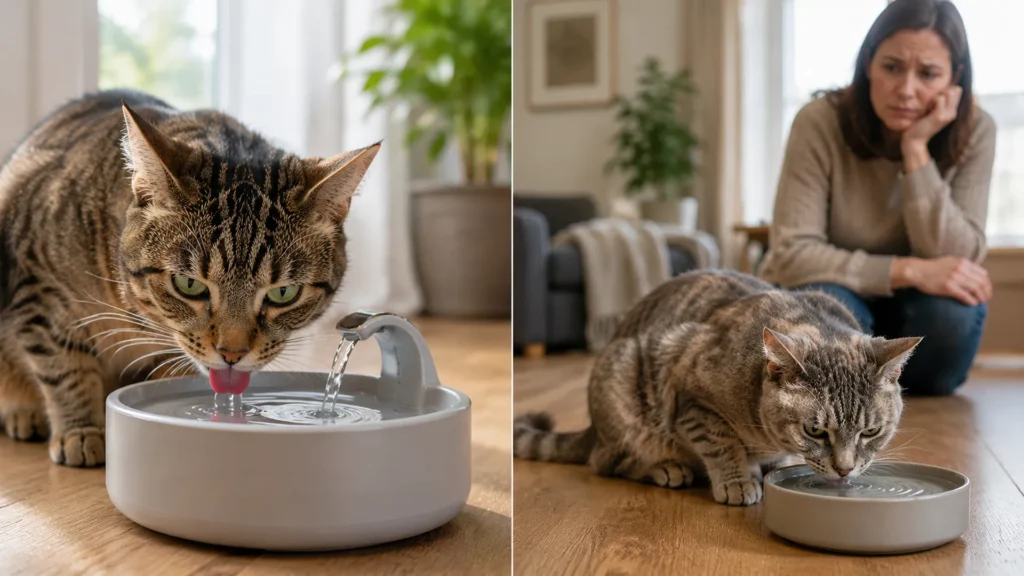
- A water fountain. Moving water hits that freshness instinct head-on, and in my experience it’s the single highest-leverage fix for a cat that barely touches its bowl.
- Multiple bowls, low-traffic spots, kept well clear of food and litter.
- Wide, shallow bowls. Deep narrow ones cause whisker fatigue, which quietly turns cats off drinking.
- A splash of water mixed into dry food. Small, passive boost, no full diet overhaul required.
Multi-Cat Homes, Travel, and Heat
Multiple cats
When cats share one bowl, you lose the ability to tell who’s actually drinking and who isn’t. Separate stations in different rooms fix that blind spot fast.
Travel
Stress cuts into how much cats drink during car rides and trips generally. Offer water at stops, and bring along a bowl your cat already recognizes if you’re able to.
Hot weather
Extra water stations, bowls kept out of direct sun, maybe an ice cube dropped in here and there. Never hurts.
FAQs: How Often Should Cats Drink Water
Is it normal for a cat to skip water for a day?
Skipping visible drinking for part of a day can be totally fine, especially on an all-wet-food diet. A full 24 hours with zero drinking and no wet food, though — that’s worth watching closely, and anything past that means a call to the vet.
How many times a day should a cat drink?
Somewhere around 5 to 6 times, in small sips, shifting a bit depending on diet, activity, and weather.
Do cats drink more in summer?
Yes — same as most animals, it’s part of how they regulate body temperature.
Can a cat live on wet food alone, no separate water?
Wet food covers a good chunk of a cat’s hydration needs, but fresh water should still be sitting out at all times regardless. Individual needs vary too much to lean on food alone.
The Bottom Line
Skip the ounce math. Learn your cat’s normal rhythm instead — roughly 5 to 6 short trips to the bowl a day, shaped by diet, weather, and age. A real, sustained shift in that pattern, in either direction, is what’s actually worth acting on. That’s when you call the vet, not the moment you fall short of some chart somewhere. The honest answer to how often cats should drink water really comes down to this: watch the pattern, skip the ounces.