A single tail position is a word, not a full sentence. A puffed tail by itself just means “aroused” — that could be fear, excitement, or even a burst of joy. Cats build meaning by stacking signals: tail position, speed, fur, ears, eyes. Get one piece and you get a fragment. Read them together and you start getting the full message. This guide covers what each tail position means alone, how breed and body type change that reading, how meaning shifts as a sequence plays out, and when a tail is flagging something that actually needs a vet, not a treat.
Why Cats Use Their Tails to Communicate
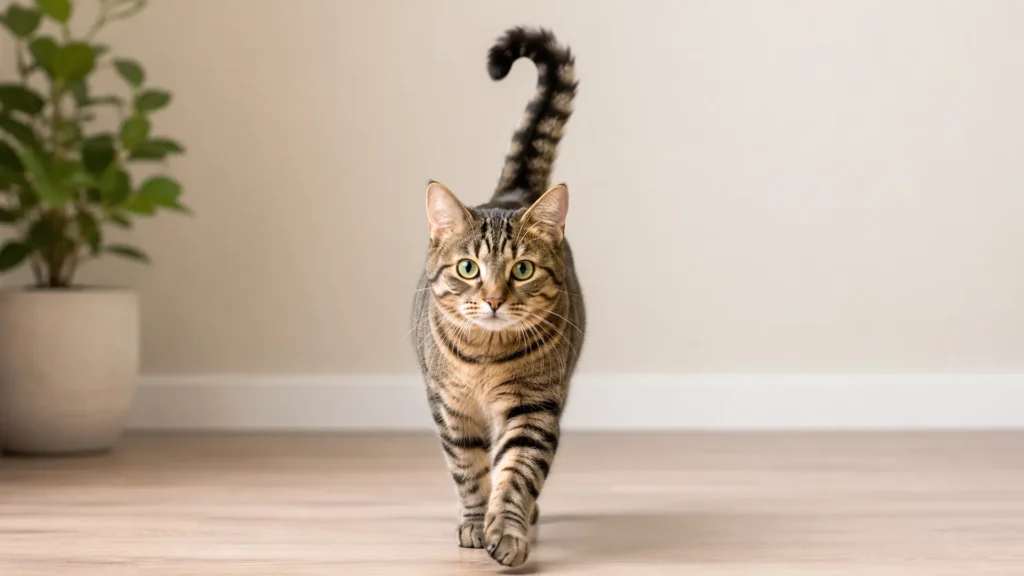
A cat’s tail is part of the spine — small vertebrae, muscles, and ligaments giving it a huge range of motion. Its original job is balance: it’s what lets a cat walk a narrow fence rail or snap into a sharp turn mid-chase. But that same mobility made it useful for something else. Evolution turned a balance tool into a flag. A raised, relaxed tail is easy to spot from across a room, so cats use it to broadcast mood before committing to a riskier close-range interaction, whether that’s with another cat, a dog, or you.
Why a Wagging Tail Doesn’t Mean the Same Thing It Does on a Dog
If you grew up around dogs, you’ll want to read a wagging cat tail the same way: happy, excited, come say hi. Don’t. That instinct will get you scratched. A dog’s wag is low-arousal and friendly almost by default. A cat’s tail motion is far more often a sign of conflict — the cat wants to stay but feels annoyed, or wants to play but is also on edge.
A fast, whipping tail is agitation or overstimulation, not joy, nearly every time I’ve seen it. A slow, gentle swish on a relaxed cat can mean contentment. That exact same slow swish on a cat crouched and staring at a toy means something closer to focus. Dogs signal one clear state at a time. Cats signal degrees of arousal and internal tug-of-war. If you only take one thing from this article, take this: a wagging cat tail is your cue to back off and watch, not an invitation to move closer.
The Core Tail Positions and What They Mean
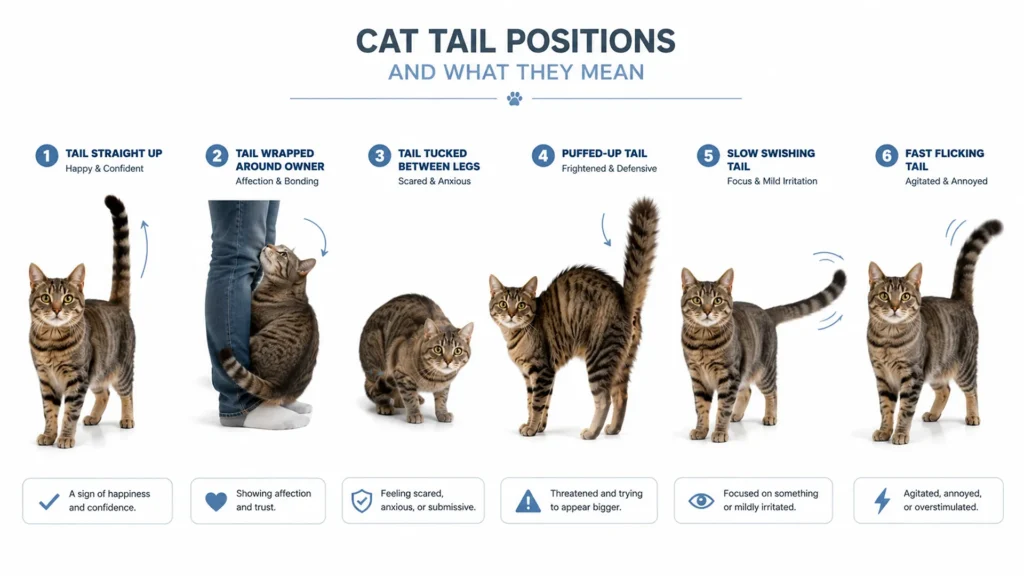
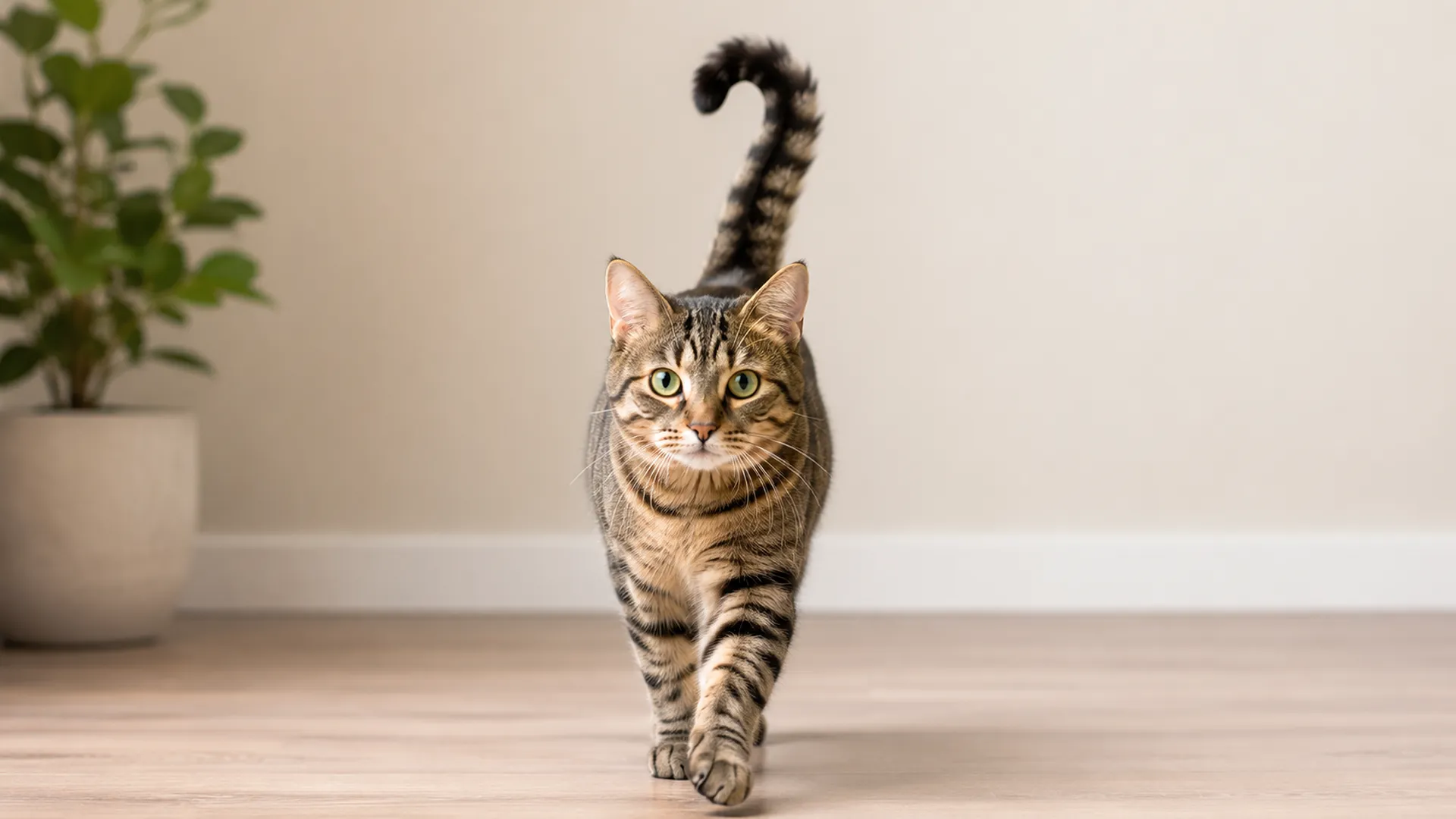
Tail straight up, with or without a curl. One of the friendliest signals a cat has. A tail held straight up, often with a slight hook at the tip, usually means the cat is confident and open to interaction. You’ll see it when a cat trots over to greet you at the door, or approaches another cat it already likes. That curl at the top softens the whole posture — think of it as the feline version of a relaxed wave.
Tail wrapped around you or another cat. This is a bonding move, closer to a hug than anything else in the tail vocabulary. When a cat winds its tail around your leg, your arm, or another cat’s body, it’s closing distance on purpose and signaling trust. Cats reserve this for people and animals inside their social circle, so it’s a genuinely good sign.
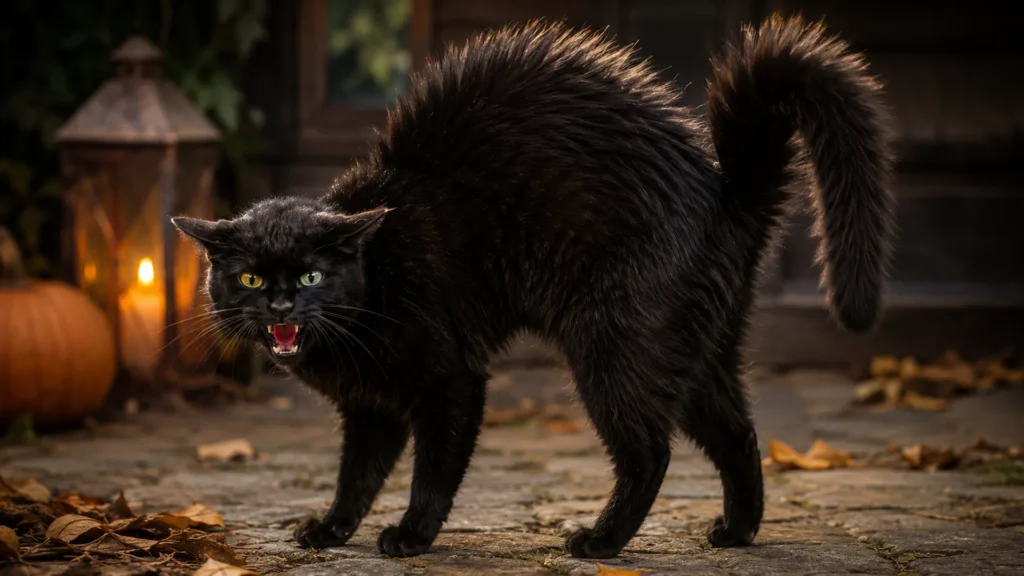
Puffed or bristled tail. This happens through piloerection: tiny muscles at the base of each hair fire, forcing the fur upright. The point is to look bigger and scarier to whatever the cat perceives as a threat. It shows up with fear, sudden fright, or a felt attack, and it almost always travels with other stress signals — arched back, flattened ears. Don’t approach a cat in this state like nothing’s wrong.
Low or tucked tail. A tail held low or pulled tight against the body usually means anxiety, submission, or discomfort. A cat unsure of a new space, or intimidated by another animal, will drop its tail this way. It’s also worth watching as a possible pain signal on its own — cats dealing with an injury or feeling off will often carry the tail lower than normal, even with nothing obviously stressful happening around them.
Slow swish versus fast lashing. Speed is the whole story here. A slow, deliberate side-to-side swish, especially paired with a crouched or still cat, usually means locked-in focus — a cat watching a bird outside, or lining up a pounce on a toy. It’s controlled and rhythmic, almost metronomic.
A fast, hard lashing or thumping tail is something else entirely: frustration, overstimulation, or anger. It often shows up right before a swat, a bite, or a cat disengaging from petting altogether. If you’re mid-cuddle and the tail starts whipping, that’s your signal to stop, not to keep going and see what happens.
Twitching tail tip. Just the tip moving while the rest of the tail stays still is the most context-dependent signal on this list. During play or hunting, it usually means the cat is locked onto a target and about to strike, a smaller cousin of the focused slow swish. Outside of play, a twitching tip can mean mild irritation, like a cat that’s been petted a little too long. What matters is what else is going on: a hunting crouch and a stiff, alert posture point to two very different moods.
Does Breed or Tail Size Change the Signal?
Not every tail moves, or even looks, the same way, and breed matters more than most guides admit. A Maine Coon’s tail is thick, long, and heavy with fur, so its movements read as slower and more deliberate even at the same emotional intensity as a smaller cat’s tail. A Siamese has a thin, short-haired tail that can look like it’s flicking rapidly during nothing more than mild irritation, simply because there’s less mass to move.
The practical fix: judge a cat’s tail against its own baseline, not a universal chart. Spend time watching how your specific cat’s tail behaves when it’s fully calm, and use that as your reference point. A “fast” flick on a Maine Coon might be an entirely ordinary speed for a Siamese.
Reading Tail Sequences: How Meaning Changes Over Time
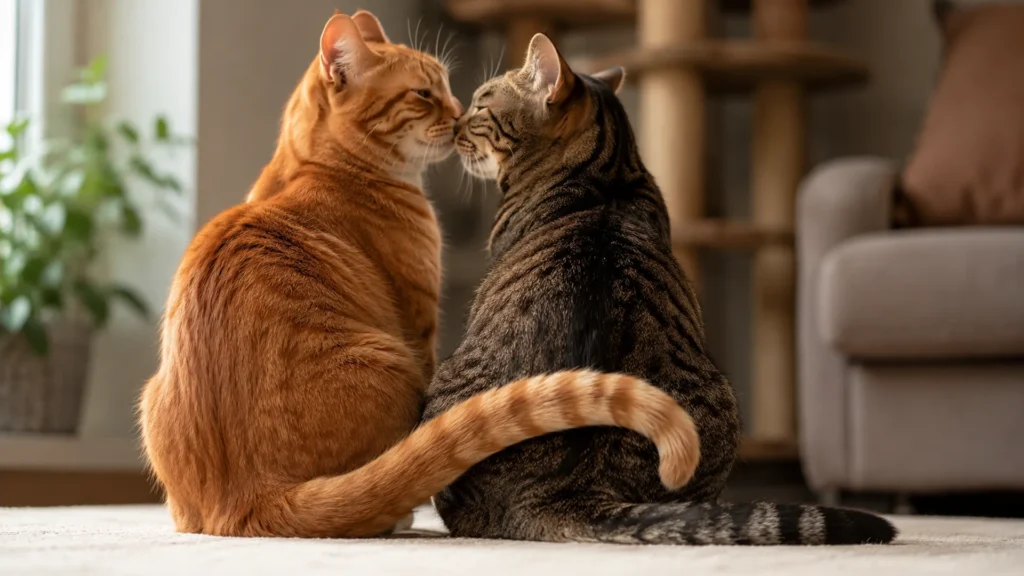
A single tail position is a snapshot. The real story is in how that position shifts over the next few seconds or minutes. Cats communicate in sequences, and the transition usually tells you more than any single frame does.
Two examples come up constantly:
- Question-mark tail, then a wrap around your leg, then a sudden puff. A cat approaches with a relaxed, curled tail, clearly greeting you. It wraps its tail around your leg and settles in. Then a loud noise startles it and the tail puffs instantly. Read that puff on its own and it looks like aggression toward you. Read the sequence and it’s obvious the fear is about the noise, not you.
- Slow swish, then crouch, then tip twitch, then pounce. This is the standard hunting sequence. The slow swish is building focus, the crouch loads the body for launch, and the tip twitch is the last wind-up before the strike. Catch a cat mid-twitch and it can look like irritation. Watch the full run and it’s obviously predatory excitement, nothing close to annoyance.
Treat tail language as a short story instead of a single still frame. That’s the difference between a decent guess and an actually accurate read.
Tail Plus Ears Plus Eyes: The Full Signal
Tail position alone can mislead you, especially in gray-zone cases like a twitching tip or a mid-height tail. Ear position and pupil size fill in the gaps, since cats move their ears independently and their pupils dilate with arousal, not just changing light. Cross-check all three and your read gets far more reliable.
| Tail | Ears | Eyes (Pupils) | Likely Meaning |
|---|---|---|---|
| Straight up, curled tip | Forward, relaxed | Normal, relaxed | Friendly greeting |
| Wrapped around leg/cat | Forward or neutral | Normal | Bonding, trust |
| Puffed/bristled | Flattened or pinned back | Dilated | Fear or defensive threat |
| Low or tucked | Flattened, sideways | Dilated or narrowed | Anxiety, submission, or pain |
| Slow swish, crouched | Forward, focused | Slightly dilated | Hunting focus |
| Fast lashing | Flattened or swiveling back | Dilated | Frustration or anger |
| Tip twitching, relaxed body | Forward | Normal | Mild interest or play focus |
When all three signals agree, trust the read. When they conflict, say a relaxed tail paired with pinned-back ears, that mismatch is worth a second look. It usually means the cat is mid-transition between emotional states, not settled into one.
When Tail Language Signals Pain or Illness
Most tail language is about mood. Every so often, though, it’s flagging something that actually needs attention, and it’s worth knowing the difference before it becomes an emergency.
Watch for:
- A limp or unusually low tail with no obvious fear trigger nearby
- Sudden flinching or avoidance when a spot near the tail base is touched, especially if the cat normally tolerates it
- Dragging the tail while walking instead of carrying it normally
- Twitching or spasming while resting, with no dream or nearby stimulus to explain it
A quick way to sort it out: if the behavior fits an obvious context (fear, excitement, focus) and clears up fast, it’s normal. If it’s unexplained, sticks around, or shows up alongside limping, appetite loss, or hiding, call the vet. Tail injuries, nerve damage, and infections all hide behind these exact signs, and catching them early is what keeps treatment simple instead of complicated.
If you’re unsure, don’t sit on it. A quick vet visit rules out anything serious and buys you peace of mind either way.
Frequently Asked Questions
Why do cats flick their tail while lying down?
Usually it means they’re alert or mildly stimulated even while otherwise relaxed, often reacting to a nearby sound or bit of movement.
Do cats wag their tails when happy?
Not really. Unlike dogs, a wagging or thrashing tail in cats usually signals irritation or overstimulation, not happiness.
Why does my cat’s tail puff up out of nowhere?
That’s almost always a fear or startle response. Puffing makes the cat look bigger to whatever it perceives as a threat.
Can a cat “talk” with just its tail, or do you need the whole body?
The tail helps a lot, but it’s most accurate read alongside ears, eyes, and overall body posture together, not in isolation.
Cat tail language comes down to sequences, not single moments. Cross-check tail movement against ears and eyes every time, and keep the pain red flags above in the back of your mind. Watching your own cat’s baseline over a few weeks will teach you more than any chart, this one included.