
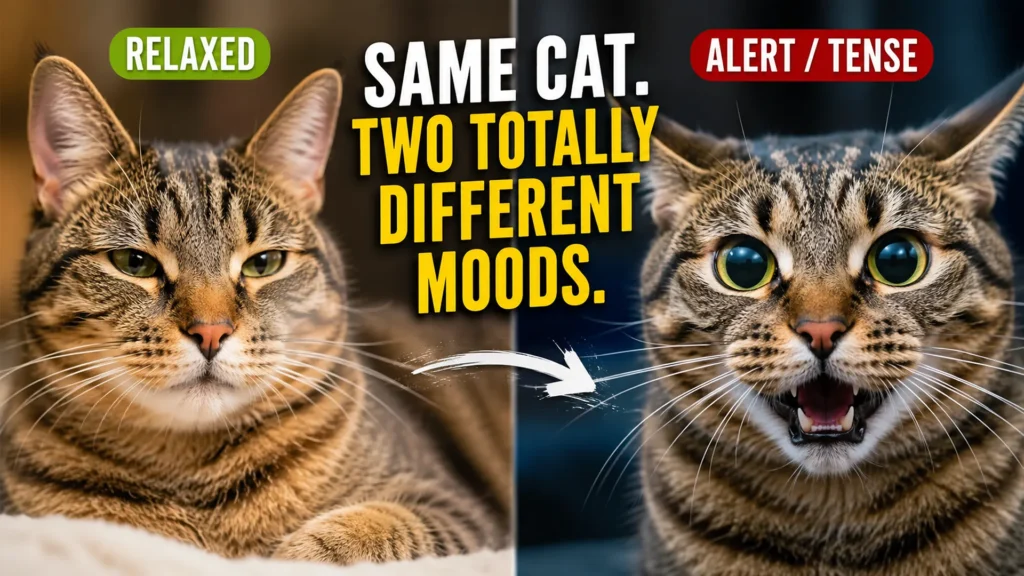
Your cat is talking to you right now, even if she’s just lying there. The slow blink, the flick of a tail, the way her ears swivel when you walk into the room — it’s all information. Most owners just don’t know how to read it yet.
Most guides don’t help much. They’ll tell you “a swishing tail means your cat is angry” and leave it at that. But cats rarely send a single signal — they send combinations. A swishing tail paired with relaxed whiskers means something very different from the same tail paired with flattened ears. This guide will help you put those pieces together: spotting warning signs before they turn into a scratch or bite, telling mood apart from illness, and learning how to “talk” back in a way your cat understands.
The Core Signals: Ears, Eyes, Tail, Whiskers, and Posture
Before you can read a cat’s mood, it helps to know the individual signals she’s working with.
Ears. A cat’s ears move constantly, and their position tracks her mood almost in real time. Forward-pointing ears usually mean she’s alert, curious, or engaged. Ears turned sideways or slightly back can signal irritation or unease. Ears pinned flat against the head are a clear warning — fear or aggression.
Eyes and pupils. Dilated pupils can mean excitement, fear, or overstimulation, while narrow, slit-like pupils often show a relaxed, focused cat. A slow blink is one of the friendliest signals a cat can give — sometimes called a “cat kiss” — and shows trust. Wide, unblinking eyes usually mean she’s on alert.
Tail. Think of the tail as a mood meter. Held high, it signals confidence; low or tucked, it points to fear or submission. A gentle curve at the tip usually means contentment. The key distinction is speed: a slow, relaxed swish reads as casual interest, while a quick, sharp flick usually means irritation is building.
Whiskers. Pushed forward, whiskers signal curiosity or focus. Pinned back flat against the face, they signal stress, fear, or discomfort.
Posture and fur. A loose, relaxed body suggests your cat feels safe; a tense, stiff one signals stress or alertness to a possible threat. Piloerection — fur standing up along the back and tail — is a classic fear or aggression response that makes her look bigger. A crouched, lowered body can mean she’s scared, defensive, or winding up to pounce during play.
Reading Combined Signals, Not Just One at a Time
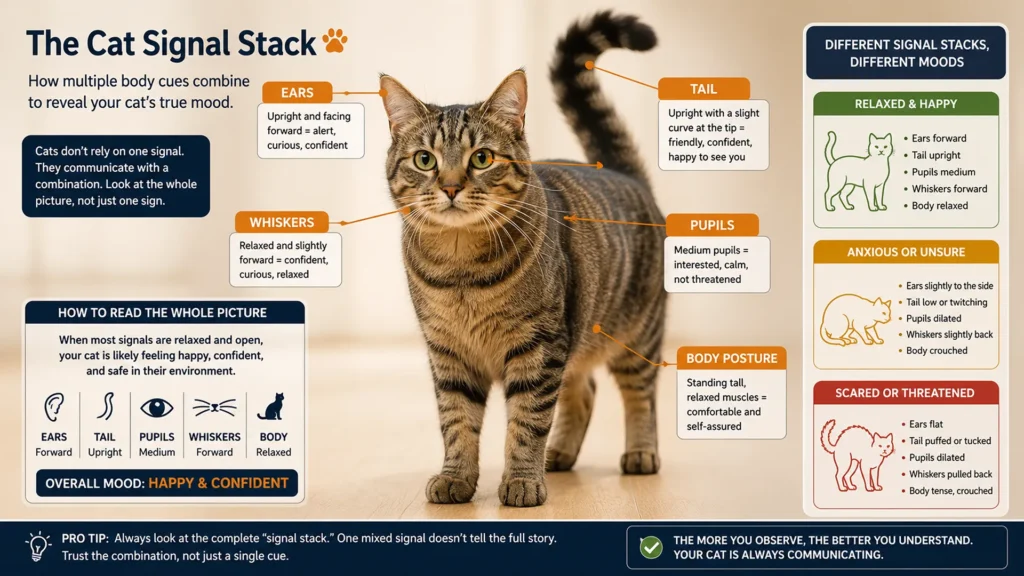
This is where most cat body language advice falls short: it teaches you to read one signal in isolation, as if a twitching tail always means the same thing. On its own, a twitching tail could mean irritation, excitement, or simple focus. It’s only alongside the ears, the posture, and the eyes that the message becomes clear.
Think of it as reading a sentence rather than a single word. One cue is a clue; two or three together are a conversation. Once you start reading the whole stack, your cat’s behavior stops feeling random. Here’s what that looks like in practice.
Relaxed and content. A loose, soft body with no tension in the shoulders or spine. Ears sit neutral and forward, not pinned back or overly alert. If she makes eye contact and slowly closes her eyes, that’s a trust signal. Loose body, relaxed ears, slow blink together mean a cat who feels safe.
Playful and excited. A crouch with the hindquarters slightly raised — the “play bow” — paired with a tail whose tip flicks or twitches rather than the whole tail lashing back and forth. Ears point forward, tracking movement. This combination usually means she’s winding up to pounce, not preparing to fight — an invitation to play, not a warning.
Anxious or uncertain. A body lowered close to the ground, as if trying to take up less space. Ears turn sideways or flatten slightly, and the tail tucks in close rather than hanging loose. Pupils often dilate even in normal lighting. Dilated pupils alone could just mean low light, but paired with a lowered body and tucked tail, they’re a clearer sign she feels unsure and could use some space.
Angry or defensive. This is the combination most people already recognize, but it’s worth spelling out: an arched back, puffed-up fur to look bigger, ears flattened tightly against the head, often with hissing as a clear warning. Together, these mean your cat feels threatened and is telling you — loudly — to back off. This isn’t the moment to reach in for comfort; it’s the moment to give her room to calm down.
Overstimulated (“pet me… now stop”). This is the combination that confuses a lot of owners. Your cat seems happy to be petted, then suddenly nips or swats without warning — except it usually isn’t sudden. Watch for skin twitching along the back, a tail that starts thumping against the floor or furniture, and ears swiveling back and forth instead of staying relaxed.
Individually these look minor. Together, they mean she’s had enough stimulation and is asking you to stop, right before her teeth make the point clearer. Recognizing this combination early is one of the simplest ways to avoid an unexpected bite, which is exactly what the next section covers.
The Warning Ladder: How Annoyance Escalates Into a Bite
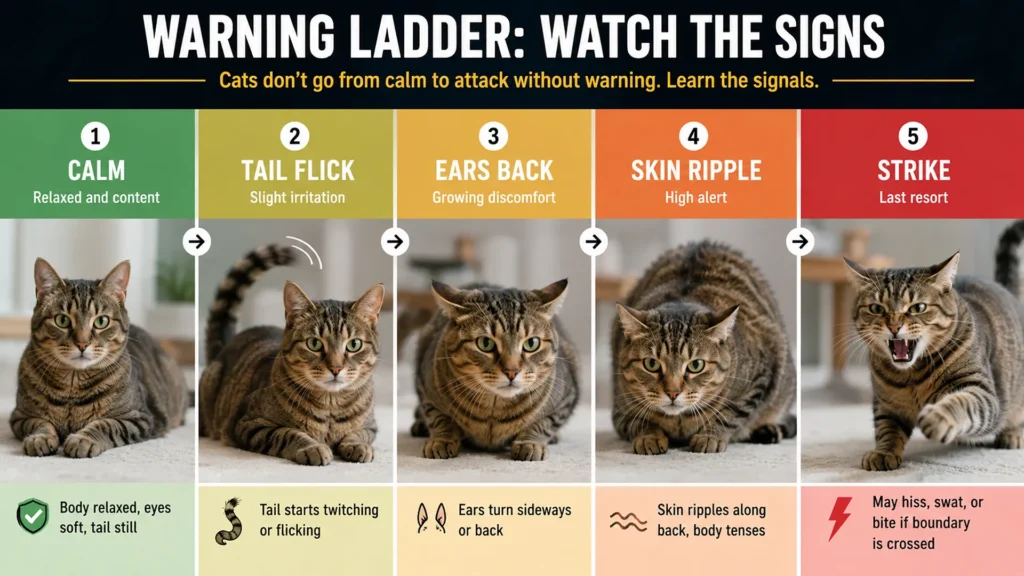
Most cat bites don’t come out of nowhere. They come at the end of a chain of small signals that built up while we weren’t paying attention. Picture it as a ladder — each rung is your cat saying “I’m getting less okay with this,” and by the top, a bite or scratch is the only tool she has left.
- Mild tension. The easiest stage to miss. Her body gets slightly stiff, purring might stop, or she goes quiet and still instead of loose and relaxed. Nothing dramatic — just a shift from melting into your lap to holding herself a bit more carefully.
- Tail flicking. Not the slow, content sway of a relaxed cat, but quick flicks or thumps at the tip. This is one of the clearest early warnings, and it’s often ignored because people assume any moving tail means a happy cat.
- Ears rotate back. As irritation builds, the ears swivel sideways or flatten slightly, like tiny satellite dishes tracking discomfort. Whatever you’re doing needs to stop soon.
- Skin ripples or twitches. The skin along her back or near the base of the tail ripples or twitches, almost like a shiver. Her nervous system is on high alert and she’s close to her limit.
- The strike. The bite or scratch. This usually isn’t aggression in the way people assume — it’s communication. She’s run out of quieter ways to ask for space, so her body takes over.
The best time to stop is at tail flicking or ear rotation — don’t wait for skin twitching. If you’re petting her and notice either sign, simply pause and let your hand rest still, or stop touching her entirely. Give her a moment to settle or walk away. Over time you’ll learn her personal threshold; some cats tolerate a lot before stage two, others reach it in seconds. Respecting these early signals builds trust, since she learns you’ll listen before things escalate.
It’s a Two-Way Conversation
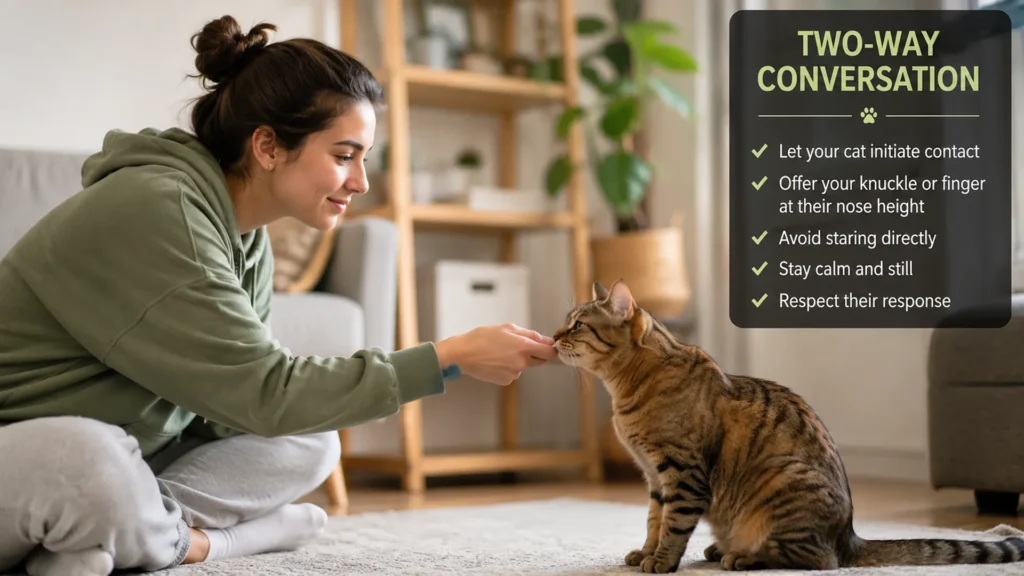
So far this has been about reading your cat’s signals. But she’s reading you too. Communication isn’t a one-way street where you decode her signals and go about your day — it’s a back-and-forth exchange, and how you move, look, and position yourself sends a message every time. Think of yourself as a participant in the conversation, not just an observer.
What staring, looming, and fast movement signal. To a cat, direct eye contact isn’t neutral — a hard stare can read as a challenge, especially from someone unfamiliar. That’s part of why cats often gravitate toward the one person in the room who’s ignoring them; that person isn’t looming, so they feel safer to approach.
Standing over a cat, leaning in quickly, or reaching straight for the top of her head can feel intimidating, since it mimics how a predator approaches. Fast, sudden movements read the same way. If you want a cat to feel at ease, approach at her level, move slowly, and let her come to you.
How to “speak back.” A slow blink is one of the simplest ways to talk to a cat in her own language: look at her, close your eyes slowly, and open them again. Many cats blink back, and it’s often described as a small gesture of trust and goodwill. You can also offer a finger or hand at nose height instead of reaching over her head, letting her sniff and decide whether to lean in. Turning your body sideways rather than facing her head-on softens your presence too, since a direct, front-on posture can feel more confrontational than an angled one.
Building trust over time. None of these gestures work like a switch — trust builds gradually, through repeated, low-pressure interactions. A cat who slow-blinks at you once isn’t bonded for life, and one loomed-over moment won’t ruin things either. What matters is the pattern over time: the more consistently you communicate in ways that feel safe and predictable, the more relaxed and confident she’ll become around you.
Every Cat Is Different: Breed and Individual Variation
Everything above applies to cats generally, but body language isn’t one-size-fits-all. Some breeds have physical traits that change how clearly they can “speak” through posture and expression, and every cat has quirks of her own.
Flat-faced breeds. Persians and exotic shorthairs have a harder time using facial expressions the way other cats do — their shortened muzzles and less mobile facial structure make subtle cues like squinting or mouth tension harder to spot. This doesn’t mean these cats feel or communicate less; their signals are just quieter. Rely more on body posture, tail position, and ear movement, which stay expressive even when the face gives less away.
Tailless and bobtail breeds. Tail position is one of the biggest mood indicators in most cats, but breeds like the Manx don’t have that tool. They compensate with ear position, body posture, vocalizations, and even how they carry their hindquarters. A Manx might puff up its back fur or arch its body to signal alarm — doing with its whole body what other cats would do with a flick of the tail.
Learning your own cat’s normal. Beyond breed, every cat has her own baseline. Some are naturally more vocal, more twitchy-tailed, or more prone to slow blinking than others. Spend time observing her when she’s calm — how she typically holds her ears, where her tail sits at rest, how her body looks when nothing is wrong.
Once you know that baseline, it’s much easier to spot a shift. A usually laid-back cat suddenly crouching or flattening her ears is telling you something different than a cat who’s always a little jumpy, and knowing the difference is one of the most reliable ways to catch changes in mood, comfort, or health early.
When Body Language Means Illness, Not Emotion
Not every hunch, squint, or tucked tail is about mood. Sometimes it’s about pain. Cats are experts at hiding when they don’t feel well — an instinct left over from wild ancestors who couldn’t afford to look weak in front of predators. That means the same postures you’d read as grumpy or anxious can actually be your cat coping with discomfort.
A hunched back, squinted eyes, and a low or tucked tail are classic mood signals, but they’re also common signs of pain. The difference is usually in the pattern: mood-related body language shifts quickly and makes sense in context — she relaxes once the vacuum is put away. Pain-related body language tends to stick around, shows up randomly, or comes paired with other changes, such as:
- Appetite changes — eating less, or suddenly more
- Hiding more than usual, especially in a normally social cat
- Changes in vocalization — more meowing and yowling, or unusual silence
- Lethargy or a drop in normal activity and play
If you notice any of these alongside unfamiliar body language, don’t chalk it up to a personality shift — it’s worth a call to your vet. Cats can’t tell you when something hurts, so their body is often the only signal you get.
Quick-Reference Cheat Sheet
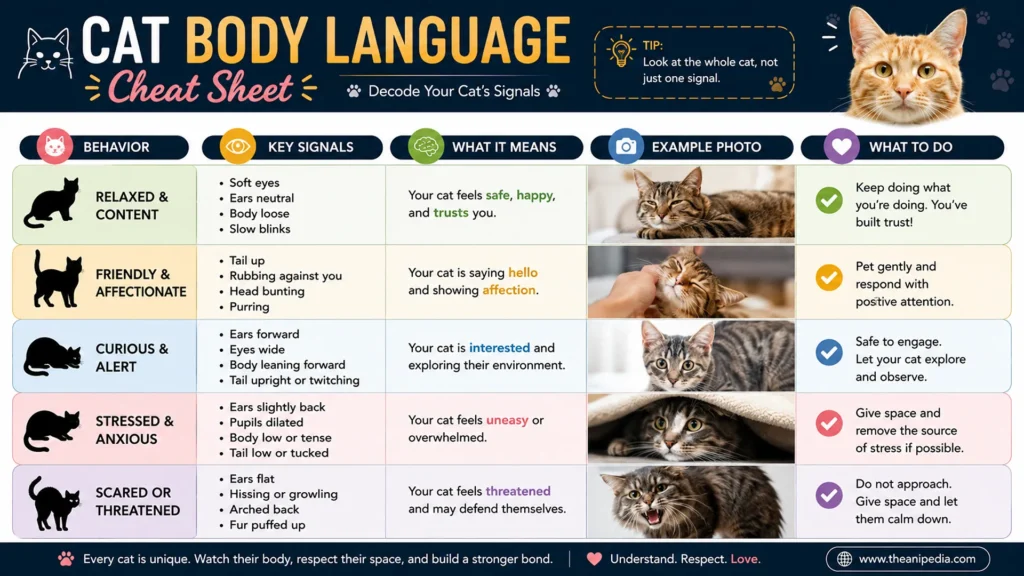
| Behavior | Signals | Likely Meaning |
|---|---|---|
| Slow blink | Half-closed eyes, relaxed face | Trust and affection |
| Tail straight up, tip curled | Relaxed body, forward ears | Happy, confident greeting |
| Puffed tail, arched back | Sideways stance, hissing | Fear or feeling threatened |
| Flattened ears, tucked body | Wide eyes, low posture | Anxious or scared |
| Tail flicking or thumping | Tense body, dilated pupils | Overstimulated, needs space |
| Belly exposed, relaxed limbs | Slow blinking, purring | Comfortable and trusting |
| Crouched, tail low and still | Focused stare, twitching rear | Hunting or play mode |
When in doubt, look at the whole body, not just one signal — context always tells the fuller story.
Final Thoughts
You don’t learn to read cat body language from a list — you learn it from your cat. The tail flick that means “I’m done” on Tuesday might look slightly different from the one on Friday, and the only way to know for sure is to keep watching, keep noticing, keep connecting what you see to what happens next.
So don’t try to memorize every signal at once. Just start today. Watch the ears, the tail, the eyes, the whole body together — and over time, you’ll find you’re not translating anymore. You’ll just understand.