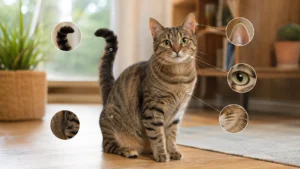
Cats bring their owners toys mostly because of hunting instinct: to your cat, that toy mouse is prey, and carrying it to you is how the hunt ends. A lot of cats also want you to play, and the habit usually gets stronger every time you respond to it.
So if you’ve been wondering why your cat brings you toys, the short answer is instinct plus a bit of training you didn’t know you were doing. The more useful answer depends on your cat. What they do right after the drop tells you most of what you need to know, and that’s what this guide focuses on.
Why Cats Bring You Toys: Reasons Ranked by Evidence
Plenty of articles on this topic present guesses as facts. I’d rather be upfront about which explanations have real support behind them. Each reason below is labeled Well supported, Plausible, or Popular theory.
The toy is “prey,” and carrying it is part of the hunt (Well supported)
Domestication didn’t take the hunter out of the cat. A hunt runs in a set order: stalk, chase, pounce, “kill,” then carry the catch off. Indoor cats go through that same sequence with toys.
Research on cat play backs this up. Hungry cats play harder, and cats get bored of a toy fast but perk up when it’s swapped for a new one. That’s how a predator treats prey. Often, bringing the toy to you is simply the last step.
They want you to play (Well supported)
A cat that drops a toy, stares at you, and waits isn’t being subtle. They’ve learned that toys plus people means a game. You’ll see this most after you’ve been out all day and the house has been quiet.
You’ve taught them it works (Well supported)
This part is on us. Pet the cat, say something, toss the toy, and you’ve rewarded the drop. Cats pick up on that quickly, which is why a once-a-week habit can turn into five times a day.
It’s their active time (Well supported)
Cats are crepuscular. They’re wired to be most active around dawn and dusk, so toy deliveries tend to bunch up early in the morning and in the evening. Sometimes in the middle of the night, too.
They’re moving “prey” to a safe spot (Plausible)
Some cats aren’t bringing the toy to you at all. They’re bringing it somewhere that feels secure, like your bed, your shoes, or their food or water bowl. Stashing a catch in safe territory fits what we know about hunting cats. Nobody has tested it with toys, though.
Why cats carry toys and meow loudly (Plausible)
You’ll know this one if you’ve heard it. The cat walks around with a toy in their mouth making a long, loud yowl that sounds nothing like their usual meow. Behaviorists often call it a “prey call,” the same sound some cats make carrying real prey. Others read it as maternal behavior, like calling kittens. The pattern is well known. The reason isn’t settled.
Affection and sharing (Popular theory)
“It’s a gift of love” is the explanation you’ll see most, and it’s the least tested. Here’s my take: I wouldn’t call it a gift in the human sense, but I wouldn’t dismiss it either. Cats don’t settle into play and prey routines around people they’re wary of. If your cat is doing this near you, they’re comfortable with you, and that counts for something.
“Teaching you to hunt” (Popular theory)
Mother cats bring prey home to teach their kittens. The leap from there to “your cat thinks you’re a hopeless hunter” makes a fun story, but there’s no direct evidence for it.
Which Reason Is It? Read Your Cat’s Clues
Watch what happens after the drop. Give it a few days and a pattern usually shows up.
| What your cat does | Likely reason | What to do |
|---|---|---|
| Stares, waits, or nudges the toy toward you | Wants to play | Play for 5–10 minutes if you can |
| Drops it and walks away | Storing or sharing “prey” | Nothing, leave it be |
| Loud, drawn-out meow while carrying | Prey call or maternal-style carrying | Respond calmly, play if it’s daytime |
| Mostly at dawn, dusk, or night | Natural active hours | Move play to the evening (see below) |
| Gets more frequent every time you react | Learned attention-seeking | Reward only at times you choose |
| Sudden change, obsessive, or paired with other changes | Possible stress or health issue | See the red flags section |
Plenty of cats mix reasons. The same cat might stash a toy on your bed in the afternoon and use it as an alarm clock at 5 a.m. That’s normal.
What We Saw: One Week Logging [Cat’s Name]
[Placeholder: fill with real observations only.]
Introduce the cat: name, age, indoor or outdoor, single or multi-cat home.
Add the log table: day, time, toy, where it was dropped, what the cat did next.
Add 2–3 honest takeaways from your own notes (e.g., which times were busiest, which toys got carried and which never did).
Add original photos and, if possible, a short video clip.
(Target about 180 words once filled in.)
How to Respond When Your Cat Brings You a Toy
In the daytime, keep it simple. A calm word and a pet is plenty. If you’ve got a few minutes, pick up the toy and play.
End the game by letting your cat catch the toy, then give a treat or a meal. That closes out the hunt and helps them settle down.
Don’t scold a cat for bringing you toys. They won’t connect the telling-off to the toy, and it can chip away at their trust. Swapping toys every few days also helps keep the “prey” worth chasing.
How to Stop 3 a.m. Toy Drops (Without Discouraging the Bond)
You don’t have to choose between the cute daytime version and a full night’s sleep. It comes down to routine, and sticking with it.
Step-by-step plan
- Play hard before bed. One to two hours before you turn in, do 10–15 minutes with a wand toy. Let your cat stalk, chase, and pounce.
- Finish with a catch and a meal. Let them grab the toy at the end, then serve the evening meal. Hunt, eat, rest is the natural order for a cat.
- Put the wand toys away. These are usually the most exciting ones, so keep them out of reach between sessions. Leave out a few small, quiet toys.
- Ignore night drops completely. No talking, no petting, no single throw. Any reaction teaches your cat that 3 a.m. gets results.
- Give it one to two weeks. Things often get worse before they get better. That’s called an extinction burst, and it means the old habit is on its way out.
What not to do
If your cat normally sleeps in the bedroom, don’t suddenly lock them out. You’ll likely just trade toy drops for yowling at the door. Skip punishment, and don’t give in “just this once,” because that puts you back at the start.
The Toy Audit: Why Your Cat Carries Some Toys and Ignores Others
Look at the toys that actually get carried around your house. They probably share a few traits:
- Small and light: mouse-sized toys are easy to pick up
- Prey-like texture: fur, feathers, or soft fabric
- Interesting sounds: crinkly toys tend to win
- Scent: catnip or silvervine can make a toy extra appealing to cats that respond to them
Novelty matters as much as design. Cats tire of the same toy quickly, so a small set on rotation works better than a basket of everything left out all the time.
Quick safety check
Toys that get carried get chewed. Bin anything with loose string, dangling feathers, torn stuffing, or small parts that could come off. Swallowed string is a real danger and can cause serious intestinal problems. Our [cat toy buying guide] has safer options.
When Is Toy-Bringing a Red Flag?
Most of the time, this behavior is completely normal. Check in with your vet or a qualified behaviorist if you notice:
- A sudden start of constant carrying or yowling, especially in an older cat
- Toy behavior alongside other changes, like eating less, hiding, overgrooming, or litter box problems
- Loud nighttime vocalizing in a senior cat, which can be linked to thyroid problems, high blood pressure, or age-related cognitive changes
If stress seems to be behind it, our guides on [cat anxiety], [cat separation anxiety], and [cat excessive grooming] can help you spot the signs.
What About Dead Animals?
Outdoor cats sometimes swap the toy mouse for a real one, or a bird. The instinct is the same, but the problems are different: hygiene, parasites, and harm to local wildlife. We cover all of that in [our guide to cats bringing dead animals].
FAQs
Is my cat bringing me toys a sign of love?
Not quite in the human sense, but it’s a good sign. Cats only relax into play and hunting routines around people they feel safe with.
Why does my cat bring me toys but not play with me?
They may just be stashing their “prey” near you, or waiting for you to start the game. Move the toy like prey and see what happens.
Why does my cat put toys in the water bowl?
Nobody knows for sure. One common idea is that the bowl feels like a safe place to stash prey, but it hasn’t been studied.
Do male or female cats bring toys more often?
There’s no solid research showing a difference. Personality, age, and play habits matter more.
Should I throw the toy back when my cat brings it?
During the day, go ahead if you want to play. At night, don’t. It teaches your cat that late-night drops pay off.
Conclusion
A cat that brings you toys is doing something normal, and usually something that means they’re at ease with you. If you want to know which reason applies to your cat, watch the next ten seconds after the drop. For more ways cats show they’re comfortable around you, read about the [cat slow blink] and [cat headbutting].