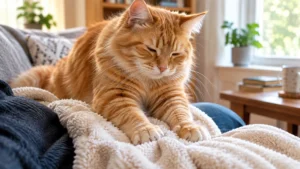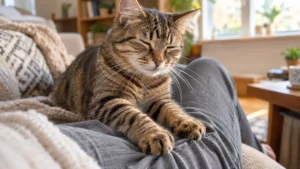
A wagging tail means a happy pet. That’s the rule most of us grew up with, and it’s just wrong for cats. Dogs, sure. Cats are basically the opposite. Ever reach out to pet a cat while its tail’s swishing and get swatted for the trouble? That’s why. Cat tail body language runs on different logic than dog tail language, and a moving tail almost never means “come say hi.”
Here’s the thing about a cat’s tail — it rarely talks by itself. It’s one piece of a sentence that also includes the ears, the eyes, and how the rest of the body is holding itself. Miss those other pieces and you’ve only got half the story. So below is a quick chart for reading the common tail positions, a section on what to do when the tail and ears seem to be arguing with each other, and a rundown of when a tail change is actually about pain, not mood.
Cat Tail Body Language 101: Does a Wagging Tail Mean a Happy Cat?
No. Get this one out of the way early because it shapes how you read everything else.
A cat’s tail moving usually means arousal, conflict, or intense focus — not joy. Pretty much the reverse of what a wagging tail means on a dog.
| Wagging/Moving Tail | Dog | Cat |
|---|---|---|
| Typical meaning | Friendly greeting, general excitement | Irritation, overstimulation, or locked-in focus (like hunting) |
New cat owners coming over from a dog household fall for this constantly. Tail’s moving, brain says happy, hand goes in for a pet — right when the cat was actually warning you off. I made this exact mistake with a foster cat years back. Got a scratch across the wrist for it and learned to check the whole animal, not just the tail, before reaching out.
So don’t judge a cat by tail motion alone. Position, movement, and what’s going on around the cat all matter together — that’s basically what the rest of this guide is about.
The Visual Tail Position Chart (Quick Decoder)
Three things to watch: shape, height, motion. This chart pairs each common tail position with what it probably means and what to actually do about it, because knowing the definition doesn’t help much in the moment when you’re staring at your cat trying to figure out cat tail body language on the fly.
(Diagram: side-by-side illustration of the eight tail positions below)
| See This | It Likely Means | Do This |
|---|---|---|
| Tail straight up, slight curve at the tip | Confident, friendly greeting | Say hi back — a slow blink or gentle pet is welcome |
| Puffed up, “bottle brush” tail | Fear or a defensive threat display | Give space immediately; don’t approach or loom over them |
| Low or tucked tail | Anxious, submissive, or possibly unwell | Approach calmly and quietly; watch for other symptoms if it persists |
| Tail wrapped around body or paws | Content, self-soothing, settling in | No action needed — this is a relaxed cat |
| Slow swish, side to side | Focused, hunting mode, or mildly annoyed | Check the context — fine during play, ease off if it’s during petting |
| Fast thrashing or lashing | Agitated, overstimulated | Back off and give them room to calm down |
| Twitching just at the tip | Mild irritation or alert focus | Pay attention to what triggered it before it escalates |
| Question-mark curve | Playful invitation | Good time to start a game with a toy |
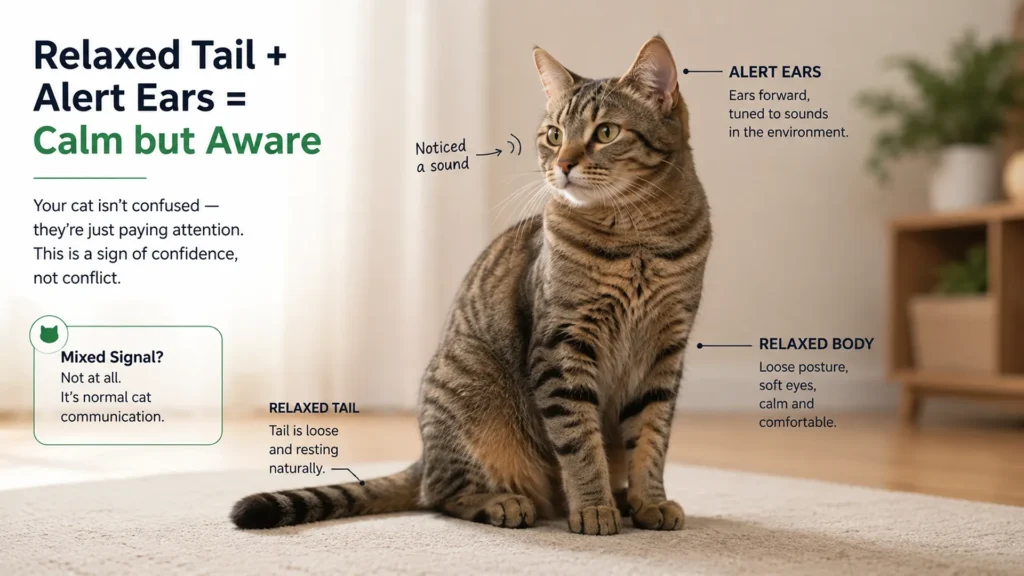
The Combo Decoder: What Tail, Ears, and Eyes Really Mean Together
Most articles on this topic give you a flat list. Tail up = this. Tail down = that. Except cats don’t send one signal at a time. They stack them, and a tail on its own only gets you partway there. Honestly, this is where cat tail body language gets more interesting than a chart can capture.
Rough way to think about it: tail sets the mood, ears tell you how strong that mood is, eyes confirm the temperature. Put the three together and you’re not guessing anymore.
Some combos worth knowing:
- Slow swish + forward ears + soft, half-closed eyes — relaxed focus, not annoyance. Just watching something with interest.
- Slow swish + flattened ears + dilated pupils — irritation is building. Step back before it turns into more.
- Tail up with a curved tip + ears forward + soft eyes — a genuine, confident greeting.
- Tail low or tucked + ears back + dilated pupils — fear or stress. Give this cat room, don’t corner them.
- Puffed tail + pinned ears + a fixed stare — a defensive threat display. Don’t approach.
- Relaxed, wrapped tail + one ear swiveled back + drowsy eyes — content, but still half-listening to the room. Probably the combo that confuses people the most.
That last one’s worth sitting with, because it throws a lot of owners off: a relaxed tail with an alert ear isn’t a mixed signal. Your cat’s just calm but still tuned in — aware, not anxious. Start reading tail, ears, and eyes together instead of as three separate clues, and a lot of those “wait, what does that even mean” moments stop being confusing.
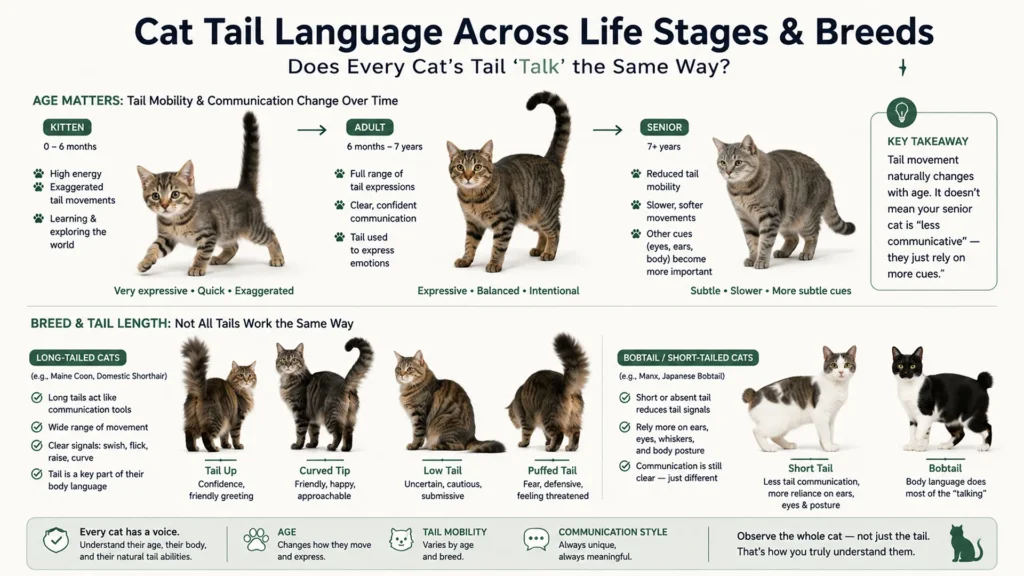
Does Every Cat’s Tail “Talk” the Same Way?
Not quite. Age matters a lot here. Kittens move their tails in big, clumsy ways because they’re still learning coordination and working out how to communicate at all. Adult cats give the clearest, steadiest signals. Older cats often lose some tail mobility to arthritis or just slowing down with age, and that’s easy to misread as a mood or personality shift when it’s really just a stiff joint.
Breed and individual quirks play into it too. Bobtail breeds — Manx, American Bobtail, Japanese Bobtail — plus any cat with a short or kinked tail naturally, lean harder on ears, posture, and vocal cues, since there’s only so much a short tail can express. And some cats are just more tail-expressive than others, breed aside. I’ve had cats whose entire mood you could read off the tail alone, and others whose tail barely twitched even when they were clearly irritated.
There’s no single rulebook that covers every cat’s tail. Learn what your own cat’s resting tail looks like on a normal day. That baseline is what lets you actually notice when something’s changed.
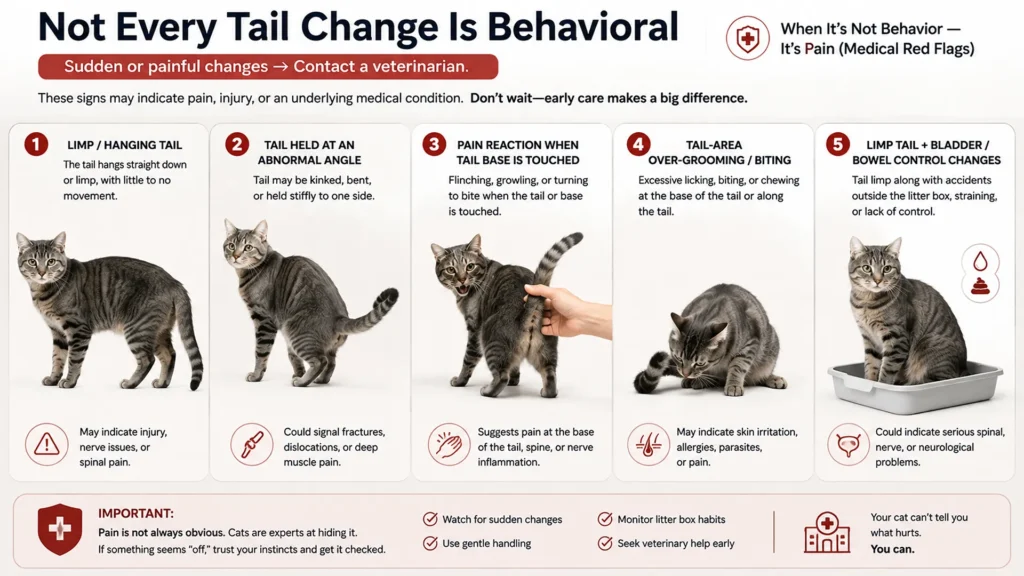
When It’s Not Behavior — It’s Pain
Not every tail change is about mood. Sometimes it’s physical, and confusing the two matters — a real injury can get misread as a behavior quirk if you’re not paying attention.
Watch for:
- A limp or hanging tail with no movement — could be a tail pull injury or nerve damage, sometimes called “limber tail.”
- Flinching, hissing, or sudden aggression when the tail or its base gets touched — usually pain, not attitude.
- The tail sitting at an odd angle after a fall, a step-on, or getting caught in a door — trauma like that can leave lasting damage if it’s ignored.
- Sudden loss of bladder or bowel control along with a limp tail — this combo can mean nerve injury and counts as urgent.
- Ongoing tail-chasing, biting, or over-grooming near the tail base — often points to pain, irritation, or a skin issue rather than play.
Any of these showing up, especially suddenly, means a same-day vet visit. Don’t sit there trying to interpret it as behavior. Let a vet rule out injury or illness first.
FAQ
Why does my cat thump its tail while lying down?
Usually just a mild reaction to something noticed — a sound, some movement nearby — while otherwise relaxed. Not typically a distress signal.
Why does my cat’s tail puff up for no reason?
There’s basically always a reason, even if it’s not obvious to you. A puffed tail means a fear or startle response, trigger visible or not.
What does it mean when a cat wraps its tail around you?
Affection. Cats do this with each other too, so wrapping their tail around you means you’re in the trusted-companion category.
Why does my cat’s tail twitch when I pet them?
Overstimulation warning. Keep petting past that point and you’re probably getting a swat or a nip next.
Can cats control their tail movements?
For the most part, yes — tail position is largely voluntary. But some of those quick tip flicks are closer to a reflex tied to nervous system arousal than a deliberate choice.
Reading the Whole Cat, Not Just the Tail
Cat tail body language works best as one piece of a bigger picture. Alone, a tail only tells you so much. Combined with ears, eyes, and body posture, it becomes something you can actually rely on.
Spend enough time with your own cat and you’ll pick up their baseline fast, and notice the moment something’s off. Keep this combo decoder in mind next time a signal feels unclear — and if pain seems even remotely possible, don’t wait around trying to figure it out. Just call the vet.