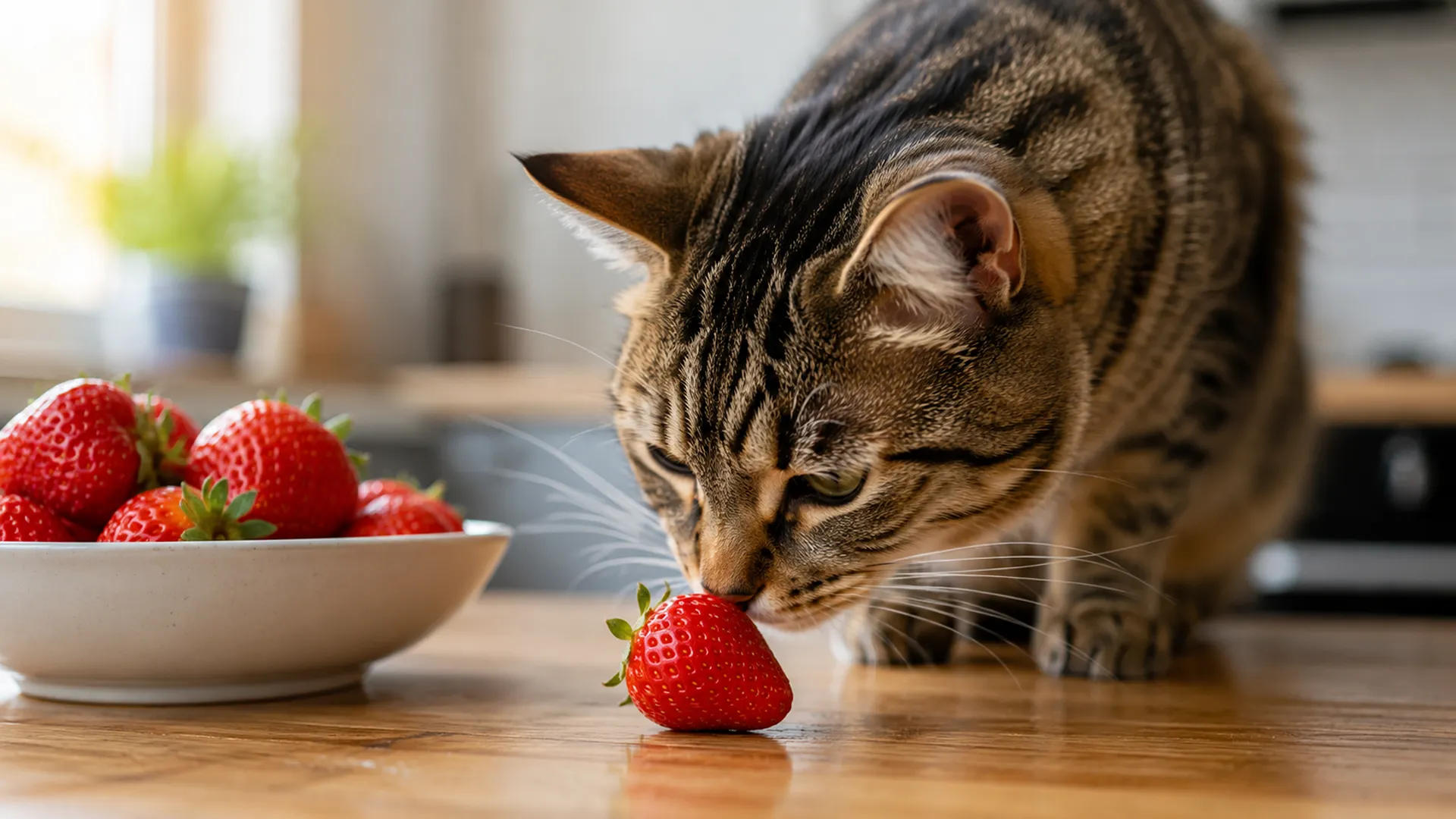
Yes, cats can eat strawberries in small amounts, and it won’t hurt them. But don’t expect any real payoff nutrition-wise. Strawberries are basically a novelty snack for a cat, not a treat with any upside. And here’s the part most owners don’t realize: your cat can’t even taste the sweetness that makes strawberries appealing to you in the first place.
Why Is My Cat Even Interested in a Strawberry?

If your cat keeps nosing around your strawberry bowl, it’s not because they’re after something sweet. Cats physically can’t taste sugar. Researchers looked at the feline TAS1R2 gene and found cats carry a broken version of it — they’re missing the receptor mammals normally use to detect sweetness.
So what’s the draw? Smell, texture, juiciness. Cats respond to the scent of the fruit, how the flesh feels against their tongue, and sometimes just the novelty of something new sitting on your plate. A lot of cats will bat a strawberry around like a toy before they ever take a bite of it.
That matters more than it sounds like it should. If your cat isn’t chasing a sugar rush, there’s no biological drive behind the behavior. It’s curiosity. Keep that in mind when you’re deciding how much, if any, to hand over.
Is It Safe? The Short Answer
Strawberries aren’t toxic to cats. An occasional nibble isn’t a vet-visit situation. But your cat’s body doesn’t need them. Cats are obligate carnivores — their whole diet is built around animal protein, and they have zero biological requirement for fruits, vegetables, or plant nutrients the way we do. A complete, balanced cat food already covers everything. Strawberries are safe in the “won’t poison your cat” sense. They’re not a health boost, and I’d stop anyone from pretending otherwise.
Nutritional Benefits vs. Risks
Potential Benefits
Strawberries do have vitamin C, folate, potassium, and antioxidants. Sounds decent on paper. Except cats make their own vitamin C internally, so they’re not relying on food for it the way we are. Any complete commercial cat food already hits their vitamin and mineral targets. These nutrients won’t hurt your cat, but don’t treat strawberries as a supplement — the amount a cat would realistically eat is too small to move the needle. Same story with hydration and fiber. A bite or two adds a trace amount and nothing more.
Real Risks
- Sugar and carbs. Cats aren’t built to process much of either, and their digestive systems handle carbohydrates far worse than ours do.
- Choking hazard. The green stem and leafy cap aren’t food. They’re a real choking risk, especially for smaller cats.
- GI upset. Cats with sensitive stomachs can get vomiting or diarrhea from fruit, even in tiny amounts.
How Many Strawberries Can a Cat Have?
Vets use the 10% rule for treats across the board, strawberries included: treats should never make up more than 10% of daily calories, with the rest coming from a nutritionally complete diet. For most cats, that means one small piece, and only now and then — not something you’re doing daily.
Here’s a rough breakdown by weight:
| Cat’s Weight | Recommended Amount | Frequency |
|---|---|---|
| Under 8 lbs | 1 small piece (pea-sized) | Once a week, at most |
| 8–12 lbs | 1–2 small pieces | Once or twice a week |
| 12+ lbs | 2 small pieces | Up to twice a week |
Can All Cats Eat Strawberries? Health Condition Breakdown
Kittens
Skip strawberries until kittens are fully weaned and settled onto solid food. Their digestive systems are still developing and don’t do well with anything outside their normal diet. Introducing fruit too early just raises the odds of an upset stomach for no real benefit.
Senior Cats
Older cats often struggle more with sugar, and they’re more likely to already be dealing with kidney issues or dental problems. A bite of strawberry seems harmless, but between the sugar and the extra chewing involved, it’s usually safer to skip it or keep the portion much smaller than what you’d give a younger, healthy cat.
Diabetic Cats
This is the one group I’d say to avoid strawberries entirely. Even a small amount of natural sugar can throw off blood glucose and complicate insulin regulation. Not worth it for a treat with zero nutritional upside.
Cats With Kidney Disease (CKD)
Strawberries contain potassium, and cats with chronic kidney disease usually have their potassium levels tightly managed as part of treatment. Too much can throw that off. If your cat has CKD, check with your vet first — the right amount, if any, depends on where their bloodwork currently stands.
Cats With IBD or Sensitive Stomachs
For cats with inflammatory bowel disease or generally touchy digestion, the fiber-and-sugar combo in strawberries is a common flare-up trigger. Vomiting, diarrhea, general GI discomfort — all possible. If this is your cat, avoid strawberries altogether, or offer only a trace amount and watch closely.
How to Prepare Strawberries for Your Cat
Wash the strawberry well to rinse off pesticide residue and dirt. Cut away the green stem, leaves, and hull — your cat doesn’t need to eat those, and they’re harder to digest anyway. Chop the flesh into pea-sized pieces so there’s no choking risk, especially for smaller cats or kittens.
Stick to fresh strawberries. Frozen is fine as a backup if fresh isn’t around, but skip anything processed. Dried strawberries, candied versions, chocolate-covered strawberries — all off the table. Chocolate is toxic to cats, and dried or candied fruit is usually loaded with added sugar that brings nothing but empty calories.
When to Worry: Symptom Severity Guide

Most cats who try a strawberry are completely fine. Still, it helps to know what’s normal and what means you should pick up the phone.
Normal, no action needed. Your cat sniffed it, maybe licked it, done. No symptoms, just curiosity.
Mild, monitor at home. Some cats get mild stomach upset within a few hours, maybe a soft stool or a little gas. If it clears on its own and your cat’s acting normal otherwise, leave it alone.
Moderate, call your vet same day. Vomiting or diarrhea that sticks around, or a cat that seems unusually tired or stops eating, warrants a same-day call. That’s more than a routine food reaction.
Severe, emergency vet now. Facial swelling, hives, or trouble breathing point to an allergic reaction, not ordinary stomach upset. Straining, repeated vomiting, or a bloated abdomen — especially if your cat swallowed a piece whole — can mean a blockage. Don’t wait these out. Get to an emergency vet.
Should You Even Give Your Cat Strawberries?
Honestly, there’s not much reason to. Cats can’t taste sweetness at all, so the appeal of a “sweet treat” exists in your head, not theirs. Nutritionally, strawberries don’t bring anything a cat actually needs. Cats are obligate carnivores built to run on animal protein, not fruit.
That doesn’t make strawberries dangerous. A small piece now and then won’t hurt a healthy cat. But be clear-eyed about what you’re actually offering: not a health benefit, just a bit of novelty, and maybe a shared moment if your cat likes the texture or the attention. If you’re doing it for fun, go for it. Just don’t kid yourself that you’re doing your cat a favor.
Frequently Asked Questions
Can cats eat strawberry leaves?
Better to remove them. Not toxic, but tough to digest and add nothing.
Can cats eat strawberry yogurt or ice cream?
No. Most cats are lactose intolerant, and these products usually pack added sugar too.
Can cats be allergic to strawberries?
Yes, though it’s rare. Watch for facial swelling, hives, or breathing trouble — signs of a real allergic reaction, not routine digestive upset.
What other fruits are safe for cats?
Small amounts of blueberries, bananas, and cantaloupe are generally fine in moderation.
Can cats eat frozen strawberries?
Yes, in small, thawed or soft pieces. Rock-hard frozen chunks are a choking hazard and rough on teeth.
The Bottom Line
Strawberries aren’t dangerous for cats in small amounts, but they’re not necessary either. Keep portions tiny and occasional, watch for any reaction afterward, and call your vet if your cat shows anything beyond mild, short-lived symptoms.