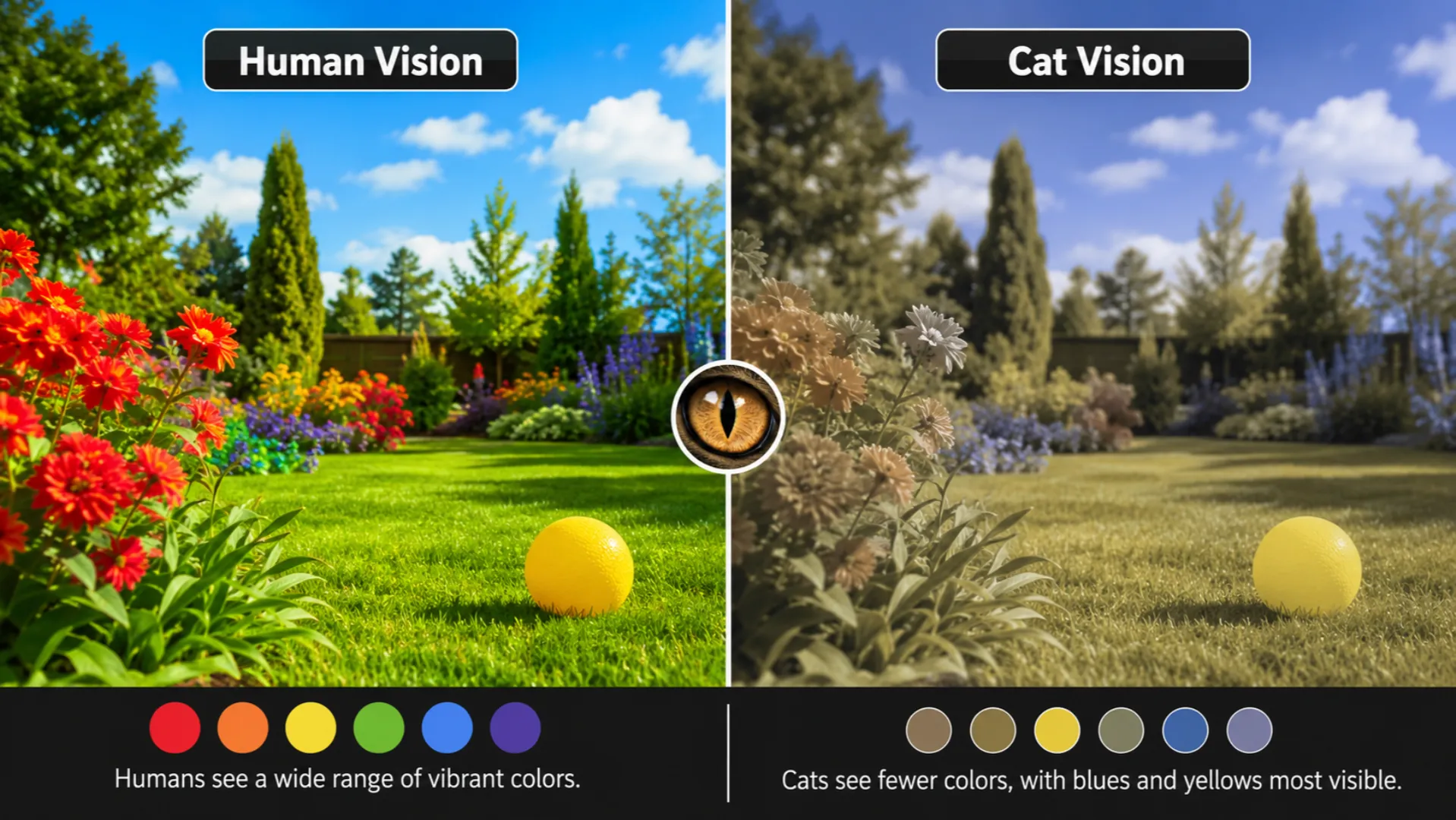
Cats can see color, but not the way humans do. The idea that cats see only in black and white is a persistent myth with no basis in fact. What’s true is that their color perception is real but limited, and that limitation isn’t an oversight of evolution so much as a trade-off. Cats evolved to hunt, and eyes built for tracking motion in near-darkness aren’t the same eyes you’d design for admiring a sunset. This guide covers which colors cats can actually see, how their vision stacks up against ours, and what that means for choosing toys and setting up their environment.
Can Cats See Color?
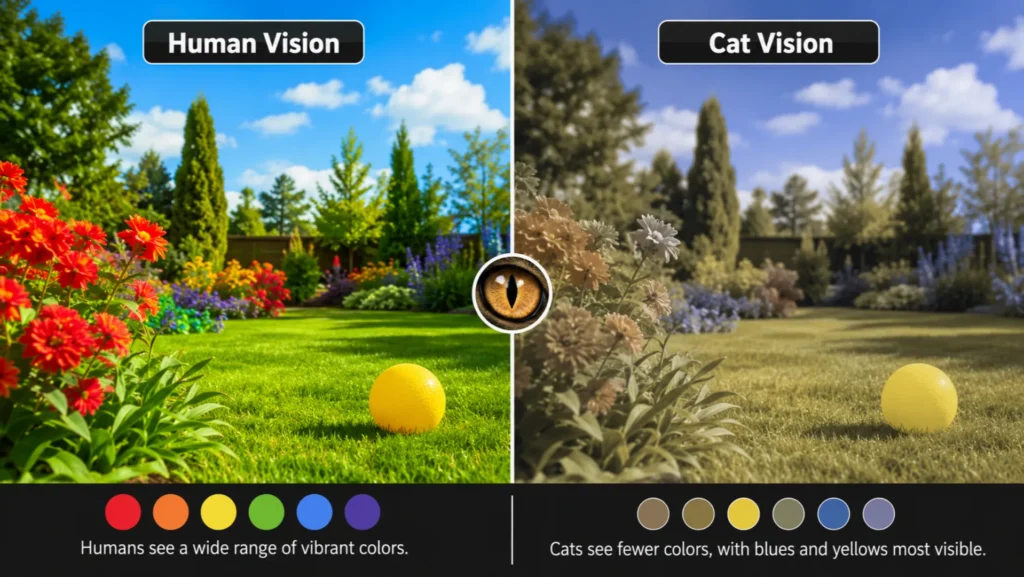
Cats are not colorblind in the popular sense of the word. Color vision starts with cone cells, the light-sensitive receptors in the eye that detect different wavelengths of light. Humans have three types of cone cells, which is what gives us access to the full visible spectrum: reds, greens, blues, and everything in between.
Cats have only two cone types. That’s the entire explanation for why their color world looks different from ours — not absent, just narrower. With two cones instead of three, cats are essentially limited to distinguishing blues and yellows, along with the shades that fall between them. Anything outside that range reads as washed out, gray, or difficult to tell apart from its neighbors.
What Colors Can Cats Actually See?
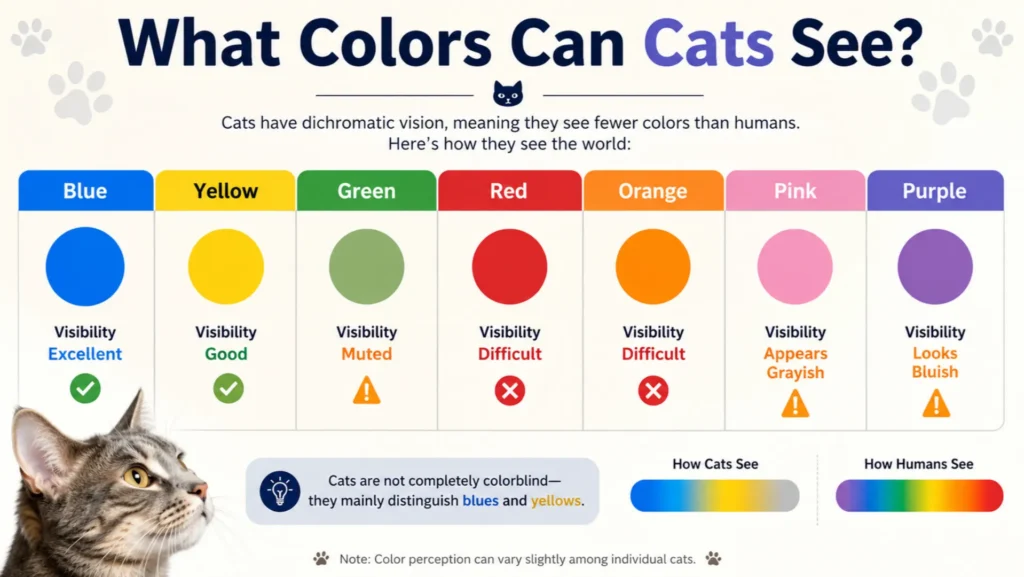
| Color | How Cats Likely See It |
|---|---|
| Blue | Clear and vivid |
| Yellow | Clear and vivid |
| Blue-gray | Clear |
| Green | Muted or dull |
| Red | Appears grayish or dark |
| Orange | Hard to distinguish from yellow/gray |
| Pink | Difficult to detect |
| Purple | May look bluish |
The pattern here traces directly back to that missing cone type. Without a receptor tuned to red wavelengths, red, orange, and pink simply don’t register the way they do for a human eye. A bright red toy that looks vivid to you likely reads as a dark or grayish shape to your cat.
Are Cats Colorblind?
“Colorblind” is technically accurate but easy to misread as “sees no color at all,” which isn’t the case. A closer human comparison is red-green color blindness: people with that condition still perceive color, they just can’t reliably distinguish certain shades — often reds and greens — from each other. Cats have a version of the same limitation. They aren’t living in a grayscale world; they’re working with a smaller palette than we are, concentrated in the blue-yellow range.
Why Do Cats See Colors Differently?
The eye relies on two types of light-sensing cells, and the balance between them explains most of what separates cat vision from human vision. Cone cells handle color and perform best in bright light. Rod cells detect light, motion, and shape, and they’re what take over in dim conditions. Cats have far more rod cells than humans, which comes at the direct expense of the cone-driven color vision most animals rely on in daylight.
That trade-off makes sense once you consider when cats actually hunt. Most of their activity happens at dawn and dusk, when light is scarce and color is the least useful sense to have sharpened. In that environment, catching the flicker of movement matters far more than distinguishing a red mouse from a brown one — so natural selection favored eyes built for motion and low-light detection over eyes built for a wide color spectrum.
How Cat Vision Compares to Human Vision
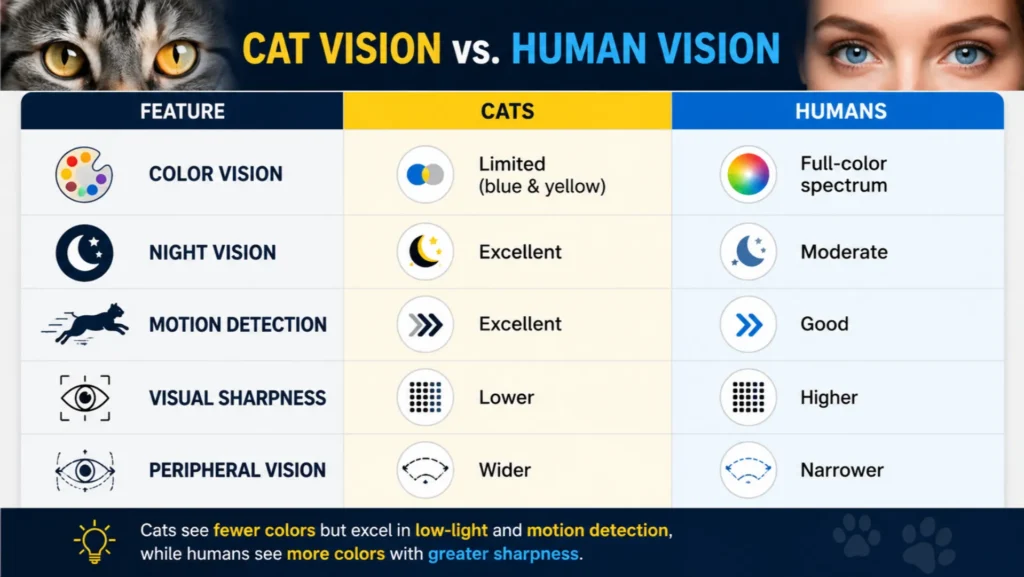
| Category | Cats | Humans |
|---|---|---|
| Color Perception | Limited (blues and yellows) | Full spectrum |
| Night Vision | Excellent | Poor |
| Motion Detection | Very strong | Moderate |
| Visual Sharpness | Lower | Higher |
| Peripheral Vision | Wider | Narrower |
The two species essentially specialized in opposite directions. Cats gave up color range and image sharpness in exchange for night vision and motion sensitivity; humans kept the full spectrum and fine detail but lost the ability to see well once the light drops.
Why Color Matters for Cat Toys and Everyday Life
Because blue and yellow are the colors cats register most clearly, toys in those tones tend to stand out best against typical backgrounds, and high-contrast patterns generally register better than color alone. That said, color is far from the main thing that grabs a cat’s attention. Movement, texture, sound, and scent all outrank it — a toy that wiggles, crinkles, or squeaks will usually win out over one that’s simply brightly colored but static.
A few practical takeaways follow from this:
- Favor blue or yellow toys when color is a factor, but prioritize movement and texture above color choice.
- For feeding accessories, contrast beats color — a light bowl on a dark mat (or the reverse) is easier for a cat to locate than color-matching for aesthetics.
- For enrichment generally, variety matters more than palette. Toys that move, make noise, or offer interesting textures will hold a cat’s interest longer than color alone ever will.
Common Myths About Cat Color Vision
“Cats only see black and white.” False — cats see color, just a narrower range centered on blue and yellow.
“Bright red toys are easiest for cats to spot.” The opposite is closer to true. Red typically appears dull or grayish to cats, making it one of the harder colors for them to notice.
“Cats see exactly like humans, just worse.” Not quite — cats have fewer cone cells and less visual sharpness, but they outperform humans substantially on night vision and motion detection. It’s a different kind of vision, not simply a weaker one.
“Color is the most important thing cats notice.” Rarely. Movement, texture, sound, and scent generally matter more to a cat than what color something is.
Frequently Asked Questions
Can cats see red?
Not clearly — it tends to appear dark, gray, or muted, since cats lack the cone cells needed to register red wavelengths.
Can cats see green?
To a degree, but it usually looks muted or washed out rather than vibrant.
Can cats see TV screens?
Yes. Cats readily pick up on movement and shapes on screen, and many are drawn to fast-moving footage, though the colors they perceive remain limited.
Do kittens see colors?
Kittens are born with underdeveloped vision that matures over their first few weeks. Once their eyes fully develop, they see color the same limited way adult cats do.
What color toys do cats prefer?
Blue and yellow toys are easiest for cats to spot, though movement and texture usually matter more than color in what actually holds their interest.
Can older cats lose color vision?
Aging can affect a cat’s overall eyesight — clarity and night vision in particular — but there’s no strong evidence that color perception specifically declines with age in otherwise healthy cats.
Final Thoughts
Cats do see color, just within a narrower range than humans: mostly blues, yellows, and the shades between them. Their vision wasn’t built for a colorful world — it was built for hunting, which is why it excels at low-light sensitivity and motion detection instead. Keeping that in mind can shape better decisions around toys, feeding setups, and general enrichment. When in doubt, lean into what cats are actually wired to notice — movement, texture, and contrast — and their environment will feel far more engaging to them, regardless of its color palette.