
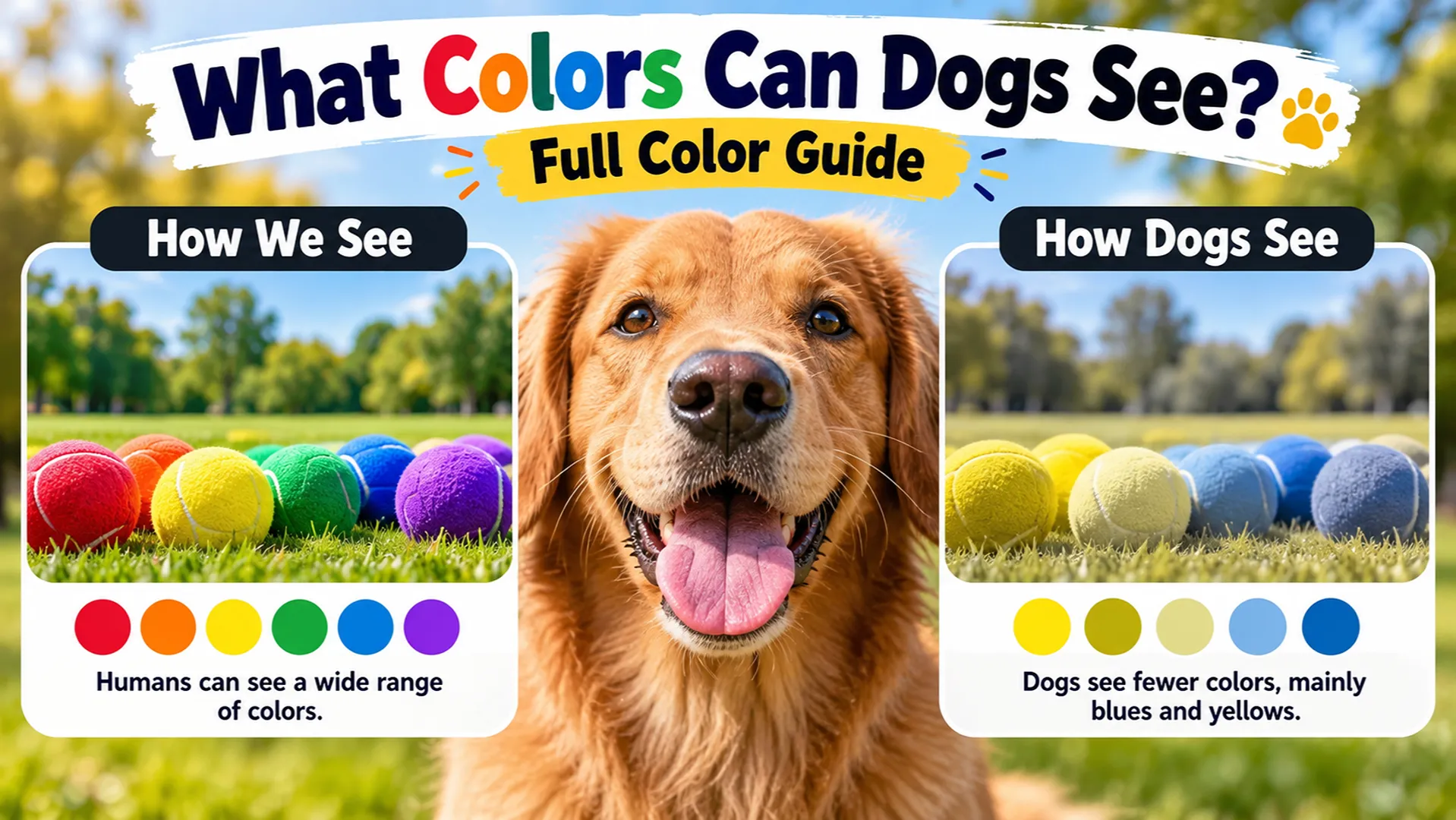
Dogs mostly see blue, yellow, and gray. Red and green are hard for them. That’s why your dog sometimes runs right past a red ball lying on the grass. To them, the ball and the grass look almost the same.
So no, your dog isn’t being dumb. They just can’t see it well. Below, I’ll explain how dog eyes work, which colors they see best, a simple test you can do at home, and how to use this when you buy toys or care for an older dog.
What Colors Can Dogs See? (Quick Answer)
Dogs see blue and yellow pretty clearly. They also see shades of gray. Red and green look brownish or gray to them. Purple looks like blue.
So their world has color. Just a lot less of it than ours.
And honestly, color isn’t even the biggest part of how dogs see. I’ll get to that later.
Are Dogs Color Blind?
Kind of. But they don’t see in black and white, which is what a lot of people still believe.
Two Cones vs Three: Why Dogs See Fewer Colors
Our eyes have small cells called cones. They help us see color. Most people have three kinds, so we see the full rainbow.
Dogs have only two kinds. One picks up blue. The other picks up yellow-ish light. Scientists call this dichromatic vision, which just means “two-color” vision. Ours is trichromatic, or three-color.
Dogs do have way more rods than we do, though. Rods don’t see color. They help with seeing in low light and noticing movement. That’s where dogs beat us easily.
How Dogs Compare to People With Red-Green Color Blindness
Some people are red-green color blind. They still see lots of colors, but red and green look alike to them. Dogs see the world in a similar way.
A good way to picture it: take a colorful photo and turn the color way down. It’s still there. Just faded.
The Dog Color Translator: What Every Color Looks Like to Your Dog
If you’ve ever wondered what colors dogs can see in everyday life, this table helps. It shows how common colors probably look to your dog:
| Color you see | What your dog likely sees | Easy or hard to spot? |
|---|---|---|
| Red | Dark brownish-gray | Hard |
| Orange | Dull yellowish-brown | Hard |
| Yellow | Yellow | Easy |
| Green | Grayish-yellow | Hard |
| Blue | Blue | Easy |
| Purple | Blue | Easy |
| Pink | Pale grayish tone | Hard |
| Teal / blue-green | Grayish-white | Hard |
| Brown | Dark yellowish-brown | Medium |
| White | White or very light gray | Easy (high contrast) |
| Black | Black | Depends on background |
| Gray | Gray | Hard |
Just so you know, nobody can say for sure what a dog sees. We can’t ask them. This table is based on how dog eyes react to light and how dogs do in color tests. It’s a good guess, backed by science, but still a guess.
Colors Dogs See Best
Blue and yellow are the winners. White also stands out, mainly because it looks so different from darker things around it. Want your dog to find something fast? Go with one of these.
Colors Dogs Struggle With
Red, orange, pink, and green. These are the hard ones, especially outdoors. A red toy on green grass looks like a dull brown thing on a yellowish-gray lawn. Not easy to spot at all.
Try It Yourself: Red vs Yellow vs Blue Ball on Grass
This is a fun one. You just need three balls and some grass.
How to Set Up the Test
Grab three balls that are the same size and type, one red, one yellow, one blue. Stand in one spot and throw each ball about the same distance. Do three throws for each color. Mix up the order so your dog can’t guess what’s coming.
You can time each throw on your phone if you want. But also just watch your dog. Do they run straight to the ball? Or do they slow down and start sniffing around?
What Your Results Tell You
If your dog finds the blue and yellow balls fast but has to sniff around for the red one, that’s their two-color vision showing. Don’t worry if the results are a bit messy. Age, eyesight, and nose all play a part. A lot of dogs switch to smell as soon as they can’t see something.
How Dogs Actually Spot Things: Contrast, Brightness, and Motion
Most articles about what colors dogs can see stop at “blue and yellow.” But in real life, a few other things matter even more.
Brightness and Contrast Matter More Than Hue
Dogs aren’t great at noticing small changes in brightness. So what really helps is contrast, meaning how different something looks from what’s behind it.
A blue ball on green grass? Easy to see. A green ball on green grass? Pretty much gone.
So when you pick something for your dog, don’t just think about the color. Think about where it’ll be. Will it stand out on that floor, or that grass?
Why Movement Beats Color
Remember those extra rods? They make dogs really good at spotting movement. A ball that’s rolling or bouncing is easy for them to follow. Once it stops, many dogs seem to lose it.
Dogs Are Near-Sighted Too
Dogs don’t see small details as sharply as we do. Their vision is often estimated at around 20/75. In simple words, what you can see clearly from 75 feet away, a dog has to be about 20 feet away to see as clearly.
But in the dark, dogs do much better than us. They have a shiny layer at the back of the eye called the tapetum lucidum. It helps them see in low light. It’s also why their eyes glow in photos.
Best Colors for Dog Toys, Training, and Gear
This is where knowing what colors dogs can see actually becomes useful.
Toys and Fetch
For fetch on grass, pick blue or yellow. On other surfaces, think about contrast again. A dark blue toy is easy to see on sand. On a dark carpet, not so much.
Here’s the funny part. Red and orange are some of the most common colors for dog toys. And they’re the colors dogs have the hardest time seeing. I think most toys are made to catch the owner’s eye in the store, not the dog’s. So when you shop, buy for your dog, not for you.
Training Cues and Agility Equipment
If you use mats, cones, or markers in training, choose colors that stand out from the ground. Blue or yellow on grass works well. Try to stick to the same colors too. If a blue mat always means “go here,” your dog can learn that. Still, your voice, your body language, and their nose will do most of the work.
Bowls, Beds, Leashes, and Collars
- Food and water bowls: pick one that stands out from your floor, like a blue bowl on light tiles.
- Beds and mats: a bed that contrasts with the floor is easier to find, especially at night.
- Leashes and collars: color matters less here. What matters is that drivers and people can see your dog. For evening walks, reflective or light-up gear is the better choice.
Using Color and Contrast to Help Senior or Visually Impaired Dogs
Dogs’ eyes can get weaker as they get older, just like ours. Look out for things like bumping into furniture, stopping at the stairs, acting nervous in dim light, or cloudy eyes. If you see any of this, visit your vet first. Some eye problems can be treated, and it’s always better to catch them early.
After that, small changes at home can really help:
- Use bowls and mats that stand out from the floor.
- Put bright or contrasting tape on the edges of stairs.
- Pick blue or yellow toys, and ones that squeak or rattle, so your dog can hear them too.
- Don’t move the furniture around. Dogs with poor eyesight find their way from memory.
- Wear blue or yellow on walks. Your dog may spot you more easily than if you wear red or pink.
If you only do one thing, do the stair tape. Stairs are where a dog with bad eyesight is most likely to get hurt, and tape costs almost nothing.
Why Did Everyone Think Dogs Saw in Black and White?
Where the Myth Started
For a long time, people believed dogs saw no color at all. Nobody agrees on exactly where this idea came from. The American Kennel Club says it goes back to Will Judy, a well-known dog writer and magazine publisher. Scientific American points to Gordon Walls, an eye doctor who wrote a popular book on animal eyes in 1942. His book said dogs saw very little color, if any.
Most likely, both helped spread the idea. Dog writers repeated it, and the science back then seemed to agree.
The 1989 Discovery That Changed Everything
In 1989, two researchers, Jay Neitz and Gerald Jacobs, tested dogs at the University of California, Santa Barbara. They trained dogs to pick out colors. The dogs could tell blues and yellows apart easily, but not reds and greens. That pretty much ended the black-and-white myth.
What Newer Research Adds
A 2013 study found that dogs made choices based on color, not just brightness. So color seems to matter to dogs more than people used to think.
Then a 2014 study looked at how light passes through the eye. It suggested that dogs, like many other mammals, might be able to see some ultraviolet light, which we can’t see at all. Research is still going on, so we’ll probably learn more.
Are TikTok “Dog Vision” Filters Accurate?
Sort of. They show the blue and yellow colors fairly well. But they don’t show the blurry details, the strong motion sense, or the good night vision. Fun to try, but they only tell half the story.
Dog vs Cat vs Human Vision: Quick Comparison
| Feature | Dogs | Cats | Humans |
|---|---|---|---|
| Colors seen | Mainly blue and yellow | Limited range, mainly blues and yellow-greens | Full color spectrum |
| Cone types | 2 | Mostly functions like 2 | 3 |
| Night vision | Much better than humans | Even better than dogs | Weak |
| Sharpness | Blurrier (about 20/75) | Blurrier than dogs | Sharpest of the three |
| Field of view | Wider than humans (varies by breed) | Wider than humans | Narrower |
| Motion detection | Excellent | Excellent | Good |
Both dogs and cats give up some color and detail. In return, they see better at night and catch movement faster. That makes sense for animals that used to hunt early in the morning and late in the evening.
FAQs
Can dogs see pink or purple?
Purple probably looks blue to dogs, so they can see it okay. Pink is harder. It likely looks like a pale gray.
Do all dog breeds see the same colors?
As far as we know, yes. All dogs have the same two types of cones. But the shape of a dog’s skull might affect other parts of vision, like how short-nosed and long-nosed breeds focus.
Can puppies see color?
Puppies are born with their eyes closed. They usually open them at about two weeks old. Their eyesight keeps getting better over the next few weeks, and they end up with the same blue-and-yellow vision as adult dogs.
Can dogs see TV screens?
Yes, they can see movement and pictures on modern TVs. Older TVs updated the picture more slowly, so they may have looked flickery to dogs. Dogs take in motion faster than we do.
What’s the best toy color for dogs?
Blue or yellow, especially on grass. Just make sure the toy stands out from wherever you play.
Conclusion
So, what colors can dogs see? Mostly blue and yellow, in a softer, faded version of our world. But color is only part of it. Contrast, movement, and that amazing nose often matter more. Pick toys and gear that stand out, make a few small changes for older dogs, and your dog will have a much easier time getting around.
