Three in the morning, cat’s yowling by the bed, and you’re lying there typing “why does my cat meow so much” into your phone with one eye open. Been there. Turns out adult cats barely bother meowing at each other — they save that sound almost entirely for humans. Every meow is a message. Most of us just never learned to translate it.
There’s actual research behind this, not just internet folklore. Meows shift depending on the situation and what the cat’s trying to get, and people can sometimes tell them apart, though we’re honestly not that reliable at it. So instead of just asking why does my cat meow so much, try asking a sharper version: what does this particular meow sound like, when does it happen, and what happened right before?
That’s what we’re covering. The different meow types, how age changes the reasons behind it, why nighttime meowing gets its own conversation, when it’s actually medical, and a real plan for cutting the habit down.
Why Does My Cat Meow So Much? The Meow Decoder
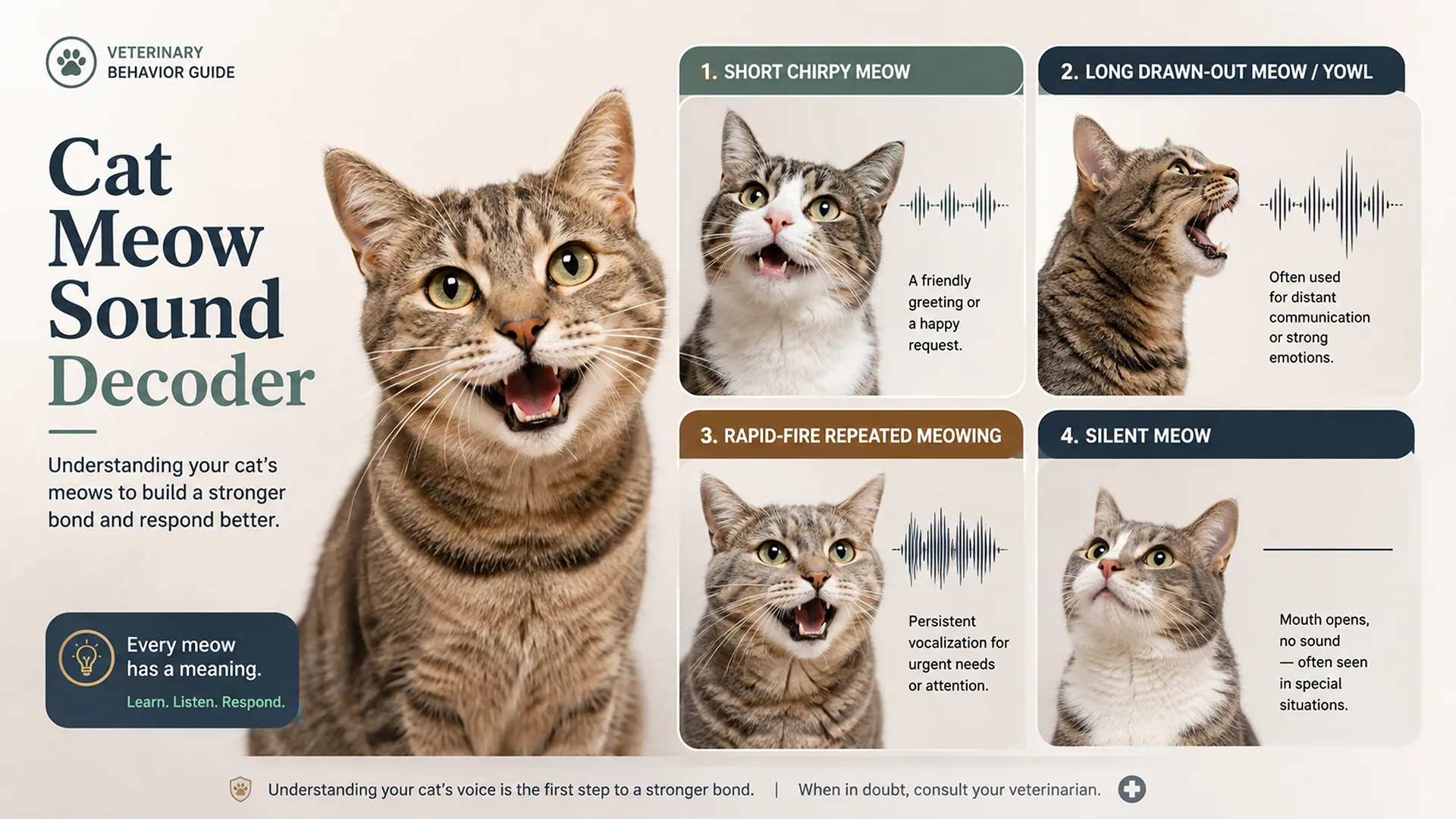
Meows aren’t interchangeable. Pitch, length, how often it repeats, what’s happening around it — all of it changes the meaning. The sound is a clue. Not the full picture on its own.
Short, Chirpy Meow
Pretty much a hello. Comes out when you walk in the door, step into a room, or just catch your cat’s eye. A lot of cats use it the way you’d wave at someone across the street.
If your cat’s acting normal otherwise — eating fine, no weird behavior — don’t read too much into this one. What matters is whether it’s new. A chirp your cat’s used for years, no big deal. That exact sound suddenly appearing in a cat who’s never made it before? Worth a second look.
Long, Drawn-Out Meow or Yowl
This is the pushy one. Long, low, insistent. Cats bring it out when dinner’s late, a door needs opening, or they want into a room right now and aren’t taking no for an answer.
Unspayed females and unneutered males also make this sound for mating reasons, which is a whole separate issue your vet can help you sort out. In older cats though, repeated yowling often points somewhere else. Cognitive decline, hearing loss, vision problems, pain — any of these can show up as yowling, and it tends to ramp up once it gets dark.
Rapid-Fire, Repeated Meowing
Same meow, over and over, barely any gap between them. Your cat is escalating and wants something handled immediately — food, play, a shut door, you.
Worth being honest about the learning side of this. If repeated meowing has gotten your cat food or attention before, they’ve clocked that persistence works. Not sneaky. Not manipulative. Just plain reinforcement.
And here’s the part people miss: inconsistency makes it worse, not better. A reward that comes sometimes is way harder to give up chasing than one that never comes at all. So if meowing works even occasionally, expect your cat to keep at it.
The Silent Meow
Mouth opens, hardly any sound comes out. Plenty of cats do this up close, as a quieter way of asking for attention when they don’t need to project across a room.
Alone, it’s not something to worry about. But if it shows up alongside coughing, labored breathing, trouble swallowing, low energy, or eating less, that’s not quirky anymore. Get your vet on the phone.
Why Kittens, Adult Cats, and Senior Cats Meow Differently
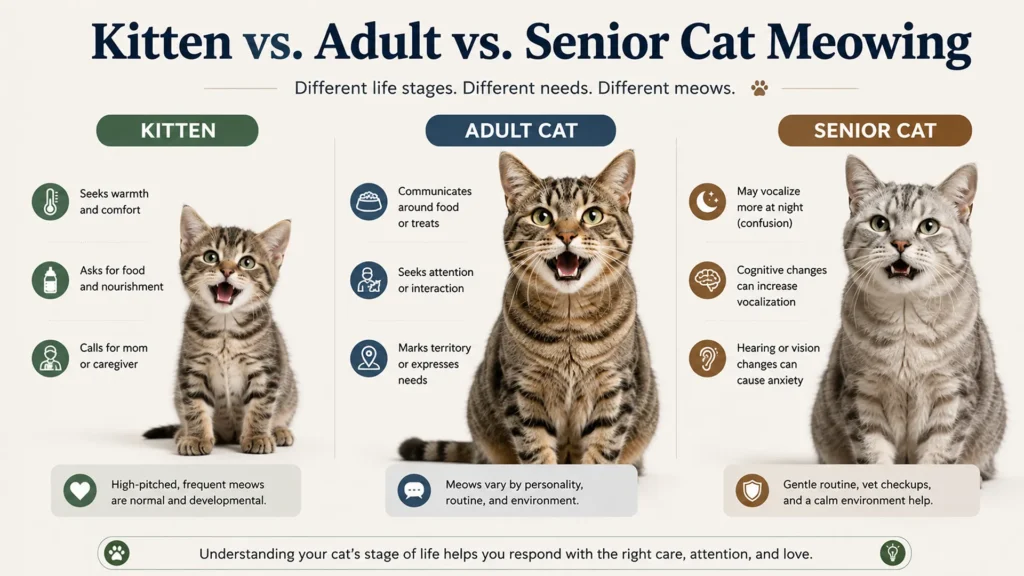
Age flips the whole equation. A kitten calling for its mother has nothing in common with an adult cat demanding breakfast, and a senior cat that suddenly gets loud overnight is dealing with an entirely different set of causes. If you’re really asking why does my cat meow so much all of a sudden, age is one of the first places I’d look.
Kittens — Learning to Communicate
Kittens meow at their mother and littermates mainly when they need warmth, food, or contact. As they grow, that shifts — meowing at people becomes a core part of how many cats learn to communicate at all.
A young kitten crying might just mean hungry, cold, disoriented, or lonely, especially in the first couple weeks in a new home. Some of that settles on its own as they adjust.
Don’t wave off everything as adjustment, though. A kitten crying a lot who also seems weak, unusually sleepy, off their food, or dealing with vomiting or diarrhea needs a vet, not more time.
Adult Cats — Learned Habits and Environmental Needs
Adult cats are the group I find easiest to read, mostly because the causes follow patterns you can actually spot. Meowing tends to cluster around feeding times, attention, play, or straight-up boredom.
Unaltered cats might vocalize for mating reasons too. For the rest, it’s often partly learned — meow near the bowl enough times and breakfast shows up faster, so the habit sticks.
This stage is also where changing your cat’s environment genuinely works. More play, food puzzles, sticking to a routine, rewarding quiet over noise — it all chips away at the meowing when the cause is behavioral rather than medical. The trick isn’t silencing the sound. It’s changing what happens right after.
Senior Cats — Cognitive, Sensory, and Medical Shifts
This is the group I’d watch closest, honestly, because a senior cat suddenly getting vocal is rarely just “getting talkative with age.” Hearing or vision loss can leave an older cat feeling less secure, and cognitive decline can bring disorientation, messed-up sleep, clinginess — and more meowing to go with it.
Hearing loss also changes volume. A cat who can’t hear itself as well tends to meow louder without meaning to. Add in hyperthyroidism, chronic kidney disease, diabetes, pain, and high blood pressure, and you’ve got a long list of things that can shift behavior in older cats. AAHA and AAFP feline guidelines specifically flag new nighttime vocalization in seniors as something to check into, since it can trace back to sensory decline, cognitive dysfunction, pain, hyperthyroidism, or hypertension.
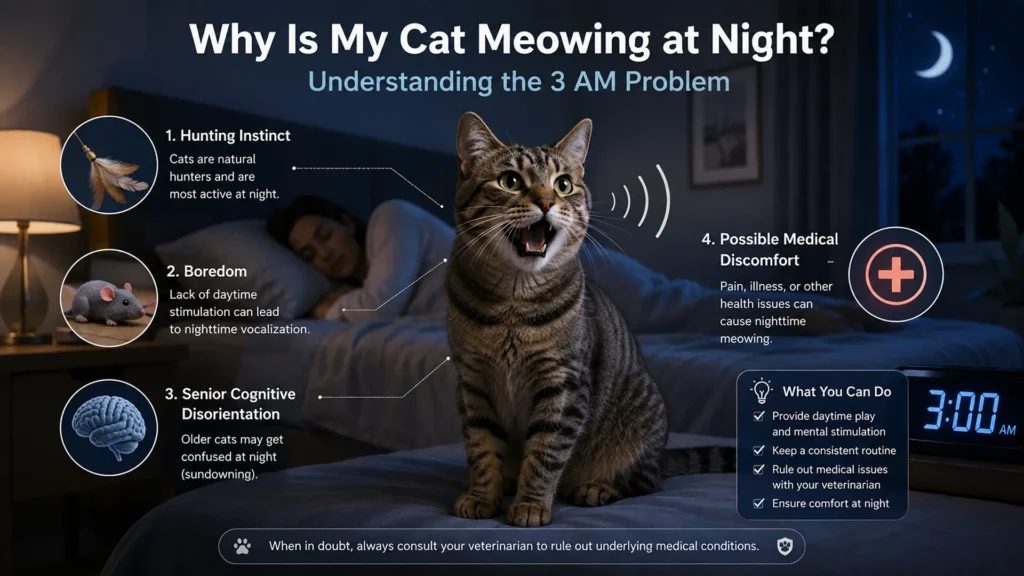
Why Does My Cat Meow So Much at Night? The 3am Problem
Nighttime meowing grinds you down differently than daytime meowing, because it repeats every single night. First step is figuring out whether your cat’s just naturally wired to be active then, or whether something’s genuinely changed.
- Nocturnal hunting instinct. Cats are built to be most active around dawn and dusk. Skip enough stalking, chasing, and climbing during the day, and that energy has to land somewhere — often right on your pillow at 3am.
- Boredom stacking up all day. A cat that naps most of the day with nothing to do tends to wake up right as the house goes silent. Toys, climbing spots, puzzle feeders, and real play give that energy a better place to go.
- Cognitive decline in senior cats. Older cats can get disoriented overnight — wandering, staring at walls, getting stuck in spots they know well, seeming genuinely lost. That’s a different animal than a cat asking for a midnight snack, and it’s worth mentioning to your vet if it’s new or getting worse.
- Medical causes worth ruling out. Pain and hyperthyroidism both drive nighttime meowing. Hyperthyroidism in particular tends to pair increased appetite with weight loss, so that combination is worth flagging.
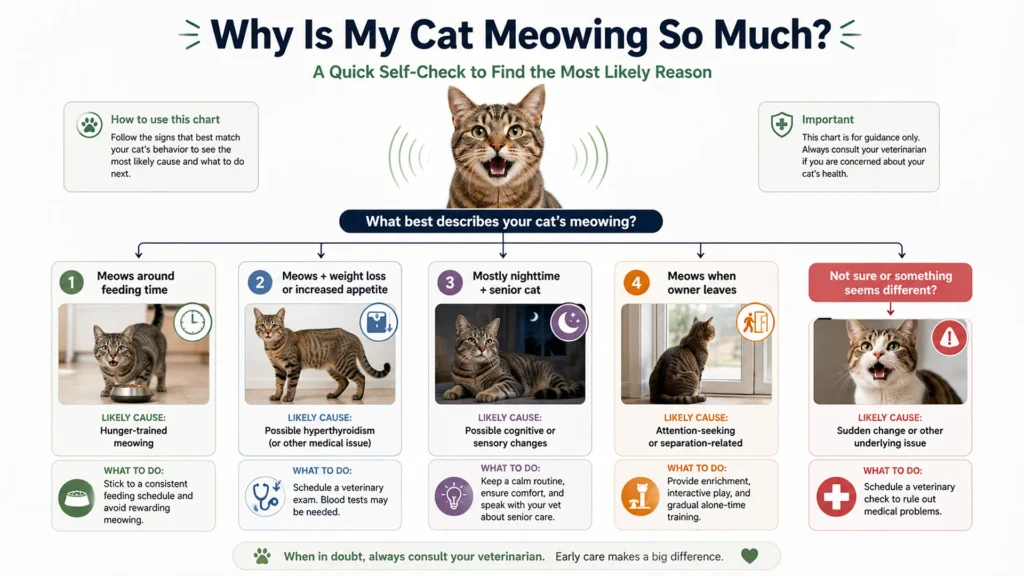
Quick Self-Check — What’s Likely Causing Your Cat’s Meowing?
Not a diagnosis. Just a place to start.
| What you notice | What it may suggest | Next step |
|---|---|---|
| Meows mainly around feeding times | Hunger-trained meowing | Start with Step 2 of the protocol below |
| Meows around feeding times, plus weight loss or increased appetite | Possible hyperthyroidism | See Medical Red Flags |
| Meows mostly at night, and your cat is a senior | Possible cognitive or sensory changes | See the nighttime section, then talk to your vet |
| Meows the second you leave the room | Attention-seeking or wanting contact | Start with Step 1 of the protocol below |
| Vocalizing suddenly started, out of nowhere | Possible medical or environmental trigger | Book a vet visit |
| Meowing plus hiding, poor grooming, or low activity | Possible pain or illness | Call your vet |
When Excessive Meowing Signals a Medical Problem
Not all of this is behavioral, and a sudden change deserves more weight than most people give it. Cats sound different when they’re uncomfortable, confused, or sick. AAHA guidance recommends checking any senior cat with new or unusual behavior for underlying medical causes instead of blaming age and calling it a day.
Book a vet visit if the meowing shows up alongside:
- A sudden start in a cat that’s normally quiet
- Weight loss despite eating more than usual
- Weight loss paired with a smaller appetite
- Drinking or peeing more than usual
- Hiding, skipping grooming, or moving less, all possible pain signs
- New disorientation, wandering, or accidents outside the litter box
- A real shift in sleep or nighttime behavior
Depending on your cat’s age and everything else going on, hyperthyroidism, diabetes, kidney disease, pain, sensory decline, and cognitive dysfunction can all be in the running. Worth repeating: research on cat-human vocal communication shows meows shift with context, and people misread them more than we’d like to admit. That’s exactly why a vet has to look at the whole animal, not just the sound coming out of it.
How to Stop Excessive Meowing — A Step-by-Step Behavior Protocol
Once medical stuff’s off the table, you can work on the behavior. This isn’t about silencing your cat. It’s teaching them that staying calm gets results just as well as meowing does, ideally better.
Step 1 — Stop Reinforcing Attention-Meowing
If the meowing’s clearly about attention, skip the eye contact, talking, or petting mid-meow. Wait for even a couple seconds of quiet, then reward that instead.
Start tiny. A few seconds of silence is plenty at first. As your cat catches on, stretch that window a little longer each time.
Expect what’s called an extinction burst. When a behavior that used to work suddenly stops paying off, it often gets louder or more frequent for a while before it drops off. Give in right at that peak and you’ve just taught your cat that going bigger eventually wins. Push through it, annoying as it gets — the consistency is the whole point here.
Step 2 — Fix Hunger-Trained Meowing
If your cat’s learned meowing equals food, take yourself out of the equation. A timed automatic feeder separates your presence from the meal actually arriving. Puzzle feeders slow the whole thing down and make mealtime more engaging than a straight countdown to the bowl.
If it fits your cat’s diet and your vet’s on board, splitting daily food into smaller, more frequent meals can help too. Bottom line: don’t let the loudest meow be what fills the bowl.
Step 3 — Add Daytime Enrichment to Prevent Boredom
Give your cat something to actually do during daylight hours. Movement, exploring, hunting, thinking, all of it. Rotate toys instead of leaving everything out permanently so nothing gets stale. Puzzle feeders, window perches, a cat tree, short bursts of play — it adds up.
A handful of short play sessions usually beats one marathon session. Toys that mimic chasing and stalking work especially well on cats who get restless the moment the house quiets down.
Step 4 — Build an Evening Wind-Down Routine
Set up a predictable sequence before bed: play, then food, then quiet. It roughly mirrors the hunt-eat-groom-sleep cycle cats are naturally wired for.
Won’t guarantee sleeping through every single night. Nothing does. But it gives your cat a consistent outlet before you turn in, and that helps more than people expect.
If your cat wakes you at 3am, don’t turn it into playtime or a feeding unless there’s a genuine need. Do that once or twice and you’ve just built a new routine — and not the one you were hoping for.
Step 5 — Know When to Call a Vet or Behaviorist
Stuck with this for 2 to 3 weeks straight with no change? Or any of those medical red flags showed up along the way? Stop treating it like a training problem. Your vet can check for medical causes and, if needed, point you toward a qualified feline behaviorist.
Frequently Asked Questions
Is it normal for cats to meow a lot?
Some cats are just naturally chatty — that’s personality, nothing wrong with it. What actually matters is your own cat’s baseline. A sudden jump, especially paired with other symptoms, is the thing worth paying attention to.
Why does my cat meow at me and not other people?
Cats build individual communication habits around whoever’s actually around. If you’re the one who consistently answers, your cat’s probably learned meowing at you specifically works.
Should I ignore my cat when it meows?
Not automatically. Rule out hunger, pain, illness, or fear first. Once it’s clearly reinforced attention-seeking, briefly holding off and rewarding the quiet stretches tends to help.
Can certain breeds, like Siamese, naturally be more vocal?
Yes. Vocal tendency varies a lot from cat to cat, and some breeds are famous for being talkers. But breed only sets the baseline — a sudden change in one cat’s normal habits shouldn’t get brushed off as “that’s just how they are.”
Conclusion
So, why does my cat meow so much? Most of the time, it’s something you can actually work out: what the sound is like, when it shows up, your cat’s age, and what happens right after. Still stuck? Run through the self-check above.
And if the meowing is new, sudden, or shows up with weight loss, pain, disorientation, or appetite changes, don’t sit around hoping a training fix handles it. Get your cat to the vet first.