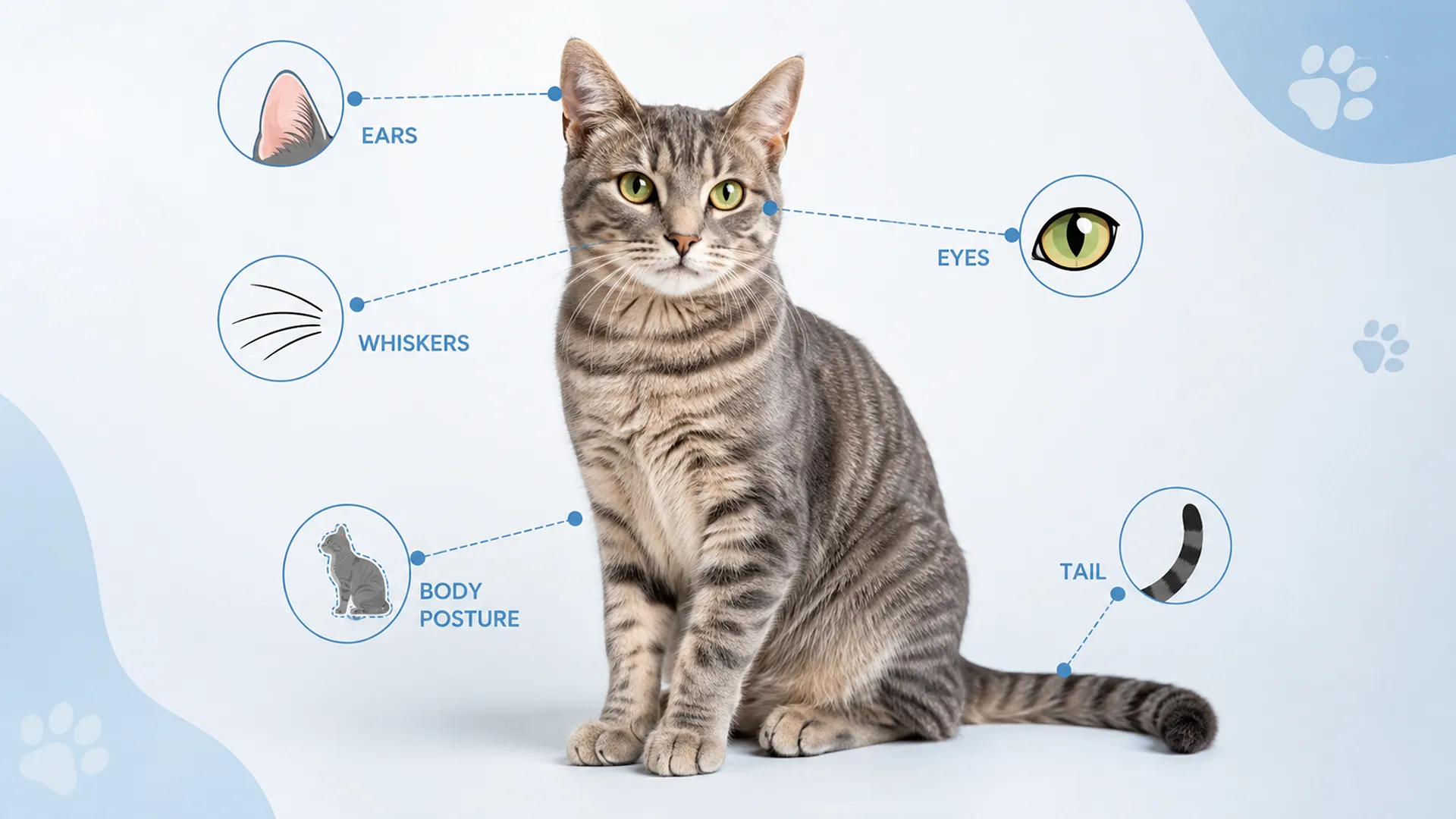
Cats don’t use words, but they’re rarely quiet about how they feel. A flick of the tail, a flattened ear, a slow blink across the room — these are all part of a running conversation most owners only half-notice. Learning to read that conversation changes how you understand your cat, and it starts with a few key signals: posture, tail, ears, eyes, and whiskers.
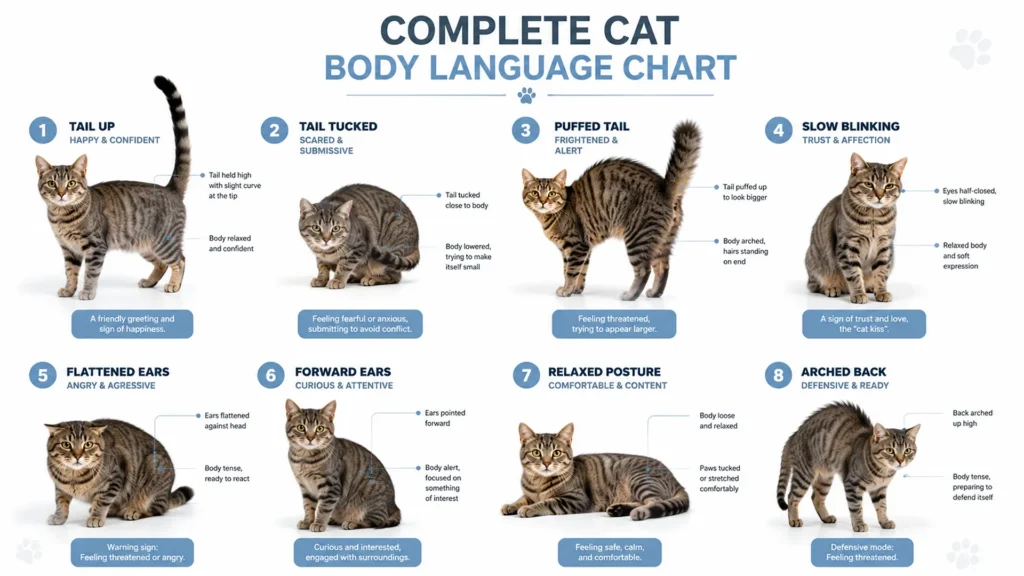
Cat Body Language Chart (Visual Reference)
Here’s a quick cheat sheet for the most common signals. Keep it handy, and cross-reference it whenever your cat’s mood shifts suddenly.
| Body Part | Meaning |
|---|---|
| Tail Up | Happy & Friendly |
| Tail Puff | Fear or Surprise |
| Tail Tucked | Anxiety |
| Slow Blink | Trust & Affection |
| Flattened Ears | Fear or Anger |
| Forward Ears | Curious |
| Arched Back | Defensive |
| Relaxed Body | Comfortable |
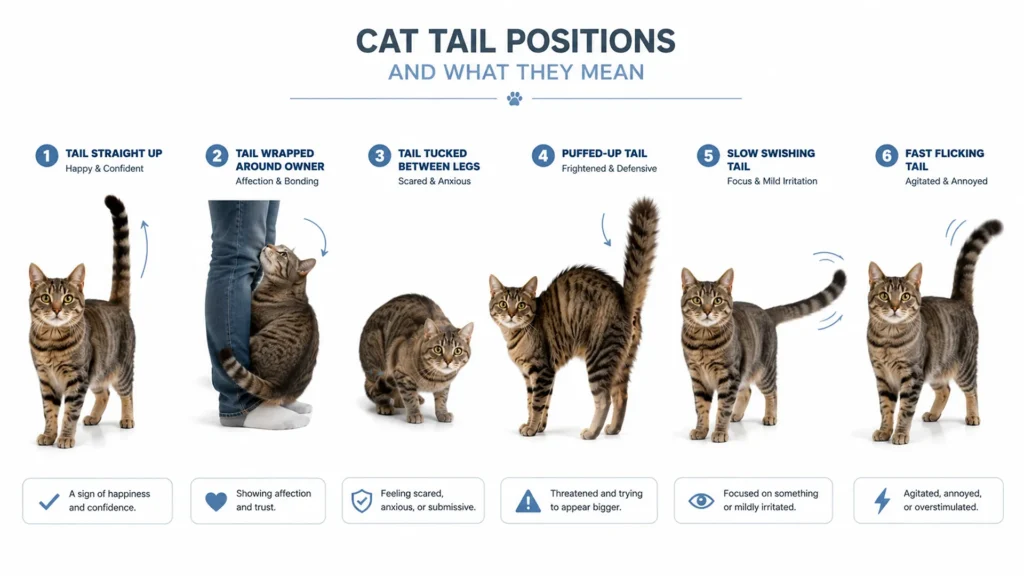
How Cats Communicate Through Body Language
Cats rarely send a single, isolated signal — they layer several at once. A twitching tail alone is ambiguous; it might mean excitement or mounting frustration. But a twitching tail paired with pinned-back ears tells a clearer story than either cue on its own. That’s why reading cat body language is less about memorizing individual signs and more about watching how tail, ears, eyes, whiskers, and posture move together.
Reading Each Signal
Tail. A tail held high signals confidence, and one wrapped around you or another pet is a gesture of affection. A puffed-up tail means your cat is startled or frightened and trying to look bigger; a tail tucked tightly beneath the body signals anxiety or insecurity. Movement matters too — a slow swish usually means focus or mild annoyance, while fast flicking is a sign of real irritation.
Ears. Forward-facing ears mean your cat is alert and curious. Sideways or twitching ears — sometimes called “airplane ears” — suggest anxiety or irritation, while ears pinned flat against the head are a clear warning of fear or anger. Independently rotating ears are simply tracking sound, not emotion.
Eyes. A slow blink is the closest thing to a kitty kiss: it signals deep trust, since closing your eyes near someone means you feel safe with them. Dilated, round pupils can mean excitement, surprise, or fear depending on context, while narrow pupils often point to anger or intense focus. A steady, unblinking stare is worth watching closely — paired with a tense body, it can be a challenge rather than simple curiosity.
Whiskers. Whiskers hanging loosely to the sides indicate a calm, content cat. Whiskers pushed forward suggest excitement or active investigation, while whiskers pulled back tight against the cheeks are a sign of fear or defensiveness.
Body posture. A cat lying on its side or back with belly exposed is fully relaxed. An alert body with a lowered front end is winding up to pounce. An arched back with raised fur is a defensive posture meant to look intimidating, while a rigid, forward-leaning stance signals active aggression. A low, tight crouch in a hidden spot means your cat is seeking safety from something it perceives as a threat.
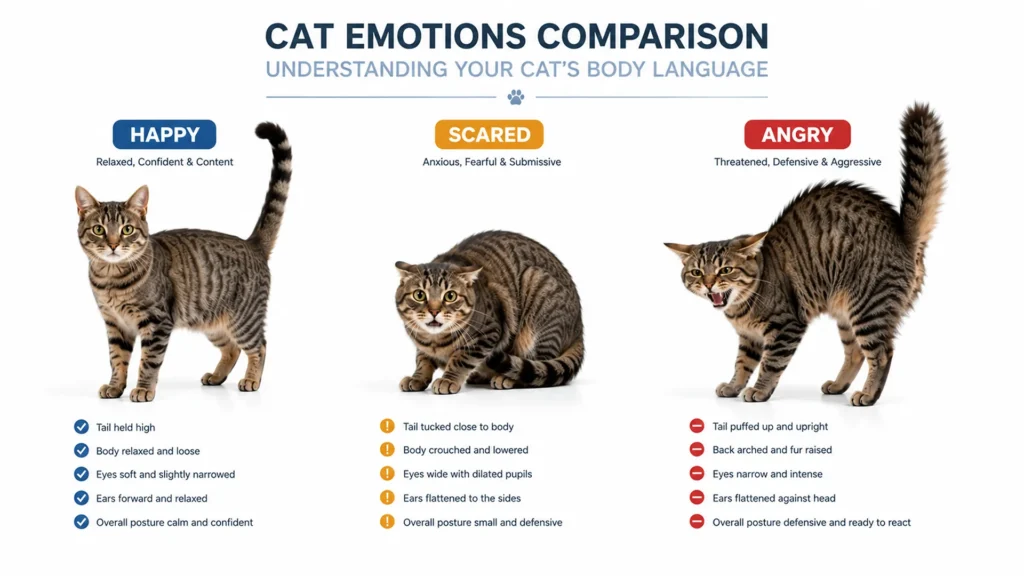
Putting It Together: Happy, Scared, or Angry
Individual signals matter less than the combination. Here’s what each emotional state typically looks like as a whole:
Happy: tail held high, sometimes with a slight curve at the tip; slow, heavy blinking; rhythmic kneading (“making biscuits”); a loose, tension-free body.
Scared: tail tucked against the body or wrapped tight around the legs; ears pinned back; pupils wide open; a strong pull toward dark, enclosed hiding spots.
Angry or defensive: hissing or low growling; a puffed, bottle-brush tail; an arched, rigid back meant to look larger and more threatening.
Catching these clusters early — rather than waiting for a hiss or a swat — gives your cat room to decompress before things escalate, and saves you a scratch.
Common Mistakes Owners Make
The biggest one: treating a wagging tail as a sign of joy, the way you would with a dog, when in cats it’s often closer to irritation. Other frequent errors include overlooking subtle ear shifts, continuing to pet a cat that’s already showing signs of overstimulation, or fixating on one signal — the tail, say — while ignoring an increasingly tense posture. The fix is simple: read the whole animal, and read it in context.
Frequently Asked Questions
Why does my cat slowly blink at me?
It’s a sign of trust. In feline body language, closing your eyes near someone is a way of saying you feel safe with them.
Why is my cat’s tail puffed up?
Fear or surprise. Puffing up is an instinctive move to look larger and more intimidating to a perceived threat.
What does it mean when my cat stares at me?
Often it’s just attention-seeking curiosity — they may want food or play. But if the body is rigid alongside the stare, it can signal tension instead.
Can cats smile?
Not with their mouths. What looks like a “smile” is usually relaxed eyes and slow, half-closed blinking.
How can I tell if my cat trusts me?
Look for an exposed belly, purring, sleeping nearby, grooming you, or greeting you with an upright tail.
Final Thoughts
Reading a cat well takes practice, but the payoff is real: fewer surprises, fewer scratches, and a much closer bond. The trick isn’t memorizing any single cue — it’s watching how the tail, ears, eyes, and posture move together, and trusting what they’re telling you.