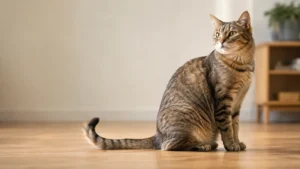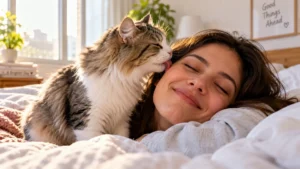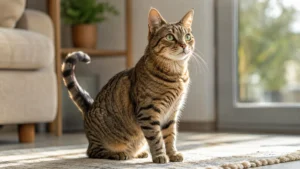
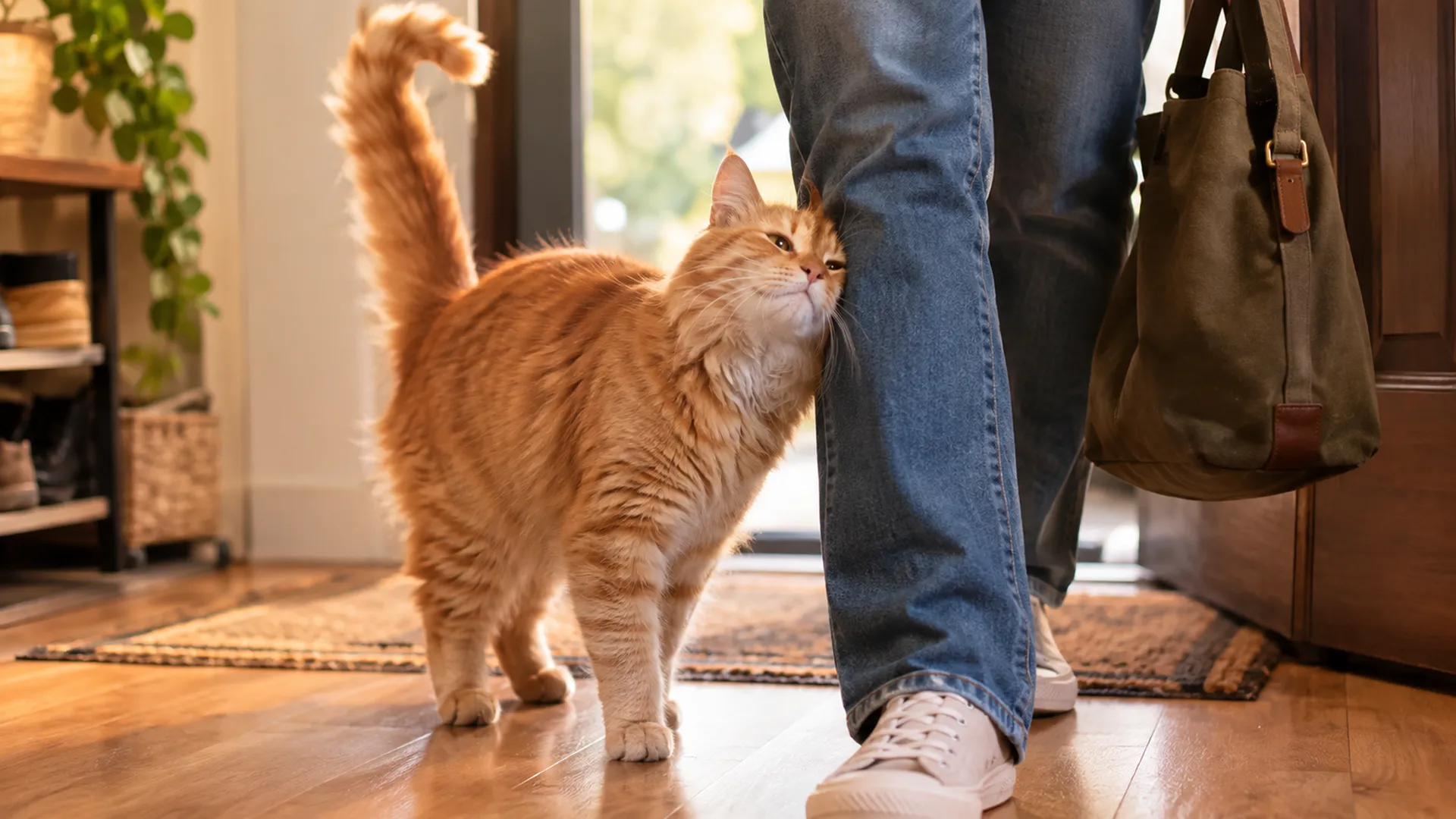
Your cat rubs against you mostly to leave its scent on you. So the short answer to “why does my cat rub against me?” is scent. Glands on the cheeks, chin, forehead, and tail base leave a trace of smell with every rub, and to a cat, that marks you as family. A rub can also be a hello, a sign of trust, or a pointed reminder that dinner is late.
You know how it goes. The bag hits the floor, you’re still looking for somewhere to put your keys, and the cat is already looping around your ankles. Some days you get a light brush. Other days you get a full lean and have to hop sideways to avoid stepping on it.
The scent part takes about a minute to learn. The harder question is “why does my cat rub against me right now, here, like this?” The decoder below is built for that one.
The Cat Rub Decoder: Why Does My Cat Rub Against Me Right Now?
A rub at the front door and a rub beside an empty bowl look identical. They mean different things. When you catch yourself wondering “why does my cat rub against me?”, check the timing, the place, and what the rest of the cat is doing.
| Situation | What you’ll notice | Likely meaning | What to do |
|---|---|---|---|
| At the door when you get home | Tail up, quick rubs, maybe a chirp | Greeting and re-marking you | Say hello and offer a cheek scratch |
| Near the food bowl | Meowing, pacing, rubbing close to mealtime | “Feed me” | Stick to your feeding schedule |
| On the sofa or your lap | Slow rubs, eyes half-closed, purring | Trust and affection | Enjoy it and pet gently |
| On a visitor or stranger | Sniffing, then rubbing | Gathering information | Let the cat finish before petting |
| Around your legs as you walk | Weaving, looking up at you | Wants attention or play | Try a short play session |
| Unspayed female rubbing everything | Rolling, loud yowling, restlessness | In heat | Talk to your vet about spaying |
| Constant face rubbing | Pawing at face, head shaking | Possible discomfort | See the warning signs section below |
In our experience, a cat described as “clingy” is almost always living in rows two and five. It learned that rubbing pays off, and it won’t give that up by itself.
Body Signals That Change the Meaning
Two people can ask “why does my cat rub against me?” about the same rub and get different answers. The tail and ears usually break the tie.
- Tail: Held straight up, sometimes hooked at the tip, it means a relaxed, friendly cat. Twitching or thumping means patience is running out.
- Ears: Forward is calm and curious. Flat or swiveled sideways means something is bothering it.
- Purring: Often a good sign, but cats also purr when stressed or sick. Read it with the rest of the body, never alone.
Why Does My Cat Rub Against Me? The Science of Scent Marking
Where Cats’ Scent Glands Are
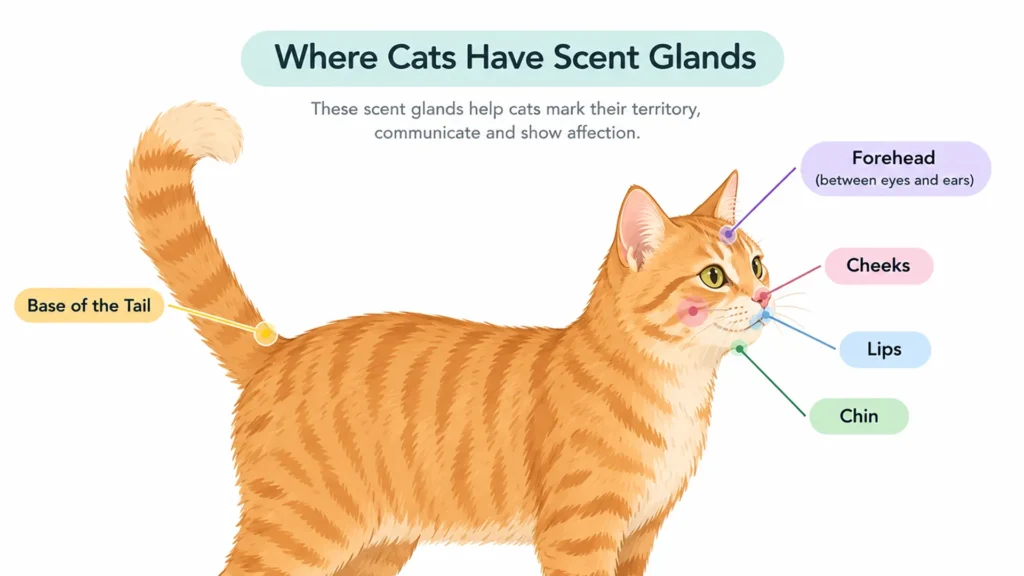
Cats carry scent glands on the cheeks, chin, lips, forehead (the thin patch of fur between the eyes and ears), and around the base of the tail. A few more sit between the paw pads, which is partly why scratching counts as marking.
Each rub leaves pheromones behind. You’ll never smell them. Other cats do, and they read a surprising amount from them.
What the Research Shows
Cats that share a home build one group smell by rubbing on each other. This is called allorubbing. A big part of the answer to “why does my cat rub against me?” is just that: you’re being folded into the family scent.
Research on scent rubbing found that cats rub more on things new to their surroundings, and harder on things that smell of another animal. Spend an evening at a friend’s place with a dog and you’ll get the proof at your own front door.
That smell wears off, so it needs topping up. Hence the daily visits to the same sofa corner, the same doorframe, and your shins.
Headbutting, or bunting, is a close cousin. Our guide to why cats headbutt covers it in detail.
Odd Rubbing Questions Other Articles Skip
Most guides answer “why does my cat rub against me?” with “scent marking” and stop. Owners ask far more specific things than that. These come up most.
Why Does My Cat Rub Against Me and Then Bite?
Usually it’s overstimulation, which vets call petting-induced aggression. Your cat wanted attention, enjoyed it for a bit, then hit its limit. The shift just happened faster than you noticed. Watch for:
- a tail that starts twitching
- skin rippling along the back
- ears turning sideways
- sudden stillness
Pull your hand back when you see any of these. Keep sessions short and stick to the cheeks and chin. Long strokes down the back are where most bites start.
Why Does My Cat Rub My Partner but Not Me?
Here the question is less “why does my cat rub against me?” and more why it heads for everyone else first. Cats usually pick whoever feeds them, plays with them, or handles them most gently. Smell plays a part too, and heavy perfume, scented lotion, or smoke can put a cat off.
Want to be the favorite? Take over dinner or a daily play session. Stop reaching for the cat and let it come to you.
Why Does My Cat Rub Against Me After I Shower or Come Home?
Your cat spent days getting its smell onto you, and one shower undid all of it. A day out is worse. You walk back in carrying other people, other pets, and the street. To your cat you smell slightly wrong, so it corrects that.
If you’ve been near another animal, the rubbing gets more intense, for the reason covered in the research section.
Why Does My Cat Rub My Face at 4 AM?
Cats are most active around dawn and dusk. If you’re half-awake wondering why does my cat rub against me at 4 AM, the answer is nearly always breakfast or company. Each time you get up, you prove to your cat that it works.
This is the habit we’d tackle first, mostly for your sleep. Play before bed, then feed a meal. An automatic feeder for the early hours helps a lot, because breakfast stops coming from you. Our cat feeding schedule guide can help with timings.
Why Does My Cat Rub My Phone, Laptop, or Shoes?
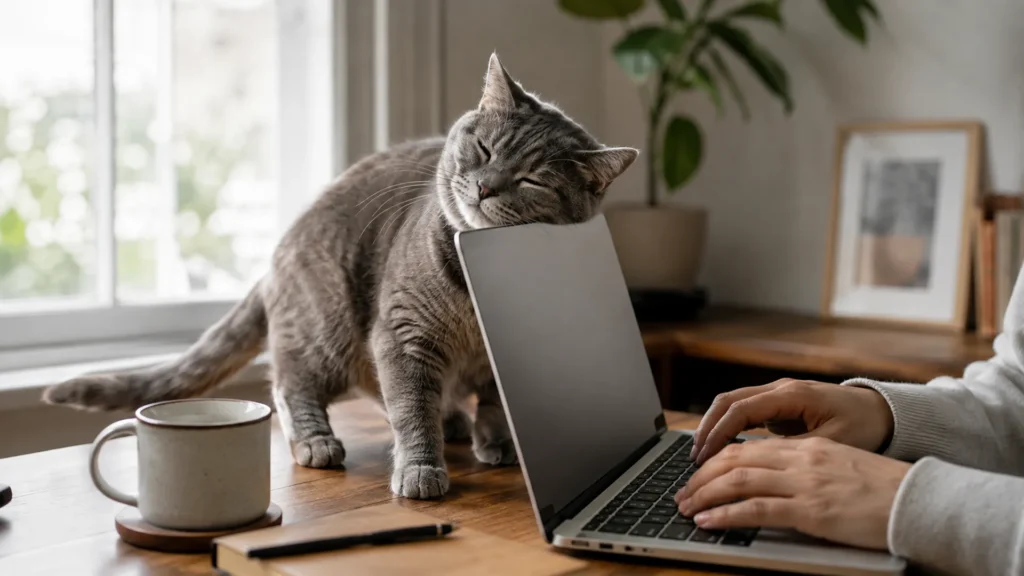
Same root answer as “why does my cat rub against me?”: these things smell like you. They also sit right at cheek height. A laptop is warm, and your cat has clearly worked out where your attention goes all day. Shoes carry outside smells, so they get a sniff and then a fresh layer of marking.
Normal Rubbing vs. a Warning Sign
Most of the time, the answer to “why does my cat rub against me?” is harmless. What deserves your attention is change. A cat that suddenly rubs far more, or in a new way, is telling you something.
| Normal | Worth a vet check | Possible cause |
|---|---|---|
| Relaxed cheek rubs on you or furniture | Frantic face rubbing, pawing at the mouth, drooling, dropping food | Dental pain |
| Occasional head rubs | Head shaking, ear scratching, dark crumbly debris in the ears | Ear mites or ear infection |
| Rubbing against you when happy | Rubbing plus scabs, bald patches, or over-grooming | Skin allergies or irritation |
| Rolling and rubbing in a spayed cat | Yowling, rolling, and rubbing in an unspayed female | Heat cycle |
| Steady everyday marking | Sudden spike after a move, new pet, or conflict | Stress (see our cat anxiety guide) |
If your honest answer to “why does my cat rub against me?” keeps pointing to the middle column, don’t wait. Book a vet visit if your cat:
- rubs its face constantly or paws at its mouth
- shakes its head or scratches its ears a lot
- has hair loss, sores, or scabs
- changes how it rubs and is also hiding or eating less
How to Rub Back: Respond in Your Cat’s Language
Once you’ve answered “why does my cat rub against me?” for your own cat, you can reply in a way it understands.
The Right Way to Greet a Rubbing Cat
- Offer a knuckle first. Hold a loosely bent finger at nose height. Plenty of cats will run a cheek straight along it.
- Scratch where the glands are. Cheeks and under the chin are the usual favorites.
- Let your cat lead. If it leans in, carry on. If it walks away, it’s done.
- Don’t reward every food rub. Feed a cat each time it rubs you in the kitchen and you’ve trained a beggar. Keep to set mealtimes.
Keep Your Home Scent-Friendly
Those scent marks are a big reason your cat feels safe at home. Avoid wiping them all out at once.
- Wash bedding in rotation. One or two items at a time, so something familiar always stays.
- Keep a scent blanket when moving. Leave one blanket or bed unwashed and put it out the moment you arrive. You can also rub a soft cloth on your cat’s cheeks and wipe it on furniture at nose height in the new place.
- Scent-swap before introductions. Before a new cat arrives, swap bedding between the two for a few days, or rub a clean sock on each cat’s cheeks and leave it near the other. With a new baby, let your cat sniff blankets and clothes before the baby comes home.
- Consider a pheromone diffuser. Synthetic facial pheromone products copy the “safe” smell cats leave when they rub. Some cats seem calmer with one during big changes, but results vary. We’d treat it as backup for the steps above, not a replacement.
If your cat struggles when you’re out, our separation anxiety guide has more ideas.
FAQs
Why does my cat rub against me? Does it mean it loves me?
Mostly, yes. You’re part of its group and it feels safe with you. A dinner request might be mixed in, but the affection is real.
Is cat rubbing a sign of dominance?
Not really. If “why does my cat rub against me?” started because someone called it a dominance move, you can drop that worry. In cat groups, rubbing usually goes from younger or lower-status cats toward more established ones. That’s closer to respect than bossiness.
Why doesn’t my cat rub against me?
Some cats just aren’t rubbers. Personality, early socialization, and how settled they feel all play a part. Watch for other signs instead, like slow blinks, following you around, or napping nearby.
Why does my cat rub against furniture and walls?
It’s marking territory so the house smells like home. Corners and edges at face height get most of the attention.
Is it safe to pet a stray cat that rubs against me?
Not automatically. A stray may only be checking you out, so let it sniff your hand and watch its body language first. Avoid handling strays you don’t know, since scratches and bites can carry infection risks, and wash your hands afterward.
Conclusion
So, why does my cat rub against me? Mostly because it has decided you belong together, and scent is how it says so. The details fill in the rest: time of day, location, tail, and ears. Usually that adds up to hello, feed me, or play with me. Once in a while, it adds up to a vet visit.