
Yes, cats are believed to dream. They experience REM sleep, the same stage where most vivid dreaming happens in humans. Below, you’ll find out why your cat twitches while it sleeps, what those twitches might mean, and how to tell normal sleep behavior apart from something that warrants a call to the vet.
Do Cats Really Dream?
The Science Behind Cat Dreams
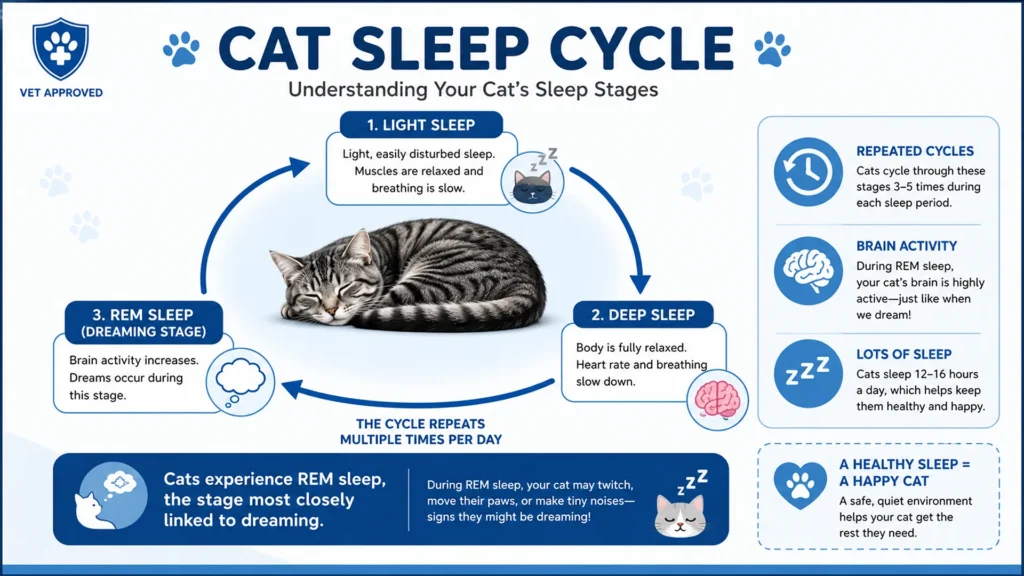
REM stands for rapid eye movement, and it’s the sleep stage where the brain lights up almost as if the animal were awake, even though the body stays still. Researchers who study mammalian sleep, cats included, have observed this same pattern: active brainwaves paired with muscle twitches and darting eye movements. No one can say exactly what a cat “sees” during a dream, since a cat can’t describe it. But the brain activity alone is enough to convince most researchers that something dream-like is happening.
How Cat Sleep Differs From Human Sleep
Cats don’t sleep in one long overnight stretch the way people do. Instead, they cycle through short bouts of light sleep and deeper REM sleep spread across the day and night, which is a big part of why they sleep so much in total. Adult cats typically log 12 to 16 hours a day, while kittens and senior cats often sleep even more — growing bodies and aging bodies both demand extra rest.
What Do Cats Dream About?
No one can know for certain, but experts suspect cat dreams draw on two sources: the day’s events and instincts hardwired long before domestication.
Everyday Experiences
A cat’s dreams may replay recent moments — batting around a favorite toy, prowling through the house, curling up with you, or dozing in a sunny spot.
Natural Hunting Instincts
Even a cat that has never set foot outside carries a hunter’s instincts, and those instincts may surface in sleep as chasing, stalking, climbing, or sprinting after imaginary prey.
Can Cats Have Nightmares?
If pleasant experiences can shape a cat’s dreams, unpleasant ones probably can too. A stressful day — a vet visit, an unfamiliar dog, a loud thunderstorm — may carry over into a rough night. Look for a startled, wide-eyed waking, a tensed body, or vocalizing that sounds distressed rather than content; these are the closest thing to evidence of a bad dream, though researchers can only infer this from behavior, not measure it directly.
Signs Your Cat Is Dreaming
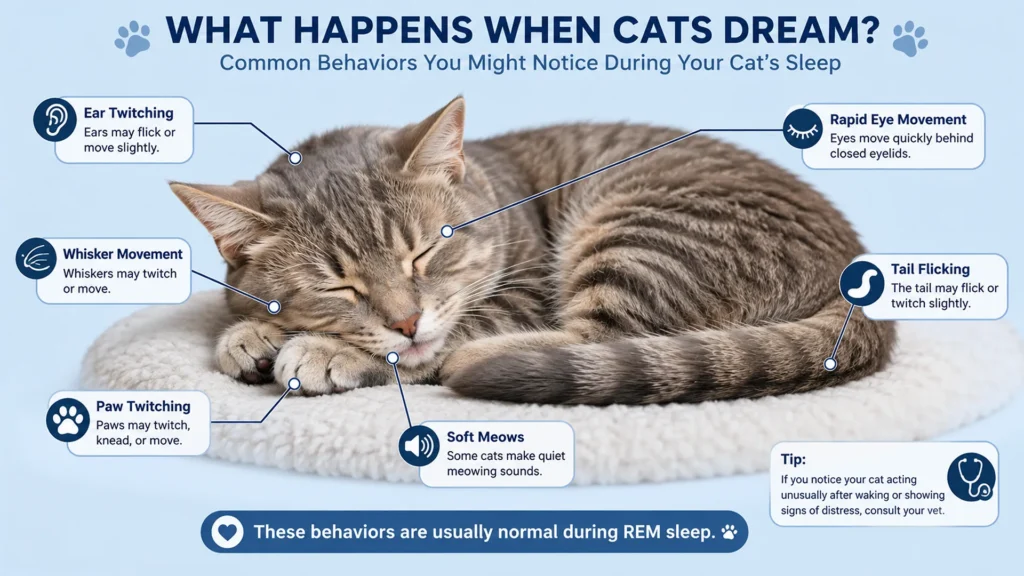
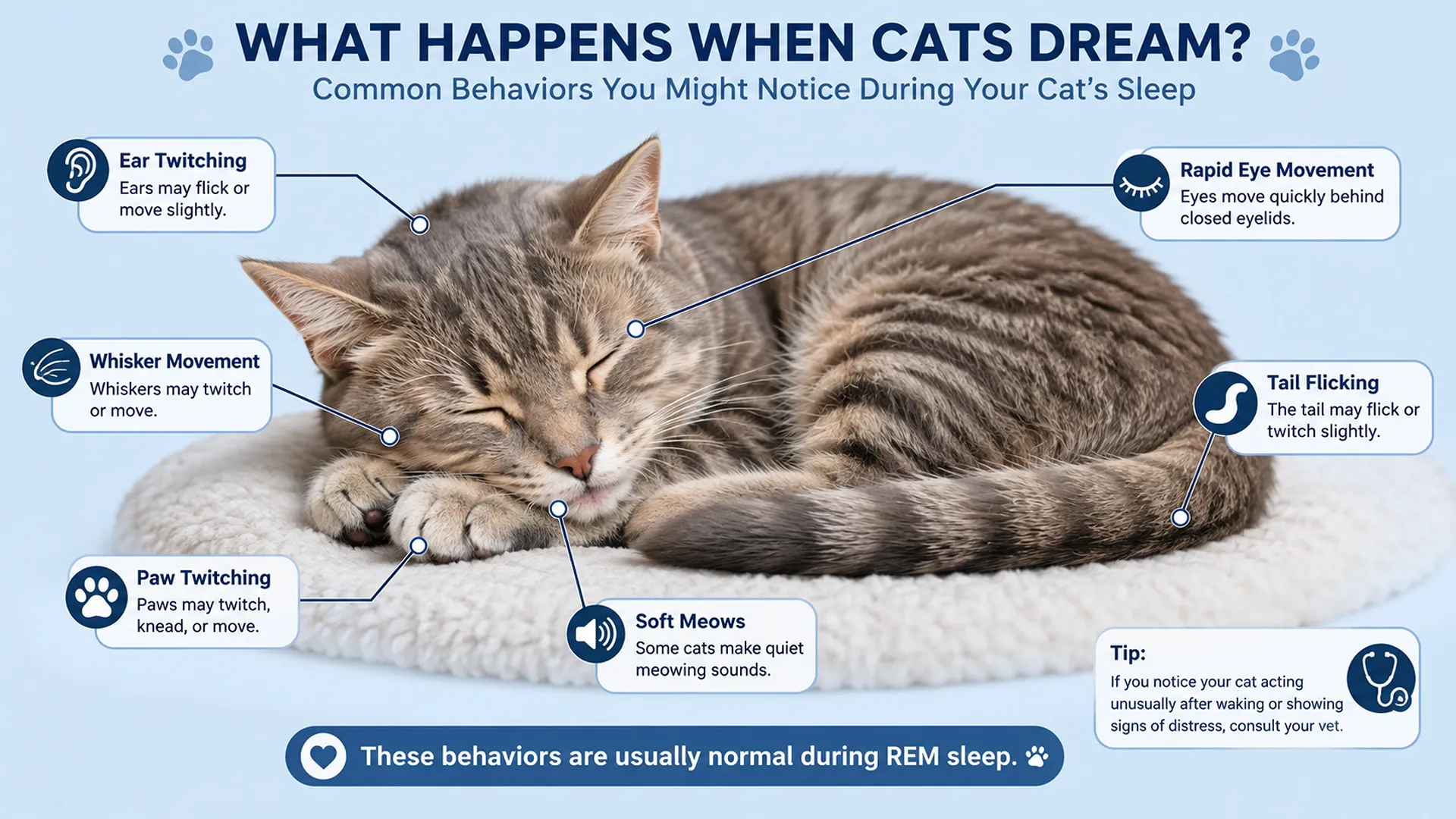
Watch a sleeping cat closely and you’ll likely catch small giveaways: twitching paws, a flicking tail, moving whiskers or ears, gentle shifts in posture, or soft meows, chirps, and purrs. These movements are entirely normal — most cats stay relaxed throughout and drift right back into stillness on their own. A few seconds of twitching followed by settled sleep is simply part of the cycle, not a reason for concern.
Dreaming or Something More Serious?
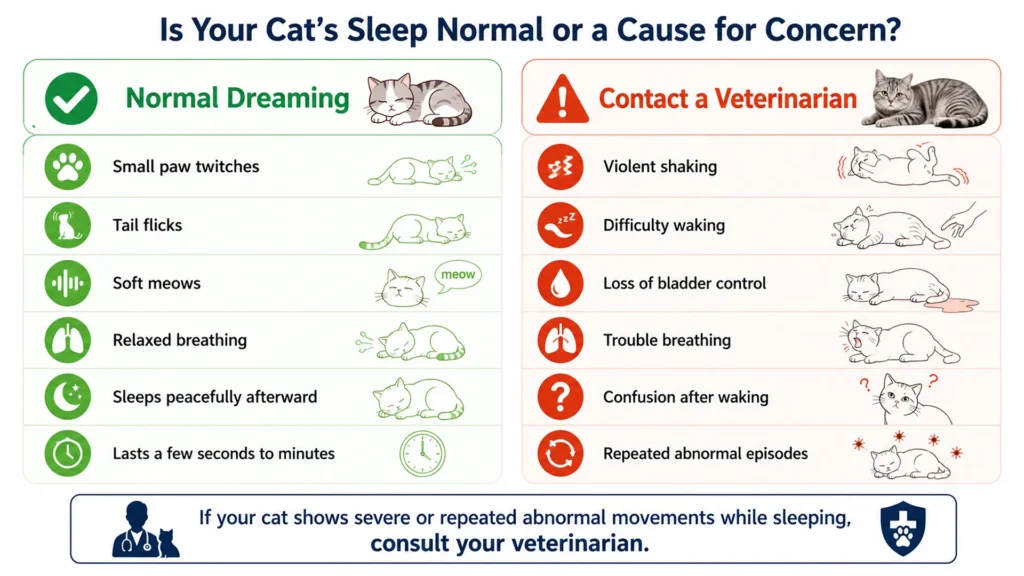
Occasionally, what looks like dream twitching is actually a seizure. Here’s how to tell them apart:
| Feature | Normal Dreaming | Seizure |
|---|---|---|
| Body movement | Small, localized twitches (paws, whiskers, tail) | Whole-body stiffening or violent shaking |
| Duration | Brief, usually seconds | Can last longer, sometimes a minute or more |
| Consciousness | Cat remains asleep | Cat may lose consciousness or awareness |
| Breathing | Steady and normal | May become irregular or labored |
| Recovery | Wakes normally, acts fine | May seem disoriented, wobbly, or confused afterward |
Call your vet if you notice violent shaking that doesn’t resemble ordinary twitching, difficulty waking your cat, loss of bladder control, confusion after waking, or repeated episodes matching this pattern.
Should You Wake a Dreaming Cat?
In most cases, no — let a dreaming cat sleep. A cat startled awake mid-dream may react defensively on instinct, scratching or biting before it fully registers what’s happening, and interrupted sleep cycles are worse for its rest overall. The exceptions are genuine emergencies: wake your cat if you suspect a seizure, or if it’s sleeping somewhere unsafe, like near a ledge or a hot stove.
How to Help Your Cat Get Better Sleep
A few habits make a real difference:
- Offer a quiet space away from noise and heavy foot traffic
- Provide a comfortable, appropriately sized bed
- Keep a stable daily routine
- Make time for daily exercise and play to burn off energy
- Feed a balanced diet suited to your cat’s age and needs
Frequently Asked Questions
Do kittens dream more than adult cats?
Likely yes. Kittens spend a larger share of their sleep in REM than adults do, since their brains are still developing — though what fills those dreams remains just as much a mystery as it is for grown cats.
Why does my cat twitch while sleeping?
It’s a byproduct of REM sleep: the brain stays active while the body’s muscles briefly slip past normal sleep paralysis. Harmless, and no different in principle from a person’s limbs jerking mid-dream.
Why does my cat meow in its sleep?
Soft sounds during sleep often echo whatever your cat vocalizes while awake — the chirp it gives a bird out the window, or the meow it uses to get your attention — suggesting the dream is replaying a familiar scene.
Should I be worried if my cat runs in its sleep?
Not unless it’s paired with stiffening, violent shaking, or trouble waking afterward. On its own, a brief sprint in place is just a hunting-instinct dream playing out.
Conclusion
Dreaming appears to be a normal, healthy part of your cat’s sleep, and most of the twitches and soft sounds that come with it are nothing to worry about. Knowing the handful of warning signs that separate a dream from a seizure means you can relax during the ordinary moments and act quickly during the rare ones that actually call for a vet.