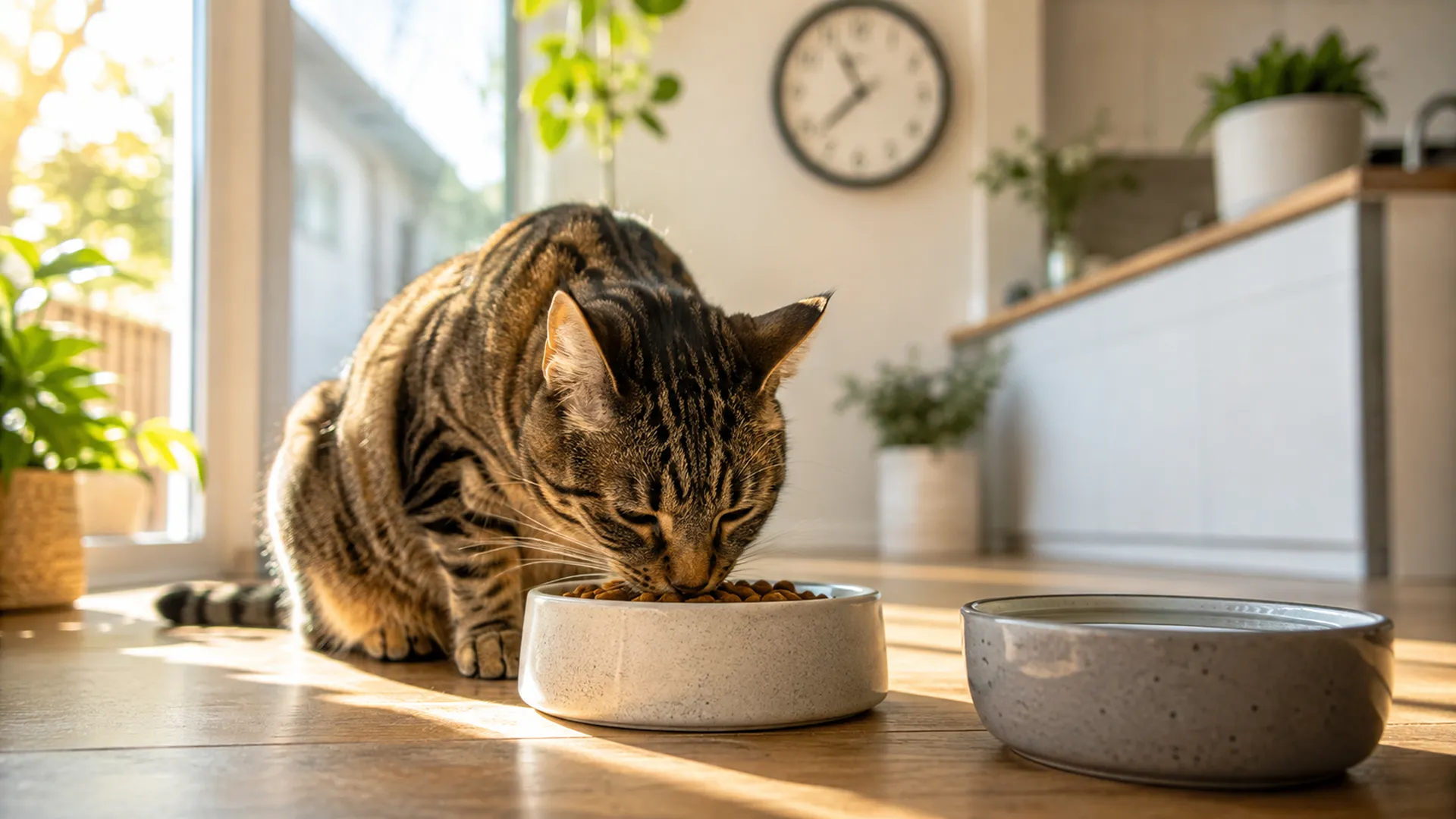
So how often should cats eat? The short version: kittens under six months need 3 to 4 meals a day, adult cats do fine on 2, and senior cats usually stick with 2 smaller portions once you factor in whatever health stuff comes with age. That’s the textbook answer, and honestly, it’s a decent starting point for most cats.
Here’s where it gets interesting though. A study came out a few years back suggesting some adult cats might actually do better on one meal a day — less begging, better body composition. We’ll dig into who that applies to (and who it doesn’t) in a minute.
How Often Should Cats Eat: Is Twice a Day Really the Gold Standard?
Feed your cat twice a day, minimum. That’s been the advice forever, and there’s real logic behind it — a cat’s stomach empties out within a few hours, hunger signals come back around the 8 to 10 hour mark, and if you only feed once, you end up with a cat pacing the kitchen well before you’re ready to serve dinner.
But a 2020 study out of the University of Guelph, published in PLOS One, threw a wrench into that. Cats fed one large meal a day showed higher levels of appetite-regulating hormones after eating than the cats on multiple smaller meals — basically, they felt fuller and stayed satisfied longer. They also burned more fat for energy and had more amino acids available to hold onto muscle.
I wouldn’t take this as a reason to switch every cat you own to one meal tomorrow. It’s a bad call for kittens, cats with diabetes, or any cat that tends to vomit bile when its stomach’s been empty too long. But it’s worth knowing the “more meals equals better” rule isn’t quite the settled science most articles treat it as.
Feeding by Life Stage
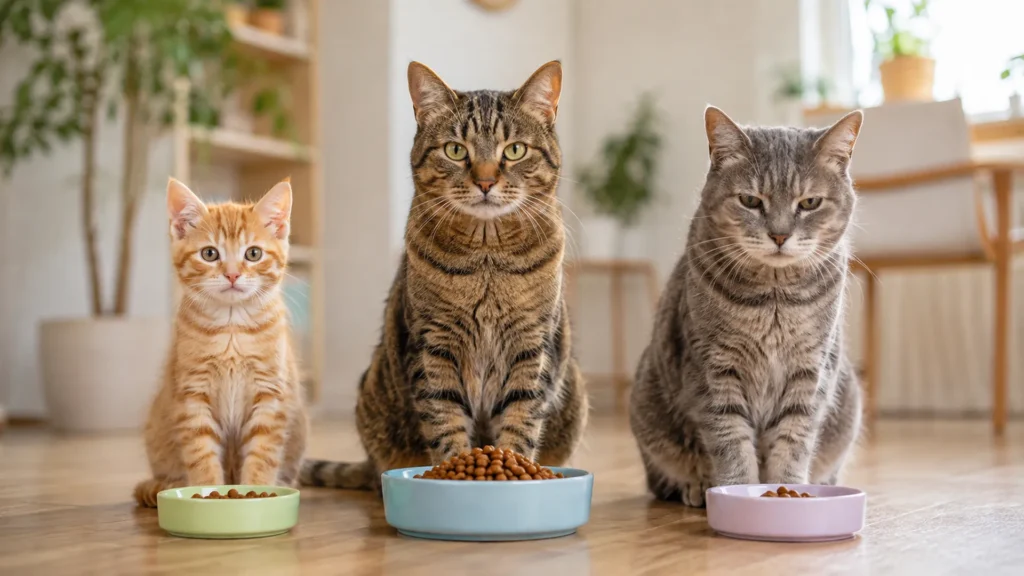
Kittens (under 6 months) — 3 to 4 meals a day. Growing takes a ton of energy, way more per pound than what an adult cat burns, and a kitten’s stomach just isn’t big enough to hold a full day’s calories in one or two sittings. That’s the whole reason frequent meals matter so much at this stage.
Adult cats (1+ years) — 2 meals a day, sometimes 1. Two meals is still the safer bet, especially if your cat begs constantly or has a history of stomach issues. That said, per the Guelph research, some healthy adults genuinely do fine, maybe even better, on one well-sized meal. If you’re curious about trying it, run it by your vet first, especially if there’s any underlying condition to worry about.
Senior cats — 2 smaller meals. Older cats generally handle smaller, more frequent portions better than one big meal. Appetite tends to shift with age, dental problems can make bigger meals uncomfortable, and smaller portions help fight off sarcopenia — the muscle loss that comes with getting older, which the Guelph study flagged as something worth managing through diet.
How to Change a Feeding Schedule Without a Meltdown
This is where most begging and vomiting problems actually start — not from the schedule itself, but from switching too fast. Slow down and you’ll dodge most of it. Really, this is the practical side of figuring out how often should cats eat for your household: the number only works if you get there gradually.
Stretching out the time between meals? Add 15 to 20 minutes every few days rather than jumping straight from four meals to two. Give the body time to adjust to the longer gap.
Same deal for kittens working their way down from four meals to two. Drop one meal at a time over a week or two instead of cutting portions all at once.
Free-fed cats are the toughest to transition since they’re used to food just being there whenever. Puzzle feeders are a good workaround here — they keep the cat busy and slow the eating down while you ease toward set mealtimes, instead of pulling the bowl away cold turkey.
Signs you’re moving too fast: vomiting bile (means the stomach’s been empty too long), aggressive begging, or gulping food the second it hits the bowl. Any of that shows up, back off and slow down further.

Does Wet or Dry Food Change How Often You Feed?
Yes, and it’s not just a habit thing. Wet food goes bad fast once it’s exposed to air, so it needs to be served in smaller amounts more often, with leftovers tossed within a few hours. It’s also higher in moisture and lower in calorie density, so a cat has to eat more of it just to feel full.
Dry food holds up on the shelf, which is why people leave it out for free-feeding or split it into fewer, bigger meals. But it packs more calories per bite, so portion control matters more than frequency here. It’s easy to overfeed dry food without even realizing it.
If you’re doing both, a simple approach works: wet food at set mealtimes, dry food as a smaller measured extra, not something left out 24/7.
Feeding Multiple Cats Without the Chaos
Multi-cat households run into feeding issues most guides never mention. A kitten and a senior cat need totally different calorie counts and schedules, and if one of them has something like diabetes, their routine can’t just get lumped in with everyone else’s.
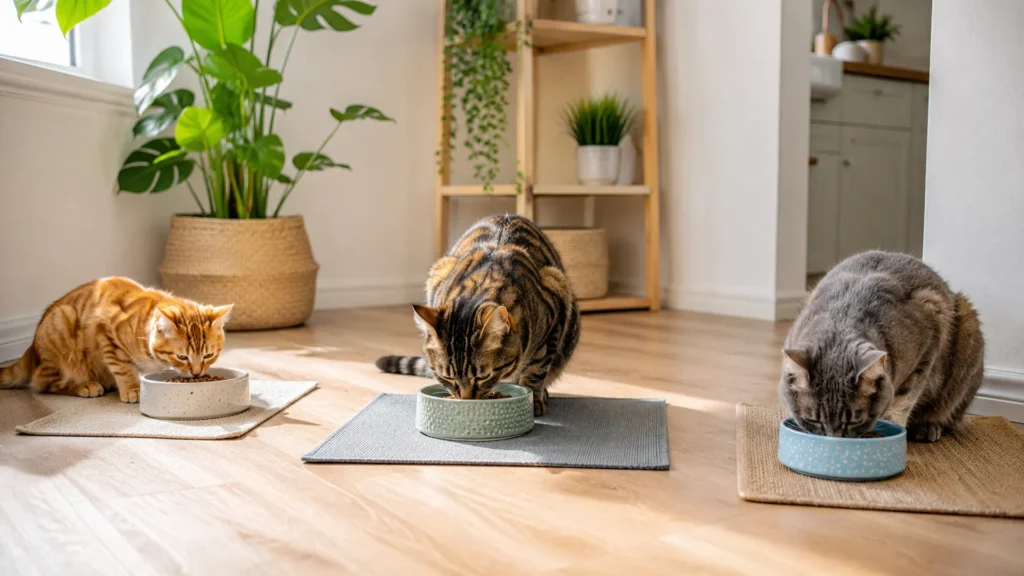
Food-guarding shows up a lot too. One bolder cat eats another’s portion, or just intimidates them away from the bowl entirely, and the quieter cat ends up underfed without anyone noticing. Separate feeding stations help a lot here. For households with really different dietary needs, timed or microchip-activated feeders work better than just spacing bowls apart and hoping for the best.
One trick that costs nothing: feed cats where they can’t see each other — different rooms, different levels, a barrier of some kind. Cuts down on the competitive overeating and stress that come with shared mealtimes.
Do Automatic Feeders Actually Cut Down Begging?
To some degree, yes, and there’s an actual reason for it. A cat’s stomach empties within a few hours, and hunger kicks back in around the 8 to 10 hour mark. Scheduled feeders work with that rhythm, delivering food at consistent times so the cat isn’t stuck waiting on you to notice it’s hungry, which is usually what fuels the begging in the first place. If you’re still trying to nail down how often should cats eat in your own home, a feeder can take a lot of the guesswork out of it.
A few worth knowing about:
- Timed dry-food dispensers, solid for consistent measured portions through the day
- Portioned wet-food feeders, which keep meals refrigerated until release
- App-controlled or microchip feeders, useful in multi-cat homes where everyone’s eating something different
One thing I’ll say honestly: a feeder isn’t going to fix begging that’s rooted in boredom or anxiety rather than actual hunger. Pair it with playtime and some enrichment, and it does a lot more good than the feeder on its own.
When Medical Conditions Change the Rules
Age and activity level aren’t the only things that matter here. Certain health conditions change feeding frequency completely, and this is one of those areas where a real conversation with your vet beats anything you’ll read online. Here’s the general picture:
| Condition | Typical Feeding Adjustment |
|---|---|
| Diabetes | Fixed meal times, usually tied to insulin dosing |
| Chronic kidney disease (CKD) | Smaller, more frequent meals to manage nausea and appetite |
| Hyperthyroidism | Increased appetite, often needs portion control more than a frequency change |
| IBD | Smaller, frequent meals to reduce flare-ups |
| Post-surgery/recovery | Gradual reintroduction, guided by your vet |
If your cat’s dealing with any of these, skip the general advice altogether. Whatever your vet says goes.
FAQ
How often should cats eat if they’re healthy adults?
Most healthy adult cats do fine on 2 meals a day. Some can manage on 1 larger meal based on recent research, but that’s a call worth making with your vet, not on your own.
Is it bad to feed a cat once a day?
Not necessarily. Some research shows healthy adult cats on one larger daily meal end up just as satisfied, sometimes more so, with less begging. But it’s not right for every cat — kittens, diabetic cats, and cats prone to vomiting on an empty stomach usually need more frequent meals.
Should I free-feed dry food?
It can work for some healthy, active cats, but it makes portion control a lot harder and raises the odds of overeating. Scheduled meals are just easier to manage well.
How do I know if I’m feeding my cat too much or too little?
Check their body condition regularly — you should be able to feel the ribs without seeing them sticking out. Track weight over time with your vet’s help.
Can I change my cat’s feeding schedule suddenly?
Better not to. Sudden changes tend to trigger vomiting or intense begging. Gradual shifts over a week or two go a lot easier on a cat’s system.